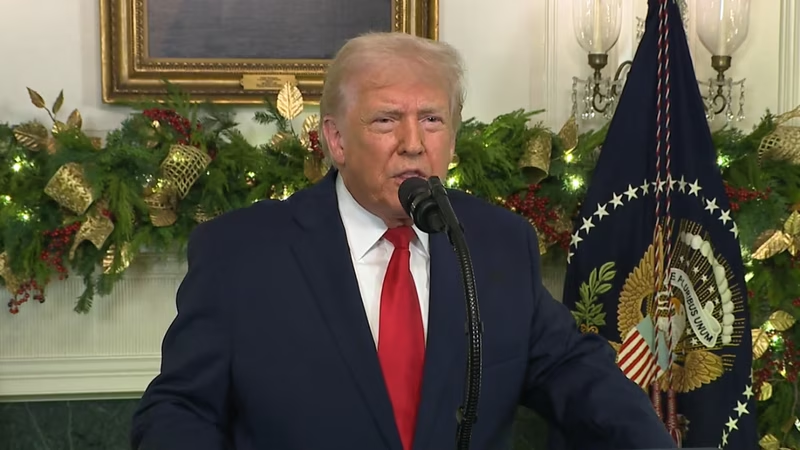
In a high-stakes diplomatic move that has sent shockwaves through global security circles, Iran has lodged a formal complaint with the United Nations Security Council (UNSC) over what it describes as “reckless and inflammatory threats” by former U.S. President Donald Trump. The Iran UN letter, dated early January 2026, marks a sharp escalation in rhetoric just as geopolitical tensions in the Middle East appear to be simmering once again .
Why would Iran—a nation long at odds with Washington—escalate matters through the world’s highest diplomatic forum? And what did Trump actually say to provoke such an official, urgent response? The answer reveals not just a clash of words, but a fragile balance of deterrence, perception, and the ever-present risk of miscalculation in one of the world’s most volatile regions.
Table of Contents
- What Did Trump Actually Say?
- The Contents of the Iran UN Letter
- Why Iran Chose the UN Security Council
- Historical Context: Decades of US-Iran Antagonism
- Implications for Middle East Stability
- Conclusion: A Warning Signal, Not a War Cry
- Sources
What Did Trump Actually Say?
While the exact wording of Trump’s recent remarks hasn’t been fully disclosed in official U.S. channels, multiple international media reports indicate he made a series of aggressive public statements during a campaign rally in late December 2025. According to Iranian state media, Trump allegedly suggested a willingness to use overwhelming military force against Iran if he were re-elected—a sentiment reminiscent of his infamous 2019 tweet threatening to “target 52 Iranian sites” in retaliation for any Iranian action against U.S. interests .
For Tehran, such language isn’t just political posturing—it’s a direct security threat. In their view, these comments violate norms of international diplomacy and could be interpreted as incitement to aggression, especially coming from a former head of state with a proven track record of implementing harsh policies like the “maximum pressure” campaign that crippled Iran’s economy.
The Contents of the Iran UN Letter
The letter, addressed to the President of the UN Security Council and the UN Secretary-General, pulls no punches. It accuses Trump of making “reckless and inflammatory threats” that “constitute a flagrant violation of the principles of the UN Charter,” particularly Article 2(4), which prohibits the threat or use of force against any state’s territorial integrity or political independence .
Key points from the Iran UN letter include:
- A formal request for the UNSC to “condemn such dangerous rhetoric.”
- A warning that continued hostile statements could “lead to unintended escalation with regional and global consequences.”
- An assertion that the U.S. government—past or present—bears responsibility for the inflammatory language of its highest officials.
Notably, Iran stopped short of calling for sanctions or military action, instead framing its complaint as a plea for international order and restraint.
Why Iran Chose the UN Security Council
Filing a complaint with the UNSC is a strategic diplomatic tool, not a routine gesture. Iran’s decision serves multiple purposes:
- Legitimization: By taking the issue to the UN, Iran frames itself as a rule-abiding nation seeking multilateral justice, not as an aggressor.
- Deterrence: The letter puts the U.S. and its allies on notice that Tehran is documenting perceived threats—a move that could complicate future military justifications.
- Global Messaging: It’s a direct appeal to the international community, especially non-aligned and Global South nations, to pressure Washington into moderating its tone.
This tactic echoes past moves, such as Iran’s 2020 UNSC complaint following the U.S. drone strike that killed General Qasem Soleimani—a case that also highlighted the limits of the UN’s power when a permanent Security Council member (the U.S.) is involved.
Historical Context: Decades of US-Iran Antagonism
To understand the gravity of this moment, one must look back. The U.S.-Iran rift dates to the 1979 Islamic Revolution and the hostage crisis. Relations hit a new low under Trump with the unilateral withdrawal from the JCPOA (Iran nuclear deal) in 2018 and the reimposition of crippling sanctions. While the Biden administration sought re-engagement, no breakthrough has occurred.
Now, with Trump surging in 2026 primary polls, his bellicose rhetoric is not just campaign noise to Tehran—it’s a forecast of potential policy. For more on the collapse of the nuclear deal and its fallout, see our in-depth analysis on [INTERNAL_LINK:iran-nuclear-deal-collapse].
Implications for Middle East Stability
The timing couldn’t be more sensitive. The region is already on edge due to ongoing conflicts in Gaza, Yemen, and Lebanon. An overt U.S.-Iran confrontation could ignite proxy wars, disrupt global oil supplies, and destabilize U.S. allies like Saudi Arabia and Israel.
The UN Security Council has so far not issued a formal response to Iran’s letter. Given the U.S.’s veto power as a permanent member, any binding resolution is unlikely. However, the mere filing of the complaint adds diplomatic friction at a time when de-escalation is most needed .
Experts warn that rhetoric can become reality. As one former State Department official noted, “When leaders talk about war casually, soldiers end up dying.”
Conclusion: A Warning Signal, Not a War Cry
The Iran UN letter over Trump’s remarks is best understood as a calibrated act of diplomatic self-defense. It’s Iran’s way of saying: “We are watching, we are documenting, and we will not be intimidated—but we also don’t want war.”
For global observers, this episode is a sobering reminder that in international relations, words carry weight. In an era of social media bravado and campaign trail bluster, the line between political theater and genuine threat has never been thinner. The world will be watching closely to see whether cooler heads prevail—or whether this latest exchange becomes the spark that lights a much larger fire.