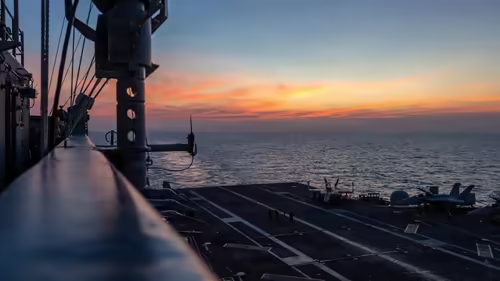
The calm of the Persian Gulf is once again being tested. As geopolitical fault lines deepen, the United States has made a powerful statement by sending one of its most formidable naval assets—the USS Dwight D. Eisenhower aircraft carrier strike group—into the heart of the Middle East. This deployment comes at a time of heightened Iran tensions, following a series of proxy attacks, maritime skirmishes, and diplomatic standoffs that have pushed the region to the brink.
This isn’t just routine naval rotation. It’s a deliberate, high-stakes signal from Washington aimed at deterring further aggression and reassuring nervous allies from Israel to Saudi Arabia. But with history as a guide, such military posturing can either de-escalate a crisis—or ignite it.
Table of Contents
- What’s in the Carrier Strike Group?
- Why Now? The Trigger Behind the Deployment
- How Iran Is Responding
- Impact on Regional Alliances and Security
- Historical Context: Past US Carrier Deployments
- Conclusion: A Delicate Balancing Act
- Sources
What’s in the Carrier Strike Group?
The USS Dwight D. Eisenhower (CVN-69), a Nimitz-class nuclear-powered supercarrier, doesn’t travel alone. It leads a full carrier strike group (CSG) that includes:
- Multiple guided-missile destroyers (e.g., USS Thomas Hudner, USS Mason)
- A guided-missile cruiser (e.g., USS Philippine Sea)
- Submarines and support vessels
- Over 75 aircraft, including F/A-18 Super Hornets
Together, this armada represents one of the most potent mobile military forces on the planet—capable of power projection, air superiority, and rapid response across thousands of square miles. Its presence in the U.S. Naval Forces Central Command (NAVCENT) area of operations is a clear message of resolve [[1]].
Why Now? The Trigger Behind the Deployment
The timing is no coincidence. The latest surge in Iran tensions stems from several converging flashpoints:
- Houthi Attacks in the Red Sea: Iran-backed Houthi militants in Yemen have repeatedly targeted commercial shipping lanes, prompting U.S.-led naval coalitions like Operation Prosperity Guardian to intervene [[3]].
- Drone and Missile Incidents: Unmanned aerial systems and short-range ballistic missiles—many traced back to Iranian supply chains—have been used against U.S. bases in Iraq and Syria, injuring personnel [[4]].
- Nuclear Program Concerns: Despite international negotiations, Iran continues to enrich uranium at levels far beyond the limits of the 2015 JCPOA deal, raising fears of a breakout capability [[5]].
In response, the Pentagon accelerated the Eisenhower CSG’s transit through the Suez Canal into the Red Sea and onward to the Persian Gulf—a move confirmed by U.S. defense officials as a “deterrence posture” [[2]].
How Iran Is Responding
So far, Tehran has issued strong rhetorical warnings but avoided direct military confrontation. Iranian state media called the U.S. deployment “provocative” and accused Washington of “fueling instability under the guise of security” [[6]].
However, Iran’s Islamic Revolutionary Guard Corps (IRGC) Navy has increased its own patrols in the Strait of Hormuz—the world’s most critical oil chokepoint. In past crises, the IRGC has harassed commercial tankers and even seized foreign vessels, so the risk of miscalculation remains high.
Analysts at the International Institute for Strategic Studies (IISS) note that while Iran prefers asymmetric warfare through proxies, the presence of a U.S. carrier could force its hand—either into restraint or a symbolic act of defiance [[7]].
Impact on Regional Alliances and Security
This deployment isn’t just about Iran—it’s also about reassurance. Key U.S. partners in the region, including Saudi Arabia, the UAE, and Israel, have grown increasingly anxious about Tehran’s reach.
The carrier’s arrival coincides with ongoing efforts to normalize Saudi-Israeli relations, a process heavily backed by the U.S. A visible American military shield may give Riyadh more confidence to proceed with diplomatic overtures, knowing Washington has its back [[8]].
At the same time, the move could complicate diplomacy. Some European nations worry that overt militarization undermines backchannel talks with Tehran. Yet others argue that strength is a prerequisite for meaningful negotiation—a classic “peace through strength” doctrine.
Historical Context: Past US Carrier Deployments
This isn’t the first time a U.S. carrier has steamed into these waters during a crisis. Notable precedents include:
- 2019: After attacks on oil tankers near the Strait of Hormuz, the USS Abraham Lincoln was rushed to the region, leading to a tense standoff that nearly resulted in airstrikes.
- 2020: Following the U.S. drone strike that killed IRGC commander Qasem Soleimani, multiple carriers were positioned to deter retaliation.
- 2023–2024: The USS Gerald R. Ford and later the Eisenhower were deployed amid Houthi threats to shipping.
History shows that while carriers can deter large-scale conflict, they don’t eliminate low-intensity threats like drone swarms or cyberattacks—tactics Iran and its allies have mastered.
Conclusion: A Delicate Balancing Act
The deployment of the USS Dwight D. Eisenhower underscores the Biden administration’s dual-track approach to Iran tensions: combine credible military deterrence with open channels for diplomacy. While the carrier’s presence may prevent a full-blown war, it also raises the stakes in an already combustible region.
For global markets, energy security, and millions living in the shadow of this rivalry, the hope is that this show of force leads not to escalation—but to a return to the negotiating table. Until then, all eyes remain on the Persian Gulf, where peace hangs in the balance of steel decks and silent submarines. For deeper analysis on U.S. foreign policy, explore our coverage on [INTERNAL_LINK:us-foreign-policy-middle-east].
Sources
- U.S. Department of Defense: “USS Dwight D. Eisenhower Strike Group Enters U.S. 5th Fleet Area of Operations”
- The Times of India: “Iran tensions: US aircraft carrier, warships arrive in Middle East”
- U.S. Central Command (CENTCOM): “Operation Prosperity Guardian Updates”
- Reuters: “U.S. says Iran-linked groups behind recent attacks on bases in Iraq, Syria”
- International Atomic Energy Agency (IAEA): “Iran Nuclear Verification Report”
- Islamic Republic News Agency (IRNA): Official statements on U.S. naval presence
- International Institute for Strategic Studies (IISS): “Naval Power and Deterrence in the Gulf”