Table of Contents
- A Stunning Breach of Iranian Propaganda
- Reza Pahlavi’s Defiant Message to a Nation in Crisis
- Trump’s Shadow Looms Large Over Tehran
- Tehran’s Response: Blame Game and War Cries
- The Broader Context of Iran’s January 2026 Uprising
- Conclusion: What’s Next for Iran?
- Sources
A Stunning Breach of Iranian Propaganda
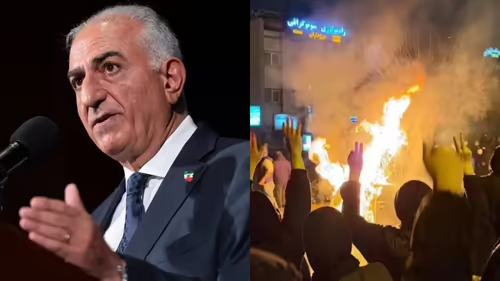
In a move that sent shockwaves through the Islamic Republic, its tightly controlled state media apparatus was compromised in a brazen cyberattack. The Iran state TV hack saw the official broadcaster briefly taken over, not by a foreign government, but by domestic anti-regime activists who used the platform to beam a powerful message of dissent directly into millions of Iranian homes .
This unprecedented event, which occurred on or around January 14, 2026, involved the hijacking of the Badr satellite signal, allowing the hackers to interrupt regular programming with footage of ongoing protests and a clear call for change . For a regime that prides itself on its narrative control, this was a profound humiliation and a stark indicator of the deep-seated unrest bubbling beneath the surface.
Reza Pahlavi’s Defiant Message to a Nation in Crisis
The centerpiece of the broadcast was the voice and image of Reza Pahlavi, the exiled son of the last Shah of Iran. His message was simple, direct, and loaded with historical weight: “I will return.” This phrase, echoing his recent public statements, is more than just a personal vow; it’s a rallying cry for a significant segment of the opposition that sees the Pahlavi legacy as a symbol of a pre-revolutionary Iran they believe was more secular and prosperous .
Pahlavi, who has lived in the United States since the 1979 revolution, has been increasingly vocal, claiming the Islamic Republic is on its last legs. He has stated, “The Islamic Republic will fall — not if, but when,” positioning himself as a unifying figure for a post-regime future . His appearance on the hacked state channel, a platform once used to vilify his family, was a masterstroke of symbolic defiance that has undoubtedly resonated with protesters on the streets.
Trump’s Shadow Looms Large Over Tehran
The timing of the hack and Pahlavi’s message is critical. It comes amidst a severe government crackdown on weeks of nationwide protests and a renewed wave of aggressive rhetoric from former U.S. President Donald Trump. In early January 2026, Trump issued stern warnings to Tehran, threatening “grave consequences” if the regime continued its violent suppression of its own people .
While the Trump administration has claimed some success in pressuring Iran to halt executions of protesters , the overall effect of these threats has been to further inflame an already volatile situation. The Iranian regime views any external pressure, especially from Washington, as a direct act of interference and a justification for its harsh internal security measures . This dynamic creates a dangerous feedback loop where domestic unrest and international posturing fuel each other.
Tehran’s Response: Blame Game and War Cries
Faced with this perfect storm of internal dissent and external pressure, the Iranian government’s response has been predictable yet alarming. Officials have swiftly blamed “foreign adversaries,” a common refrain used to delegitimize domestic opposition movements and rally nationalist sentiment . This narrative attempts to frame the protests and the cyberattack not as a homegrown uprising, but as a plot orchestrated by enemies like the United States or Israel.
More concerning is the regime’s escalation in its rhetoric. State media and senior officials have begun issuing dire warnings of a “full-scale war” should the perceived foreign-backed threats continue. This language is not just bluster; it signals a regime that feels cornered and is willing to raise the stakes dramatically to maintain its grip on power. The fear in Tehran is that the current protests, amplified by events like the Iran state TV hack, represent a genuine existential threat.
The Broader Context of Iran’s January 2026 Uprising
The hack and Pahlavi’s declaration cannot be viewed in isolation. They are symptoms of a much deeper crisis. The January 2026 protests are part of a long arc of popular discontent that has seen multiple waves of demonstrations since 2017, each met with increasing brutality. The current crackdown, reportedly ordered at the highest levels, has been described as an attempt to crush what the regime sees as a “proto-revolution” before it can fully ignite .
The opposition itself is a complex tapestry. While figures like Reza Pahlavi command a loyal following, the movement on the ground is diverse, encompassing students, workers, women, and various political factions. The challenge for the opposition is to unify these disparate groups under a common vision for Iran’s future—a task made more complicated by the regime’s efforts to paint all dissent as a foreign conspiracy.
Conclusion: What’s Next for Iran?
The brief seizure of Iran’s state television was a watershed moment. It demonstrated the vulnerability of the regime’s information monopoly and the potent symbolic power of Reza Pahlavi’s promise to return. Combined with Trump’s aggressive stance and Tehran’s apocalyptic warnings, the stage is set for a period of extreme uncertainty. The path forward is fraught with danger, holding the potential for either a historic shift in Iran’s political landscape or a devastating descent into wider conflict. One thing is certain: the world is watching, and the stakes for the Iranian people have never been higher.
Sources
- Details on the Iran state TV hack and Reza Pahlavi’s involvement: , ,
- Context on Reza Pahlavi’s “I will return” statement: , ,
- Information on Trump’s threats against Iran: ,
- Background on the Iranian government’s crackdown and its framing of the protests: , , ,
- For a high-authority perspective on US-Iran relations, see the Council on Foreign Relations: [INTERNAL_LINK:us-iran-relations-history]