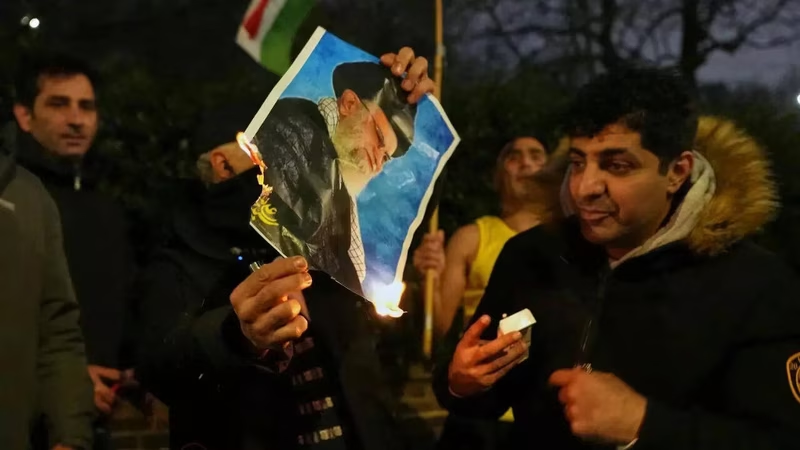
The streets of Iran are boiling over. But this time, the anger isn’t just about ideology or a single tragic event—it’s about an empty pantry, a worthless wallet, and a future that feels impossibly bleak. At the heart of this historic wave of unrest is the Iran rial collapse, a financial freefall so severe it has pushed ordinary citizens and the middle class to their absolute limit.
This isn’t the Iran of past protests. The current uprising, which began in late December 2025, is a broad-based, desperate cry for economic survival that cuts across provincial and social lines, striking directly at the regime’s most fundamental promise: stability .
Table of Contents
- What is the Iran Rial Collapse?
- From Currency Crisis to National Unrest
- The Human Cost: A Nation in Mourning
- Why Did the Rial Collapse? The Perfect Storm
- Khamenei’s Regime on a Knife-Edge
- Conclusion: What’s Next for Iran?
- Sources
What is the Iran Rial Collapse?
The Iran rial collapse refers to the dramatic and rapid devaluation of Iran’s national currency against major foreign currencies, particularly the US dollar. In recent months, the exchange rate has plummeted to staggering lows, with reports indicating the dollar was trading at over 1.47 million rials . For the average Iranian, this means their life savings are evaporating by the hour, and the cost of basic necessities like food, medicine, and fuel has become unaffordable.
This isn’t just a market correction; it’s a complete breakdown of the currency’s value, fueled by a toxic mix of internal mismanagement and external pressures. The resulting hyperinflation—reaching over 48% in late 2025 —has wiped out household budgets and shattered any remaining public trust in the government’s economic stewardship.
From Currency Crisis to National Unrest
The economic despair caused by the rial’s implosion quickly translated into action. Protests erupted on December 28, 2025, and have since spread to all provinces of the country [[1], [13]]. Unlike previous movements that were often centered in specific cities or demographics, this wave of dissent is truly national, uniting shopkeepers, factory workers, students, and professionals in a shared sense of outrage.
The core demand is simple yet profound: an end to the economic policies that have led to this catastrophe. As one analyst put it, “It’s the economy, mullah!” . The protests are less about overthrowing the system on ideological grounds and more about a primal need for survival and dignity—a direct challenge to the state’s ability to provide its most basic function .
The Human Cost: A Nation in Mourning
The regime’s response to the economic revolt has been brutal and uncompromising. Security forces have moved swiftly to crush the demonstrations, leading to a horrifying human toll.
Reports on casualties vary, but all point to a massive crackdown:
- A US-based human rights group reported that over 500 people have been killed .
- Other sources, including Iran International, claim the death toll has soared past 12,000, though this figure is highly contested [[2], [4]].
- Arrests have numbered in the thousands, with some estimates exceeding 10,000 detainees as authorities attempt to silence dissent through fear .
These figures represent not just statistics, but families torn apart and a generation traumatized by state violence. The sheer scale of the crackdown underscores the regime’s deep fear of this particular uprising.
Why Did the Rial Collapse? The Perfect Storm
The roots of the Iran economic crisis 2026 are complex, but they can be traced to a confluence of several critical factors:
Internal Mismanagement and Corruption
Decades of economic mismanagement, systemic corruption, and a lack of structural reforms have left Iran’s economy fundamentally weak and vulnerable . Budget deficits and poor policy decisions have created a fragile foundation that couldn’t withstand external shocks.
External Sanctions and Geopolitical Tensions
The U.S.’s “maximum pressure” campaign, along with other international sanctions, has severely restricted Iran’s access to global markets and its primary source of revenue: oil . The situation was further exacerbated by a brief but damaging war with Israel in June 2025, which caused significant infrastructural damage and spooked investors .
Collapsing Oil Revenues
Iran’s economy is heavily dependent on oil exports. In 2025, Brent crude prices fell by 18%, dropping to around $60 a barrel—far below the estimated $165 per barrel Iran needs to balance its budget . This massive shortfall crippled government finances and accelerated the currency’s decline.
Khamenei’s Regime on a Knife-Edge
For Supreme Leader Ali Khamenei, this crisis represents one of the gravest challenges to his rule since he assumed power . The protests are not merely a political inconvenience; they are a direct referendum on the Islamic Republic’s legitimacy and its core promise of providing for its people .
The regime’s traditional tools of control—propaganda, repression, and appeals to revolutionary ideology—are proving ineffective against the raw, visceral anger of an economically devastated populace. While the leadership remains outwardly unified, the pressure is immense, and its long-term resilience is being called into question [[15], [17]].
However, experts caution that regime collapse is not a foregone conclusion. A key factor in its survival has been the continued loyalty of its security apparatus—the IRGC and Basij militias—who have shown no signs of fracturing . Without a split in these enforcement bodies, the regime may endure, albeit in a far weaker and more isolated state.
Conclusion: What’s Next for Iran?
The Iran rial collapse has done more than just devalue a currency; it has exposed the deep rot at the heart of the country’s political and economic system. The resulting protests are a powerful testament to the fact that when a government fails its people on the most basic level—economic survival—it risks losing its very reason for existence.
While the immediate future points towards continued repression and instability, the long-term trajectory is uncertain. The regime may survive this storm, but it will emerge scarred, distrusted, and facing a population that has lost its fear. For the people of Iran, the fight for a dignified life has only just begun.
Sources
- Original Article: Times of India
- Amnesty International on Iran Protests: Amnesty International
- Iran International News: Iran International [[2], [4]]
- Reuters: Reuters
- Human Rights Activists News Agency: HRANA
- Trading Economics – Iran Inflation: Trading Economics
- Chatham House Analysis: Chatham House
- Council on Foreign Relations: Council on Foreign Relations [[8], [9]]
- International Crisis Group: International Crisis Group [[10], [13], [15], [18], [19], [21], [22]]
- Bloomberg Economics: Bloomberg [[12], [14]]
- Brookings Institution: Brookings [[16], [20]]
- Washington Institute: The Washington Institute