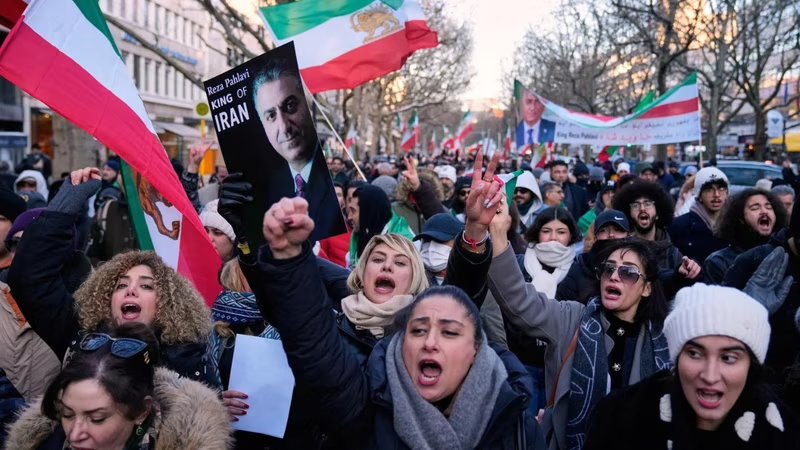
The Middle East is once again a powder keg, and the fuse has been lit by a wave of unprecedented civil unrest inside Iran. What began as localized demonstrations has exploded into a nationwide challenge to the Islamic Republic’s authority, now in its third week with a reported death toll exceeding 116 .
But the internal chaos in Tehran has triggered a dangerous external crisis. US President Donald Trump is reportedly being briefed on military strike options against Iran , while Israel has placed its armed forces on high alert, bracing for potential regional fallout . In a chilling escalation, Iran’s leadership has declared that in the event of an American attack, both US military assets across the region and Israel itself would be considered “legitimate targets” .
Table of Contents
- Deadly Iran Protests Challenge the Theocracy
- Trump Weighs Military Options Amid Chaos
- Iran’s Retaliation Threat Targets US and Israel
- Israel on High Alert for Regional War
- What Happens Next? A Fragile Tipping Point
- Sources
Deadly Iran Protests Challenge the Theocracy
The current Iran protests represent one of the most significant threats to the regime since its founding in 1979. Sparked by a confluence of economic despair, political repression, and social frustration, the demonstrations have spread to at least 15 provinces .
Human rights groups report a brutal crackdown by security forces, resulting in over 2,600 detentions alongside the grim death toll . The Iranian government has imposed severe internet blackouts to stifle communication and hide the extent of the violence from the international community . This level of state-sponsored suppression underscores just how seriously Tehran views this internal threat.
Trump Weighs Military Options Amid Chaos
From Washington, the situation is being viewed through a lens of both opportunity and peril. According to a New York Times report, President Trump has been formally briefed on a range of new military strike options against Iran . While officials stress that no final decision has been made, the very fact that these plans are being actively discussed at the highest levels signals a major shift in US posture .
Historically, Trump has oscillated between “maximum pressure” sanctions and direct threats of military force. His recent public statements, warning that Iran is in “big trouble,” suggest he may be leaning towards a more aggressive stance . The administration appears to be calculating whether a limited strike could either cripple the regime’s ability to suppress its people or, conversely, rally nationalist support around its leaders—a classic double-edged sword.
Iran’s Retaliation Threat Targets US and Israel
Tehran is not waiting passively. In a stark and unambiguous warning, Iran’s parliament speaker has declared that any US aggression will be met with overwhelming force directed at America’s regional footprint. “In the case of an attack on Iran, the occupied territories (Israel) as well as all US bases and ships will be our legitimate targets,” the official stated .
This threat is not mere rhetoric. Iran possesses a vast arsenal of short and medium-range ballistic missiles, along with a network of proxy militias from Lebanon to Iraq that can harass US interests. By explicitly naming Israel—a key US ally—as a target, Iran is attempting to raise the stakes dramatically, hoping to deter Washington by promising a wider, uncontrollable regional war.
Israel on High Alert for Regional War
Caught in the crossfire of this geopolitical chess game is Israel. Israeli authorities have confirmed that the nation’s military is on high alert, a direct response to the possibility of US intervention and the subsequent Iranian retaliation .
Israel’s concerns are multifaceted:
- Direct Missile Threat: Iranian ballistic missiles could target population centers and critical infrastructure.
- Proxy Warfare: Groups like Hezbollah in Lebanon, backed by Iran, could launch attacks on Israel’s northern border.
- Air Defense Readiness: Israel’s vaunted Iron Dome and other air defense systems are being prepped for a potential barrage.
This heightened state of readiness is a clear indicator that Jerusalem believes the risk of conflict is not just theoretical but imminent .
What Happens Next? A Fragile Tipping Point
The coming days are critical. The trajectory of the Iran protests will heavily influence decisions in Washington and Tel Aviv. If the internal uprising in Iran gains even more momentum, it could embolden the Trump administration to act. Conversely, if the regime manages to brutally quell the dissent, the immediate justification for external intervention may fade.
For now, the world is left watching a dangerous standoff. On one side, a wounded but defiant Iranian regime; on the other, a US president known for his unpredictability and an Israeli state preparing for the worst. The path to de-escalation seems narrow, making this one of the most volatile flashpoints in recent global history. One misstep, one miscalculation, could ignite a firestorm across the entire Middle East.
Summary
In summary, the deadly Iran protests have created a perfect storm of internal instability and external threat. With Trump considering a military strike, Iran threatening to retaliate against US and Israeli targets, and Israel on high alert, the region is at a precarious tipping point. The world must hope for a peaceful resolution, but all signs point to a tense and uncertain future.
Sources
- Associated Press. “Death toll in 2-week-old protests challenging Iran’s theocracy reaches 116, activists say.” January 10, 2026.
- Human Rights Activists News Agency (HRANA). “Iran protests: Death toll reaches 116, activists say.” January 2026.
- The New York Times. “Trump briefed on options for military strikes in Iran, NYT reports.” January 2026.
- Iranian Parliament Speaker’s Statement. Reported by multiple outlets including Times of India, January 2026.
- Critical Threats Project / Institute for the Study of War (ISW). “Iran Update, January 8-10, 2026.”
- [INTERNAL_LINK:middle-east-conflict-analysis]
- [INTERNAL_LINK:us-foreign-policy-trump-era]