Table of Contents
- Khamenei’s Defiant Stance on the Iran Protests Crackdown
- The Fuel Behind the Fire: Soaring Inflation and Public Anger
- Digital Darkness: Iran’s Nationwide Internet Blackout
- The Human Cost of Unrest: Deaths and Detentions
- Khamenei’s Dual-Front War: Against Protesters and Trump
- Conclusion: A Nation at a Crossroads
- Sources
Khamenei’s Defiant Stance on the Iran Protests Crackdown
In a move that has escalated tensions both domestically and internationally, Iran’s Supreme Leader, Ayatollah Ali Khamenei, has issued a stern and uncompromising ultimatum. Addressing the nation amidst widespread civil unrest, Khamenei declared that the Islamic Republic “will not back down” and promised a severe Iran protests crackdown . His message was clear: the government views the demonstrations not as a legitimate expression of public grievance, but as a foreign-backed conspiracy aimed at regime change .
This hardline stance from the highest authority in the land signals a significant escalation in the government’s response, moving away from any potential dialogue and firmly towards suppression. For observers of Iranian politics, this is a familiar playbook, but one deployed with renewed intensity against a backdrop of deep economic despair.
The Fuel Behind the Fire: Soaring Inflation and Public Anger
The current wave of protests, which began in late December 2025, was ignited by a potent mix of economic desperation and political frustration. At its core is an annual inflation rate hovering around 40%, which has devastated household budgets and crippled small businesses . Market traders and shop owners in Tehran were among the first to close their doors in protest, a powerful symbol of a struggling economy .
While the Iranian president has acknowledged the protesters’ “legitimate” grievances over the cost of living, this conciliatory tone stands in stark contrast to Khamenei’s aggressive rhetoric . The disconnect between the executive and the supreme leadership highlights the internal power dynamics at play, with Khamenei firmly taking control of the narrative and the state’s response.
Digital Darkness: Iran’s Nationwide Internet Blackout
To quell the spread of information and organization among protesters, the Iranian government has resorted to a near-total communications blackout. On January 8, 2026, as the protests entered their twelfth day and grew in scale, authorities cut off internet and telephone services across much of the country .
This digital darkness serves a dual purpose: it makes it incredibly difficult for protesters to coordinate and for citizen journalists to document events, while also allowing the state to control the official narrative through its own media channels. This tactic, used in previous bouts of unrest, is a hallmark of the regime’s strategy to manage dissent in the digital age .
The Human Cost of Unrest: Deaths and Detentions
The human toll of the government’s Iran protests crackdown is mounting rapidly. As of January 9, 2026, various human rights monitoring groups have reported alarming figures:
- At least 45 protesters have been killed [[6], [7]].
- Over 2,000 people have been arbitrarily arrested .
- Among the dead are at least five children under the age of 18 .
These numbers, gathered from fragmented reports despite the internet blackout, paint a grim picture of the state’s use of force. Security forces have been accused of using live ammunition against crowds, leading to a sharp increase in fatalities, including a single day where at least 11 protesters were killed . The government’s description of demonstrators as “rioters” who “should be put in their place” underscores its justification for this violent response .
Khamenei’s Dual-Front War: Against Protesters and Trump
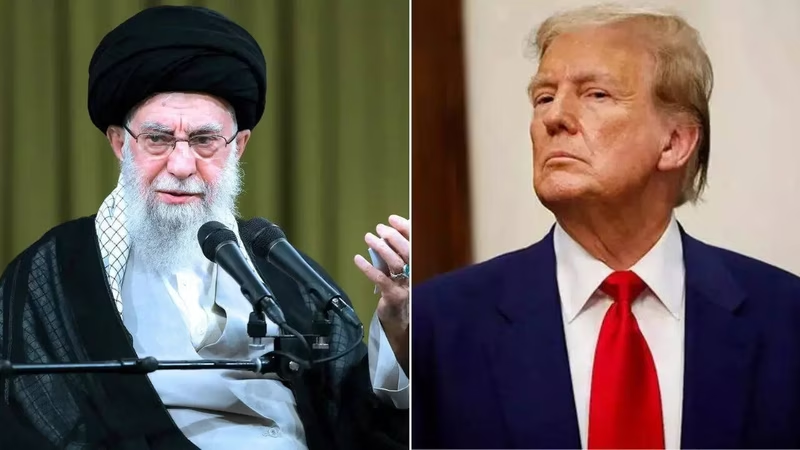
Khamenei’s speech was not solely focused on domestic affairs. In a direct and provocative message to the United States, he accused President Trump of having “hands… stained with blood” and declared that the “arrogant” leader would be overthrown . He framed the domestic unrest as being orchestrated by foreign enemies, specifically to please the US president .
This linkage of internal dissent with external enemies is a classic strategy to rally nationalist sentiment and deflect blame from domestic policy failures. By positioning himself as the defender of the nation against both internal “mercenaries” and an external tyrant, Khamenei seeks to consolidate his power base and justify the harsh Iran protests crackdown as a matter of national survival .
Conclusion: A Nation at a Crossroads
Iran stands at a critical juncture. The combination of a severe economic crisis, a population willing to risk everything to voice its discontent, and a leadership determined to crush dissent at all costs creates a volatile and dangerous situation. The Iran protests crackdown, enforced through violence and digital isolation, may succeed in silencing the streets in the short term. However, it does nothing to address the underlying economic despair that fueled the anger in the first place. Meanwhile, Khamenei’s inflammatory rhetoric against the US only adds another layer of complexity to an already tense geopolitical landscape. The world watches as Iran navigates this perilous moment.
Sources
- Times of India: ‘Hands of US president stained with blood’: Khamenei says ‘arrogant’ Trump will be overthrown
- Reuters: Protests grow as Iran’s government makes meager offer
- Amnesty International: Iran: Deaths and injuries rise amid authorities’ renewed crackdown
- NetBlocks: 2026 Internet blackout in Iran
- HRANA: Iranian Authorities Intensify Crackdown on Protests
- Xinhua: Iran’s Supreme Leader Ali Khamenei to give speech