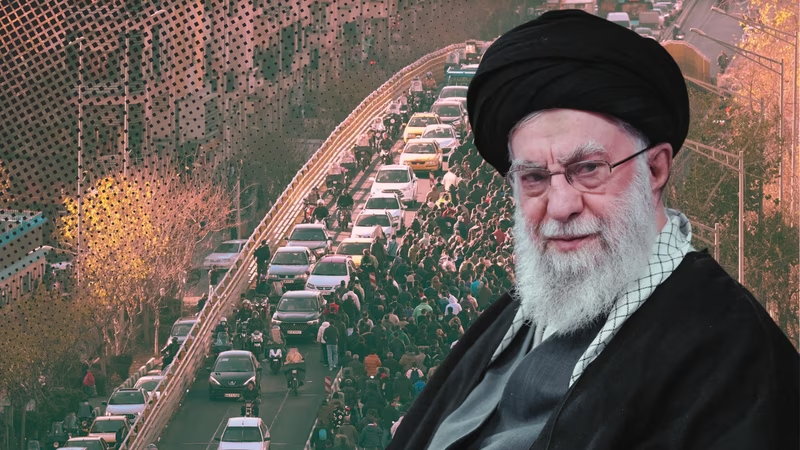
The streets of Iran are boiling over. What began as economic grievances has exploded into a nationwide uprising against the very foundations of the Islamic Republic. And from his exile, a voice from Iran’s past is making a desperate, controversial appeal to a figure from America’s recent political history.
Exiled Crown Prince Reza Pahlavi, the son of the last Shah of Iran, has publicly and urgently called on former U.S. President Donald Trump to intervene in the escalating Iran protests 2026. His message is stark and direct: “Be prepared.”
Table of Contents
- The Prince’s Urgent Call to Trump
- Ground Zero of the Iran Protests 2026
- The Maduro Comparison: A Bold and Risky Analogy
- Why Trump? And What Does ‘Intervention’ Mean?
- The Regime’s Response: Crackdown and Blackout
- What’s Next for Iran and the World?
The Prince’s Urgent Call to Trump
In a series of public statements on January 9, 2026, Reza Pahlavi framed his request in the most provocative terms possible. He praised the U.S. for its reported capture of Venezuelan leader Nicolas Maduro—a claim that itself is part of a complex geopolitical narrative—and urged Trump to be ready for a similar decisive action in Iran .
“Please be prepared to intervene to help the people of Iran,” Pahlavi stated, describing Trump as “a man of peace and a man of your word” . This isn’t just a casual request; it’s a strategic gambit by a long-time opposition figure who sees a narrow window of opportunity in the chaos gripping his homeland.
Pahlavi’s call comes at a time when his own profile within the protest movement appears to be rising. Social media posts and videos from inside Iran, despite severe restrictions, show demonstrators chanting his name and calling for the return of a monarchy—a sentiment that, while not universal among protesters, is gaining traction .
Ground Zero of the Iran Protests 2026
The current wave of unrest, now firmly etched in history as the Iran protests 2026, started with familiar triggers: economic despair, inflation, and government mismanagement. However, the speed and scale of its evolution into an explicitly anti-regime movement have stunned observers.
The human cost is already severe. According to reports from international human rights monitors, at least 62 people have been killed, and more than 2,300 have been detained by security forces . The Iranian leadership has responded not with concessions, but with chilling threats of “severe punishment” for those they label as rioters and foreign agents.
The Maduro Comparison: A Bold and Risky Analogy
Pahlavi’s reference to a “Maduro-style operation” is a deliberate and high-stakes rhetorical move. By invoking the reported U.S. capture of Venezuela’s leader, he is attempting to frame the situation in Iran as one where a swift, external action could catalyze the regime’s collapse .
However, this analogy is fraught with complications. Iran is not Venezuela. Its military and security apparatus, particularly the Islamic Revolutionary Guard Corps (IRGC), is far more powerful, entrenched, and ideologically driven. A direct military intervention, as the Maduro comparison might imply, would be an act of war with catastrophic global consequences.
Many analysts believe Pahlavi’s real ask is not for boots on the ground, but for a robust package of non-military support: intelligence sharing, cyber assistance to combat the government’s internet shutdowns, and a clear, unified diplomatic front from Western powers to delegitimize the Tehran regime on the world stage.
Why Trump? And What Does ‘Intervention’ Mean?
Pahlavi’s focus on Trump is strategic. During his presidency, Trump adopted a “maximum pressure” campaign against Iran, withdrawing from the nuclear deal and imposing crippling sanctions. While this policy was criticized for hurting ordinary Iranians, it also demonstrated a willingness to confront the regime head-on—a posture that many in the Iranian opposition prefer over diplomatic engagement.
Furthermore, Trump has previously commented on the Iranian protests, calling the demonstrators “brave people” . In a past interview, he acknowledged Pahlavi as a “good man” but stopped short of endorsing him as a future leader, stating a desire to see who emerges organically from the situation .
For Pahlavi, getting Trump’s ear is about more than personal ambition; it’s about ensuring that if the regime falls, the U.S. is prepared to support a transition that aligns with Western democratic values—or, in his view, a constitutional monarchy.
The Regime’s Response: Crackdown and Blackout
Faced with an existential threat, the Islamic Republic has deployed its two most reliable tools: brutal force and information control.
On January 9, 2026, Iranian authorities initiated a near-total internet blackout across the country. NetBlocks, an internet monitoring organization, confirmed a nationwide outage beginning around 8:30 AM local time, effectively severing the primary channel through which protesters organize and share evidence of the government’s crackdown with the outside world .
This digital siege is a critical component of the regime’s strategy. By cutting off the internet, they aim to:
- Prevent the coordination of new protests and rallies .
- Stop the flow of graphic images and videos of violence from reaching international media.
- Create an atmosphere of fear, confusion, and isolation among the populace.
What’s Next for Iran and the World?
The path forward is shrouded in uncertainty. The Iran protests 2026 represent the most significant challenge to the Islamic Republic’s authority in years. Whether they will lead to its downfall, a bloody stalemate, or a temporary retreat by the regime remains to be seen.
Reza Pahlavi’s call to Trump is a pivotal moment. It forces a global conversation about the West’s responsibility in the face of a popular uprising against a theocratic dictatorship. Will the international community, led by the U.S., heed the call for a form of intervention that stops short of war but provides meaningful support? Or will the world watch from the sidelines as the Iranian regime attempts to drown the revolution in blood and darkness?
One thing is certain: the people of Iran have spoken, and their message is clear. They are no longer willing to live under the current system, and they are demanding change—now.
Conclusion
The Iran protests 2026 are a historic flashpoint. Fueled by deep-seated anger and a yearning for freedom, they have drawn an urgent response from exiled opposition leader Reza Pahlavi, who is betting on Donald Trump to champion their cause. While the “Maduro-style” analogy is imperfect and dangerous, it underscores the desperation and high stakes of the moment. As the regime enforces a suffocating internet blackout and unleashes its security forces, the world must decide its role in this unfolding drama.
Sources
- Times of India: Another Maduro-style op? ‘Be prepared’: Iran’s exiled prince issues ‘urgent’ call for Trump
- NetBlocks: Internet blackouts hinder reporting amid nationwide protests in Iran
- Various news reports on Reza Pahlavi’s statements and the protest situation , , , , , .