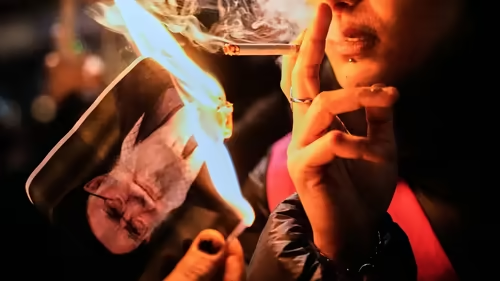
Iran Protests 2026: A Nation at a Crossroads
In late December 2025, a wave of anger over Iran’s crumbling economy erupted into a nationwide uprising that has shaken the Islamic Republic to its core. What began as a protest by bazaar merchants against soaring prices and the plummeting value of the national currency quickly spiraled into a broad anti-regime movement . Now, in January 2026, a tense and fragile calm has settled over many cities, but the government’s response—a mix of brutal crackdowns and a surprising offer of amnesty—reveals a regime struggling to maintain control.
Table of Contents
- What Sparked the Iran Protests 2026?
- The Human Cost of the Unrest
- Khamenei’s Response: Crackdown and a Calculated Amnesty
- The Digital Blackout and Information War
- What’s Next for Iran?
What Sparked the Iran Protests 2026?
The immediate trigger for the Iran protests 2026 was economic despair. On December 28, 2025, shopkeepers in Tehran’s Grand Bazaar shut their doors in protest against a catastrophic economic crisis characterized by hyperinflation and a historic low for the Iranian rial . This act of defiance resonated across the country, where ordinary citizens have been squeezed by years of mismanagement, international sanctions, and a widening gap between the ruling elite and the general populace . The protests were not just about bread and butter; they became a powerful outlet for deep-seated frustration with the entire political system.
The Human Cost of the Unrest
The government’s response to the demonstrations was swift and severe. Security forces were deployed nationwide, leading to violent clashes, particularly in Kurdish regions and other marginalized areas. The human toll has been staggering and is a subject of intense international scrutiny.
While official figures are scarce and often downplayed, independent human rights organizations report alarming numbers:
- At least 3,428 protesters have been killed, according to Iran Human Rights (IHRNGO) as of mid-January .
- Other reports from inside the country, compiled by medical professionals, suggest an even higher death toll, with estimates reaching over 16,500 killed and some 330,000 injured .
- Mass arrests have been widespread, with one opposition group claiming over 50,000 people have been detained .
These figures paint a grim picture of a state willing to use extreme violence to quell dissent. The crackdown has included live fire on crowds, arbitrary arrests, and attacks on hospitals treating the wounded .
Khamenei’s Response: Crackdown and a Calculated Amnesty
Supreme Leader Ayatollah Ali Khamenei has taken a hardline stance, publicly vowing harsh punishment for what he labels as “rioters” and “villains,” blaming foreign powers like the US and Israel for orchestrating the chaos [[11], [13]]. He has made it clear that any challenge to the regime’s authority will be met with overwhelming force.
However, alongside this threat of violence, a more nuanced strategy has emerged: an offer of amnesty. Authorities have begun distinguishing between what they call “enemy soldiers”—hardened opponents of the state—and “deceived” youth who were allegedly misled into joining the protests . This amnesty for Iran protesters is a classic tactic aimed at fracturing the protest movement, encouraging defections, and reducing the number of detainees the state must manage.
It’s a cynical yet strategic move. By framing young protesters as naive victims of foreign propaganda rather than legitimate political actors, the regime attempts to delegitimize the core grievances driving the Iran economic crisis 2025 protests while appearing merciful.
The Digital Blackout and Information War
To control the narrative and prevent the organization of further protests, the Iranian government imposed a near-total internet shutdown on January 8, 2026 . This digital blackout severed the country from the outside world, making it incredibly difficult for journalists, activists, and ordinary citizens to share information or document the ongoing crackdown .
As of January 19, 2026, officials have promised a restoration of internet services by the end of the week [[19], [22]]. While there are signs of limited connectivity returning in some urban centers, the full extent of the Iran internet shutdown January 2026 and its long-term impact on the economy and civil society remains to be seen. This blackout is a stark reminder of the regime’s primary tool for maintaining power: controlling the flow of information.
What’s Next for Iran?
The situation in Iran remains highly volatile. The partial calm could be a temporary lull before another storm, or it could signal the beginning of a new, more repressive normal. The regime’s dual strategy of brutal suppression and selective leniency has bought it some time, but it has not addressed the root causes of the public’s fury.
The economic crisis continues to deepen, and the deep well of public resentment is unlikely to disappear. The world is watching closely, and the pressure on the Iranian government from international human rights bodies is mounting. For now, the streets may be quieter, but the underlying tensions that fueled the Iran protests 2026 are very much alive. The fate of the thousands arrested, and the truth behind the casualties in Iran unrest, will be a critical factor in determining the nation’s future path.
For more on global political movements, see our coverage on [INTERNAL_LINK:global-protest-movements].
Summary
The Iran protests of 2026, born from a dire economic crisis, have been met with a devastating government crackdown resulting in thousands of deaths and arrests. In a strategic move, Supreme Leader Khamenei has offered amnesty to “deceived” youth while promising harsh punishment for others, all while attempting to control the narrative through a severe internet blackout. Although a fragile calm has returned to some areas, the fundamental issues remain unresolved, leaving Iran’s future uncertain.
Sources
- Web Search Result on “Iran protests December 2025 economic hardship causes”
- Web Search Result on “December 2025 Iran Uprising: A Comprehensive Report”
- Web Search Result on “Iran in Crisis: Time for a Change from Within”
- Web Search Result on “Iran protests 2026: UK and international response”
- Web Search Result on “Iran: More than 100 protesters believed to be killed as top”
- Web Search Result on “Khamenei’s Conditional “Amnesty;” The Great Repentance”
- Web Search Result on “2026 Internet blackout in Iran”
- Web Search Result on “Iran says internet to return to normal by Friday”
- Web Search Result on “Iran’s latest internet blackout extends to phones and Starlink”
- Web Search Result on “Iran promises internet restoration by end of week”
- Web Search Result on “Iranian Authorities Intensify Crackdown on Protests with”
- Web Search Result on “At Least 3428 Protesters Killed in Iran; Serious Risk of”
- Web Search Result on “Iran crackdown left 16500 dead, 330000 injured”
- Web Search Result on “Iran: PMOI Announces Over 50000 Arrests During Uprising”