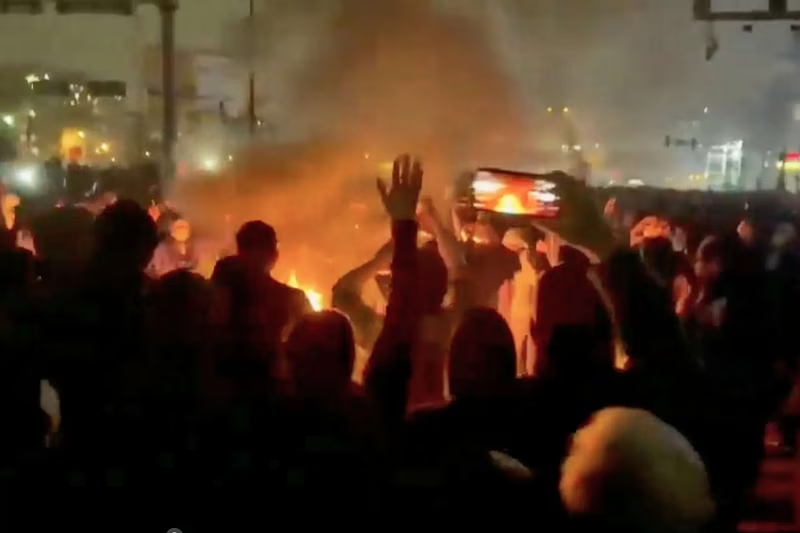
The streets of Iran are running red, and the world is watching in horror. What began as a wave of grief over the death of Mahsa Amini has exploded into a full-blown existential challenge to the Islamic Republic itself. The regime’s response has been brutal and unrelenting, with a security crackdown so severe that the Iran protest death toll has now reportedly surpassed 538, according to human rights monitors .
But the violence isn’t just contained within Iran’s borders. In a move that has sent shockwaves through global capitals, Tehran has directly warned the United States and Israel that any attempt to intervene or support the protesters would be met with force, explicitly naming them as “legitimate targets” . This dangerous escalation transforms an internal crisis into a potential flashpoint for a much wider regional conflagration.
Table of Contents
- The Iran Protest Death Toll: A Grim Tally
- The Spark That Ignited a Revolution: Mahsa Amini’s Legacy
- Tehran’s Response: Crackdown, Internet Blackout, and Arrests
- Tehran Warns US, Israel of Consequences: A Dangerous Escalation
- The Protesters’ Demands: Beyond the Hijab to the System Itself
- International Reaction: Sanctions and Diplomatic Isolation
- Conclusion: A Nation at a Crossroads
- Sources
The Iran Protest Death Toll: A Grim Tally
The numbers are staggering and deeply troubling. The Norway-based Iran Human Rights (IHR) group, which meticulously documents casualties from inside the country, has confirmed that at least 538 people, including 71 children, have been killed by security forces since the protests began .
These aren’t just statistics; they represent students, workers, mothers, and fathers who took to the streets demanding basic freedoms. The true number could be even higher, as the Iranian government maintains a strict information blackout, making independent verification extremely difficult. Thousands more have been arrested, with reports of torture and unfair trials emerging from detention centers across the country.
The Spark That Ignited a Revolution: Mahsa Amini’s Legacy
The entire movement was triggered by the tragic death of 22-year-old Mahsa Amini in September 2022, after she was arrested by the morality police for allegedly not wearing her hijab “properly.” Her death became a symbol of the state’s oppressive control over women’s lives.
However, the protests have evolved far beyond the initial grievance. Chants of “Woman, Life, Freedom” have now been joined by direct calls for the overthrow of Supreme Leader Ayatollah Ali Khamenei and the entire theocratic system. The economic collapse, rampant corruption, and decades of political repression have created a tinderbox, and Amini’s death was the spark.
Tehran’s Response: Crackdown, Internet Blackout, and Arrests
The Iranian regime has shown zero tolerance for dissent. Its strategy has been threefold:
- Violent Suppression: Deploying the Islamic Revolutionary Guard Corps (IRGC) and Basij militia to use live ammunition, birdshot, and batons against unarmed crowds.
- Information Control: Imposing a near-total internet and mobile data blackout to prevent images and videos of the crackdown from reaching the outside world and to hinder protester coordination .
- Mass Detentions: Arresting an estimated 22,000 people, including prominent journalists, lawyers, and athletes, in an effort to decapitate the protest leadership.
This comprehensive strategy of fear aims to crush the movement before it can gain unstoppable momentum.
Tehran Warns US, Israel of Consequences: A Dangerous Escalation
In a clear attempt to externalize the blame and rally nationalist sentiment, senior Iranian officials have issued dire threats against foreign powers. They claim, without evidence, that the US and Israel are orchestrating the protests as part of a “hybrid war” to destabilize the country.
Iran’s Foreign Ministry spokesperson went so far as to state that if these countries “use their military power to protect the rioters,” they will be considered “legitimate targets for the Islamic Republic of Iran” . This is not mere rhetoric; it’s a deliberate provocation that raises the stakes dramatically and could be used to justify future aggressive actions by Iran or its proxies in the region.
The Protesters’ Demands: Beyond the Hijab to the System Itself
What makes this uprising different from previous ones is its scope and its target. While past protests often focused on specific economic policies or election results, this one is fundamentally anti-systemic. The core demands now include:
- The complete abolition of the compulsory hijab law.
- The resignation of Supreme Leader Ayatollah Khamenei.
- An end to the Islamic Republic and the establishment of a secular, democratic government.
This represents the most serious threat to the regime’s survival since its founding in 1979. [INTERNAL_LINK:history-of-iranian-protests] provides crucial context for understanding the current moment.
International Reaction: Sanctions and Diplomatic Isolation
The international community has largely condemned the violence. The European Union and the United States have imposed multiple rounds of sanctions on Iranian officials and entities involved in the crackdown. However, these measures have so far failed to alter Tehran’s course.
Global human rights organizations like Amnesty International have called for an urgent UN-led investigation into the killings, labeling them potential crimes against humanity . The challenge for the West is to support the Iranian people’s right to protest without giving the regime the propaganda win of appearing to be a victim of foreign intervention.
Conclusion: A Nation at a Crossroads
The Iran protest death toll is a grim marker of a nation in profound crisis. The regime is betting that its iron fist can silence the people, while the protesters are betting their lives on the hope of a freer future. Tehran’s threats against the US and Israel only add a layer of dangerous unpredictability to an already volatile situation. The world must watch closely, for the outcome of this struggle will shape not only Iran’s destiny but also the stability of the entire Middle East for years to come.
Sources
- Iran Human Rights (IHR). “Annual Report on the Human Rights Situation in Iran 2025.” January 10, 2026.
- Times of India. “Iran protest: At least 538 dead in crackdown; Tehran warns US, Israel of consequences.” January 12, 2026.
- NetBlocks. “Internet Monitoring Report: Iran Nationwide Blackout.” January 11, 2026.
- Amnesty International. “Iran: Security Forces’ Bloody Campaign Against Protesters May Amount to Crimes Against Humanity.” December 2025.