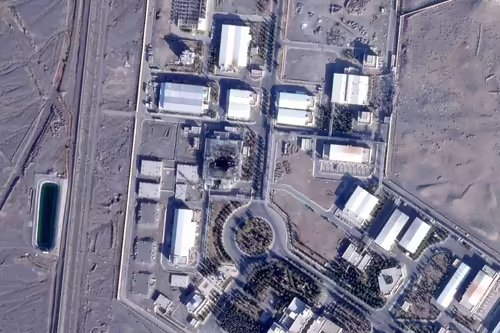
The cat-and-mouse game over Iran’s nuclear ambitions has entered a new, more ominous phase. Fresh commercial satellite imagery analyzed by international experts reveals that Tehran is engaged in a massive construction project: erecting enormous, permanent canopies over its two most critical Iran nuclear sites—the uranium enrichment facility at Natanz and the nuclear complex at Isfahan [[1]]. This move, far from routine maintenance, is widely interpreted as a deliberate attempt to shield sensitive activities from the prying eyes of spy satellites, raising serious alarms in Washington, Tel Aviv, and at the International Atomic Energy Agency (IAEA) headquarters in Vienna.
The timing is particularly fraught. These developments come amid a complete stalemate in diplomatic efforts to revive the 2015 nuclear deal (JCPOA) and growing evidence that Iran has mastered the technical capability to produce weapons-grade uranium at an industrial scale. By physically blocking overhead surveillance, Iran is effectively slamming the door on one of the last remaining windows into its clandestine program.
Table of Contents
- What the Satellite Images Show
- Why Covering the Sites is a Major Red Flag
- Natanz and Isfahan: The Heart of Iran’s Program
- The IAEA and International Response
- Is Iran Rushing Towards a Bomb?
- Conclusion: A Dangerous New Chapter
- Sources
What the Satellite Images Show
The imagery, captured in recent weeks, shows large-scale construction activity at both locations. At the Natanz Fuel Enrichment Plant (FEP), a site already buried deep underground for protection, workers are building a massive steel and concrete canopy over the above-ground sections of the facility [[1]]. Similarly, at the Isfahan Uranium Conversion Facility (UCF), where raw uranium ore is processed into feedstock for enrichment, a similar large-scale covering project is underway.
These are not temporary tarps or simple roofs. They appear to be robust, permanent structures designed to withstand scrutiny and potentially even minor military strikes. Their primary function, however, seems clear: to obstruct the view of optical and radar satellites that Western intelligence agencies rely on to monitor for signs of illicit activity, such as the installation of advanced centrifuges or the movement of nuclear materials.
Why Covering the Sites is a Major Red Flag
In the world of nuclear non-proliferation, transparency is the currency of trust. By choosing to obscure its facilities, Iran is sending a powerful and unambiguous signal: it has something to hide. This action directly contradicts its long-standing claims that its nuclear program is solely for peaceful, civilian purposes like energy generation.
Historically, nations pursuing nuclear weapons have gone to great lengths to conceal their activities. Iraq under Saddam Hussein and Syria before its reactor was bombed by Israel both employed extensive camouflage and concealment tactics. Iran’s current actions fit this troubling historical pattern, suggesting a shift from a policy of calculated ambiguity to one of active concealment.
Natanz and Isfahan: The Heart of Iran’s Program
Understanding the significance of these two sites is crucial:
- Natanz: This is Iran’s primary uranium enrichment hub. It houses thousands of advanced IR-2m and IR-6 centrifuges, which can enrich uranium to near-weapons grade (60% purity) at a much faster rate than the older IR-1 models. It’s the engine room of Iran’s breakout capability [[2]].
- Isfahan: This complex is the starting point of the fuel cycle. It converts yellowcake (uranium oxide) into uranium hexafluoride (UF6) gas, the form required for enrichment in centrifuges. Controlling this step gives Iran complete command over its nuclear supply chain [[3]].
Concealing activity at these two nodes effectively blinds the international community to the very core of Iran’s nuclear enterprise.
The IAEA and International Response
The International Atomic Energy Agency (IAEA), tasked with verifying Iran’s compliance with its non-proliferation obligations, is in a difficult position. While it has on-the-ground inspectors in Iran, its access has been severely curtailed in recent years. Tehran has removed many of the agency’s surveillance cameras and denied inspectors access to key locations [[4]].
The satellite imagery of the canopies will undoubtedly be a central topic at the next IAEA Board of Governors meeting. Western powers are expected to demand immediate, unfettered access to these newly covered areas. Iran’s response—to grant access or to stonewall—will be a critical indicator of its true intentions.
Is Iran Rushing Towards a Bomb?
Most experts believe Iran is not currently building a nuclear weapon. However, it is widely assessed to be in a state of “nuclear latency” or “threshold status”—meaning it has accumulated enough fissile material and technical knowledge to build a bomb within a matter of weeks if its leadership so decides [[5]].
The construction of these canopies could be a preparatory step for just such a breakout scenario. By shielding the final stages of weaponization or the assembly of a device from detection, Iran could theoretically sprint to a bomb before the international community could mount an effective response. This makes the current situation incredibly dangerous and unstable.
Conclusion: A Dangerous New Chapter
The images of covered Iran nuclear sites at Natanz and Isfahan mark a significant and alarming escalation. This is no longer just about enriching uranium; it’s about actively hiding what happens next. By choosing concealment over transparency, Tehran is pushing the region closer to a potential nuclear crisis. The international community now faces a stark choice: find a way to force Iran back to the negotiating table with credible incentives and consequences, or prepare for a future where a nuclear-armed Iran is a terrifying reality.
Sources
[INTERNAL_LINK:iran-nuclear-deal-jcpoa-explained]
[INTERNAL_LINK:middle-east-geopolitical-tensions-2026]
Times of India: Why is Iran covering its nuclear sites? [[1]]
International Atomic Energy Agency (IAEA): Iran Verification and Monitoring [[4]]
Federation of American Scientists: Iran Nuclear Program [[2, 3, 5]]