Table of Contents
- Trump’s Bold Claim and Its Immediate Backlash
- Iran’s Official Rebuttal: “No Such Number Exists”
- The Harsh Reality of Iran’s Execution Crisis
- A Geopolitical Chess Game or a Dangerous Distraction?
- Conclusion: The Truth in a Time of Tension
- Sources
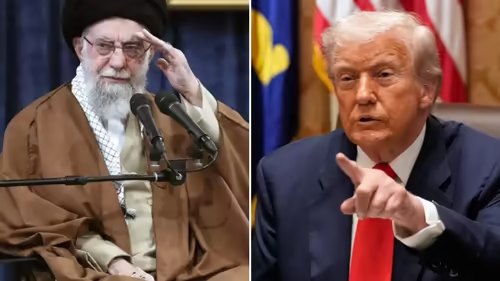
In a world where political rhetoric often outpaces reality, a recent claim by former U.S. President Donald Trump has ignited a firestorm of controversy and a swift, scathing rebuttal from Tehran. The claim? That his personal intervention single-handedly halted the execution of 800 people in Iran. The response? A blunt and unequivocal statement from Iranian authorities: “No such number exists.” This clash of narratives isn’t just political theater; it cuts to the heart of a very real and ongoing human rights crisis in Iran, where Iran executions have reached a horrifying decade-high.
Trump’s Bold Claim and Its Immediate Backlash
On January 14, 2026, Donald Trump took to his platform to assert that he had received “on good authority” that Iran had planned to execute 800 individuals but had called off these plans due to his influence . This claim, which was also echoed by the White House at the time , appeared to be an attempt to position himself as a decisive global actor capable of swaying the actions of one of America’s most entrenched adversaries. However, the claim was met with immediate skepticism from human rights groups and regional experts who saw no evidence to support such a specific and large-scale cancellation of executions.
Iran’s Official Rebuttal: “No Such Number Exists”
The Iranian government did not let the claim go unchallenged for long. In a direct and forceful denial, Iran’s top prosecutor publicly refuted Trump’s assertion, stating there was no truth to the story of 800 halted executions . Foreign Minister Abbas Araghchi further reinforced this position, dismissing the claim outright and asserting that the situation regarding protests was under control . The core of Iran’s rebuttal was simple and damning: the premise of the claim was false because the alleged mass execution event simply never happened. As one official put it, the number “800” in this context is a fiction . This categorical denial from the highest levels of the Iranian judiciary and foreign ministry leaves Trump’s claim hanging on a thread of unsubstantiated rumor.
The Harsh Reality of Iran’s Execution Crisis
While the specific claim of 800 halted executions appears to be unfounded, it inadvertently casts a spotlight on a far more terrifying truth: Iran’s actual execution rate is alarmingly high and shows no signs of slowing down. In fact, the data paints a grim picture that contradicts any notion of a recent, large-scale reprieve.
According to multiple reputable human rights organizations, Iran executions in 2024 soared to nearly 1,000, marking a significant increase from previous years [[6], [3]]. The trend has only accelerated in 2025. Reports indicate that by the end of September 2025 alone, Iranian authorities had already executed over 1,000 people—the highest number for that period in a decade [[1], [5]]. Some estimates even suggest the total for the full year could exceed 1,300 .
This surge in state-sanctioned killings is widely seen as a tool of political repression, particularly in the wake of widespread protests. Many of those executed are charged with vague crimes like “enmity against God” or “corruption on earth,” which are often used to target political dissidents, protesters, and members of ethnic minorities like the Kurds . The idea that Iran would halt 800 executions out of goodwill or fear of a foreign leader stands in stark contrast to its documented, systematic use of the death penalty as a mechanism of control.
A Geopolitical Chess Game or a Dangerous Distraction?
So, why make such a claim? Analysts suggest Trump’s statement may be less about factual accuracy and more about domestic political posturing. By portraying himself as a powerful figure who can directly influence a hostile regime, he aims to bolster his image as a strong leader on the world stage. This narrative fits neatly into a broader political strategy, but it risks trivializing a serious and ongoing humanitarian crisis.
For Iran, the rebuttal serves its own purposes. By denying the claim, Tehran can project an image of sovereignty and defiance, refusing to be portrayed as bending to American pressure. It allows them to control the narrative both domestically and internationally, framing the entire episode as a baseless fabrication from a political adversary .
However, this exchange of claims and counter-claims can be a dangerous distraction. It shifts the focus away from the verifiable, documented reality of Iran’s brutal crackdown and its record number of Iran executions. The international community’s attention should be on holding the Iranian regime accountable for its human rights abuses, not on parsing the truthfulness of a politically motivated anecdote. For more on the complex history of US-Iran relations, see our deep dive on [INTERNAL_LINK:US-Iran relations history].
Conclusion: The Truth in a Time of Tension
The bottom line is clear. While Donald Trump’s claim of halting 800 executions in Iran makes for a dramatic headline, it is firmly rejected by Iranian officials as a complete fabrication. The phrase “no such number exists” is a powerful indictment of the claim’s validity. The real story is far more sinister: Iran is in the midst of its most prolific period of state executions in years, using the death penalty as a weapon to silence dissent. In this high-stakes game of political messaging, the truth is often the first casualty, but the lives lost to Iran’s execution chambers are a tragic and undeniable reality. Understanding the facts behind the Iran executions crisis is crucial for anyone seeking to grasp the true nature of the regime’s actions and the gravity of the situation on the ground.
Sources
- Iran Human Rights (IHRNGO) Annual Reports and Statements [[1], [3], [5], [6]]
- Times of India: “‘No such number exists’: Iran debunks Trump’s halted 800 executions claim” [[10], [16]]
- Fact-checking reports from major international news agencies on Trump’s claim [[12], [13], [14], [15], [19], [20]]
- United Nations Human Rights Council documentation on Iran