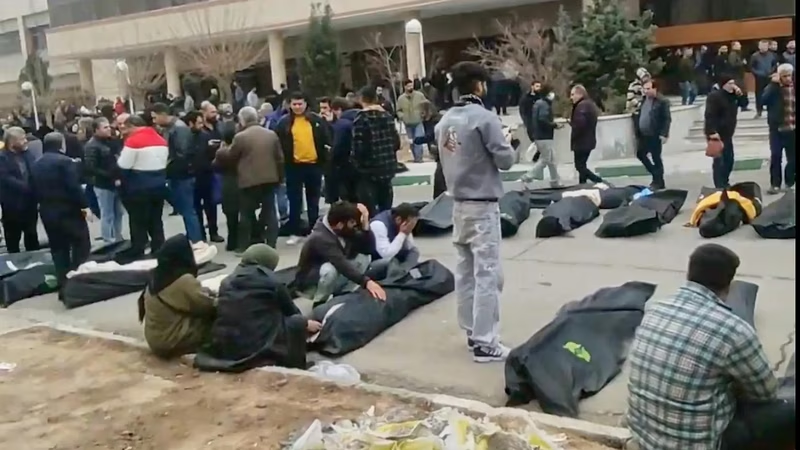
The streets of Iran have turned into a battlefield. In what observers are calling the most severe Iran crackdown since the 2009 Green Movement, the Islamic Republic’s security apparatus has unleashed a wave of lethal violence against its own citizens. Eyewitnesses on the ground, speaking through fragmented communication channels, have described a regime that is “on a killing spree” .
With a near-total internet and telecommunications blackout imposed since January 8, 2026, the world has been largely blind to the unfolding horror . But scattered reports, smuggled videos, and testimonies from those who have managed to get information out paint a chilling picture: an estimated 2,000 civilians dead, hospitals overflowing with the wounded, and a government that appears willing to do anything to silence dissent.
Table of Contents
- The Scale of the Iran Crackdown: A Death Toll Hidden in Darkness
- Eyewitness Accounts: Stories of Terror from the Streets
- The Internet Blackout: A Deliberate Strategy of Concealment
- International Response and the Challenge of Verification
- Defiance in the Face of Terror: The Spirit of the Protesters
- Conclusion: A Nation at a Crossroads
- Sources
The Scale of the Iran Crackdown: A Death Toll Hidden in Darkness
The numbers are staggering, yet impossible to fully verify due to the government’s iron grip on information. Credible sources, including international human rights monitors and diaspora groups, estimate that around 2,000 people have been killed since the protests began in late 2025 . This would make it the deadliest period of civil unrest in Iran in more than a decade.
The Iran crackdown is not just about the sheer number of deaths. Reports indicate a systematic use of live ammunition against largely peaceful and unarmed crowds. Security forces, including the feared Basij militia and the Islamic Revolutionary Guard Corps (IRGC), have been accused of firing directly into residential areas and using snipers on rooftops .
Adding to the horror, there are widespread accounts of authorities storming hospitals to arrest the injured. Medical personnel have reported being pressured to falsify death certificates, listing causes of death as “heart attacks” or “accidents” to hide the true nature of the state’s violence .
Eyewitness Accounts: Stories of Terror from the Streets
In the absence of official transparency, the voices of ordinary Iranians have become our most vital source of truth. These are their stories:
- “They shot my brother for holding a phone.” A young man from Tehran recounted how his sibling was gunned down while filming a protest. “He wasn’t even shouting slogans, just recording,” he said via a satellite messenger.
- “The ambulances were stopped.” In Isfahan, a nurse described how security forces blocked emergency vehicles from reaching a square where dozens had been shot, leaving the wounded to bleed out for hours .
- “They are taking the bodies.” Multiple families have reported that morgues are refusing to release the bodies of their loved ones, a tactic often used by authoritarian regimes to prevent public funerals that could spark further protests.
These accounts, while harrowing, are consistent with the modus operandi of a regime that views any form of dissent as an existential threat.
The Internet Blackout: A Deliberate Strategy of Concealment
On January 8, 2026, Iranian authorities imposed a “near-total internet shutdown” across the country . This was not a technical glitch; it was a calculated act of information warfare. By severing almost all digital connections, the regime aimed to achieve three goals:
- Prevent Coordination: Stop protesters from organizing and sharing real-time information about safe routes or security force movements.
- Hide Atrocities: Make it nearly impossible for evidence of killings and torture to reach the outside world .
- Create Fear and Isolation: Cut citizens off from each other and from international support, fostering a sense of helplessness.
This digital siege has been a hallmark of the Iranian government’s response to major uprisings, but the 2026 blackout is reportedly one of the most comprehensive yet, lasting for over five days with only sporadic, heavily monitored access returning in some areas .
International Response and the Challenge of Verification
The international community has condemned the violence, but its ability to act is hampered by the very blackout the regime engineered. Without verifiable, real-time data, diplomatic efforts risk being based on incomplete or outdated information.
Organizations like Amnesty International and Human Rights Watch are working tirelessly to document abuses, relying on a patchwork of satellite imagery, encrypted messages, and calls from landlines that haven’t been cut. For a deeper look at how these groups operate under such conditions, see our analysis on [INTERNAL_LINK:human-rights-monitoring-digital-blackouts].
The challenge is immense. As one UN official stated, “A communications blackout is the first sign of a massacre. It’s the regime’s way of saying, ‘We can do whatever we want, and you can’t stop us or even see it.’”
Defiance in the Face of Terror: The Spirit of the Protesters
Despite the overwhelming brutality, the spirit of resistance in Iran remains unbroken. In cities and towns across the nation, citizens continue to find ways to defy the regime. From rooftop chants of “Death to the Dictator” echoing through the night to graffiti appearing on walls overnight, the message is clear: fear will not win.
This resilience is the most potent threat to the regime’s power. History has shown that no amount of repression can permanently extinguish a people’s desire for freedom, especially when that desire is shared by millions.
Conclusion: A Nation at a Crossroads
The Iran crackdown of 2026 represents a critical juncture for the country. The regime’s choice to respond to popular grievances with extreme violence and a total information blackout reveals its deep insecurity and fragility. While the immediate future is dark, the courage of the Iranian people offers a glimmer of hope. The world must not look away. We must amplify their voices, demand accountability, and stand with them in their fight for a free and democratic Iran.
Sources
- Times of India. “Iran’s crackdown: ‘Regime is on a killing spree’ – eyewitnesses recount brutality”. https://timesofindia.indiatimes.com/world/middle-east/irans-crackdown-regime-is-on-a-killing-spree-eyewitnesses-recount-brutality/articleshow/126507558.cms
- Amnesty International. “Iran: Internet shutdown hides violations in escalating crackdown”. https://www.amnesty.org/
- Reporters Without Borders. “Iran: Bloodshed unfolding amid communications blackout”. https://rsf.org/
- Committee to Protect Journalists. “Iran’s internet blackout tightens information chokehold”. https://cpj.org/