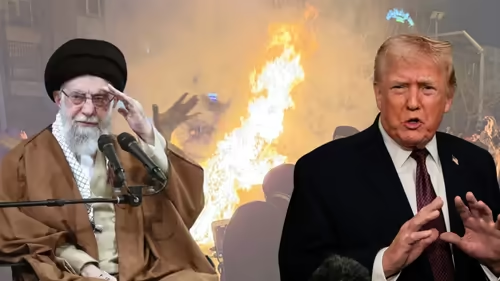
The Middle East is holding its breath. In a stark and unambiguous declaration, a senior Iranian official has warned that Tehran will treat any military aggression as an Iran all-out war warning—a signal that the region may be teetering on the edge of a catastrophic conflict . This comes as the United States accelerates its military presence in the area, deploying a formidable aircraft carrier strike group just days after President Donald Trump vowed to keep a “close watch” on Iran .
Table of Contents
- The Escalating Crisis: From Rhetoric to Reality
- The US Military Build-Up: A Show of Force
- Iran’s Military Posture and Capabilities
- The Trump Administration’s Stance on Iran
- What Happens Next? Potential Scenarios
- Conclusion
- Sources
The Escalating Crisis: From Rhetoric to Reality
The current crisis didn’t erupt in a vacuum. It’s the culmination of months of rising tensions, fueled by US-backed Israeli strikes on Iranian interests and a hardening of positions from both Washington and Tehran. The Iranian government, already on high alert, has now officially declared its readiness for the “worst-case scenario” .
Speaking to reporters, the Iranian official’s message was clear: an attack on Iran is not a limited engagement—it is a declaration of total war. This shift in rhetoric suggests a move away from a doctrine of strategic patience towards one of immediate and overwhelming retaliation. Such a stance dramatically raises the stakes for any miscalculation or accidental clash in the already volatile Persian Gulf.
The US Military Build-Up: A Show of Force
In response to the perceived threat from Iran, the United States has initiated a significant US military build-up Middle East. The centerpiece of this deployment is the USS Nimitz aircraft carrier strike group, a floating city of war capable of projecting immense power across the region . This naval force, combined with other assets, is expected to arrive in the Middle East in the coming days, serving as both a deterrent and a ready strike force .
This move is a classic show of American military might, designed to signal resolve to both allies and adversaries. However, in the context of Iran’s explicit warning, it also risks being interpreted as a direct provocation, potentially creating a dangerous feedback loop of action and reaction.
Iran’s Military Posture and Capabilities
While the US possesses overwhelming conventional superiority, dismissing Iran’s military capabilities would be a grave error. Ranked as the 16th most powerful military in the world out of 145 countries by GlobalFirepower.com, Iran’s strength lies in its asymmetric warfare tactics, vast missile arsenal, and its network of regional proxies .
Tehran’s strategy is not to win a head-to-head fight with the US Navy but to make any conflict so costly and chaotic that it deters the initial attack. Key elements of this strategy include:
- Ballistic and Cruise Missiles: Iran possesses thousands of missiles capable of striking US bases and allies across the region.
- Naval Swarming Tactics: The Islamic Revolutionary Guard Corps Navy (IRGCN) can deploy hundreds of small, fast attack craft to overwhelm larger vessels in the confined waters of the Strait of Hormuz.
- Regional Proxy Network: Groups like Hezbollah in Lebanon and various militias in Iraq can open multiple fronts, stretching US and allied resources thin.
This combination makes Iran a formidable and unpredictable adversary, perfectly suited to wage the kind of protracted, messy conflict it has threatened in its Iran all-out war warning.
The Trump Administration’s Stance on Iran
The return of Donald Trump to the White House has ushered in a new, more aggressive phase in Trump Iran policy. His administration has already signaled a return to the “maximum pressure” campaign of his first term, which included crippling economic sanctions and the assassination of a top Iranian general .
Recent actions, such as plans to deport dozens of Iranian nationals and the imposition of new tariffs on nations trading with Iran, demonstrate a hardline approach [[28], [33]]. President Trump’s public statements about sending a “big force” to the region further underscore his willingness to use military power as a primary tool of diplomacy . This posture stands in sharp contrast to previous administrations’ attempts at negotiation and is a key driver behind the current escalation in Iran-US tensions 2026.
What Happens Next? Potential Scenarios
The path forward is fraught with peril. Several scenarios could unfold from this tense standoff:
- Diplomatic De-escalation: A last-minute backchannel negotiation could lead to a mutual drawdown of forces, though this seems increasingly unlikely given the current rhetoric.
- Limited Strike and Retaliation: A targeted US or Israeli strike on an Iranian facility could trigger a calibrated Iranian response, leading to a cycle of tit-for-tat attacks that could spiral out of control.
- Full-Scale Regional Conflict: The worst-case scenario, where a single incident triggers the very Middle East conflict escalation that Iran has warned about, drawing in multiple regional and global powers.
The coming weeks will be critical. The arrival of the US carrier group and Iran’s state of high alert create a tinderbox environment where a single spark could ignite a conflagration.
Conclusion
The Iranian regime’s “all-out war” warning is not mere bluster; it is a serious declaration of intent born from a perception of existential threat. Combined with the massive US military build-up and the Trump administration’s confrontational stance, the stage is set for a historic and potentially devastating confrontation in the Middle East. The world must hope that cooler heads prevail, but the window for diplomacy is closing rapidly. For more on global political flashpoints, see our analysis on [INTERNAL_LINK:global-geopolitical-risks].
Sources
- Times of India: Iran reacts to ‘military build-up’ in Middle East; warns US of ‘all-out war’
- CNN: Iran will treat any US attack as ‘all-out war against us’
- Reuters: US carrier strike group deploys to Middle East
- GlobalFirepower: 2026 Global Firepower Index
- Council on Foreign Relations: U.S.-Iran Relations