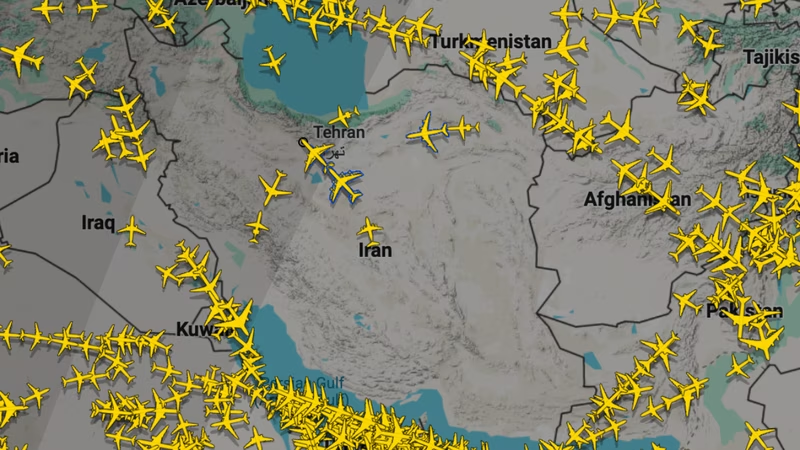
Imagine being mid-flight, cruising at 35,000 feet, when your pilot announces you’re turning around—not because of weather, but because the country you were about to fly over has just slammed its doors shut. That’s exactly what happened to passengers on an IndiGo flight from Istanbul to Delhi this week, as a sudden Iran airspace closure sent shockwaves through the global aviation industry .
The closure, announced with little warning by Iranian authorities, has caused immediate and widespread disruption. Air India was forced to cancel three crucial long-haul flights to the United States, while numerous other carriers are scrambling to reroute their planes on longer, more expensive paths to avoid Iranian skies. For travelers, this means delays, cancellations, and a hefty dose of uncertainty.
Table of Contents
- What Happened: The Facts on the Ground
- Why Iran Airspace Closure Matters for Global Travel
- Airlines Impacted and Passenger Fallout
- The Geopolitical Context Behind the Closure
- What Travelers Should Do Next
- Conclusion
- Sources
What Happened: The Facts on the Ground
On January 14, 2026, Iran’s Civil Aviation Organization (CAO) issued a NOTAM (Notice to Airmen) effectively closing its entire airspace to civilian traffic . The notice provided minimal explanation, citing only “security reasons.” This lack of transparency is what makes the situation so alarming for airlines and passengers alike.
The most direct impact was felt by Air India, which had to cancel three of its flagship services: AI-101 (Delhi to New York JFK), AI-127 (Mumbai to Newark), and AI-103 (Delhi to San Francisco). These are critical routes that connect India to major U.S. economic hubs, and their cancellation stranded hundreds of passengers.
In another dramatic incident, IndiGo flight 6E-53, en route from Istanbul to Delhi, was already in the air when the closure took effect. With no safe or legal way to proceed through Iranian airspace, the pilots had no choice but to divert and return to its last departure point, Heydar Aliyev International Airport in Baku, Azerbaijan—a significant detour that added hours to the journey .
Why Iran Airspace Closure Matters for Global Travel
Iran isn’t just any country on the map; it’s a massive landmass that sits directly on one of the world’s busiest aviation superhighways. Flights between Europe, South Asia, and Southeast Asia routinely cross Iranian territory because it offers the shortest, most fuel-efficient path.
When this corridor is closed, the consequences are severe:
- Massive Rerouting: Airlines must divert south over the Arabian Sea or north through Russian/Central Asian airspace, adding 1-3 hours to flight times.
- Increased Costs: Longer routes mean more fuel burned, which translates to higher operational costs that are often passed on to consumers.
- Safety Concerns: While commercial aviation is incredibly safe, flying near conflict zones or through areas of heightened military activity always carries an elevated, albeit small, risk. The memory of Ukraine International Airlines Flight 752, shot down by Iran in 2020, is still fresh in the industry’s mind .
This makes the Iran airspace closure not just a regional issue, but a global logistical headache.
Airlines Impacted and Passenger Fallout
While Air India and IndiGo have been the most visibly affected Indian carriers, they are far from alone. European giants like Lufthansa, British Airways, and Turkish Airlines, as well as Asian carriers like Singapore Airlines and Thai Airways, all operate routes that typically traverse Iranian airspace.
Passengers are bearing the brunt of this disruption. Common issues include:
- Stranded Travelers: Those with connecting flights are missing their onward journeys, leading to overnight stays and rebooking chaos.
- Refund Delays: Processing refunds or issuing travel vouchers can take days or even weeks during such large-scale events.
- Communication Gaps: Many travelers report a lack of clear, timely information from their airlines about the status of their flights.
If you’re booked on a flight that might be affected, it’s crucial to check your airline’s website or app constantly for updates [INTERNAL_LINK:travel-disruption-tips].
The Geopolitical Context Behind the Closure
Airspace closures don’t happen in a vacuum. This sudden move by Iran comes amid a period of extreme regional volatility. Just days prior, Tehran had issued stern warnings to the United States and accused Israel of fomenting deadly domestic protests .
Experts believe the closure is a direct response to these internal security concerns and a potential fear of foreign military intervention or surveillance. By shutting down its airspace, Iran can:
- Prevent any unauthorized aircraft (including spy drones or military planes) from operating overhead.
- Assert its sovereignty and send a strong signal of control to both its domestic audience and international rivals.
- Create a buffer zone in case of any escalation in its shadow war with Israel.
Historically, Iran has used airspace restrictions as a geopolitical tool, and this latest action fits that pattern perfectly.
What Travelers Should Do Next
If you have upcoming travel plans that could be routed through the Middle East, here’s your action plan:
- Contact Your Airline Immediately: Don’t wait for them to contact you. Check your flight status online or call their customer service.
- Review Your Travel Insurance: A good policy should cover expenses related to unexpected delays or cancellations due to airspace closures.
- Be Flexible: Prepare for the possibility of significant delays or the need to reschedule your trip entirely.
- Stay Informed: Follow official sources like your country’s foreign office for travel advisories related to the region.
Conclusion
The sudden Iran airspace closure is a stark reminder of how fragile global connectivity can be. A single decision by one nation can ripple across continents, stranding passengers, costing airlines millions, and disrupting supply chains. While the immediate cause appears rooted in Iran’s internal security fears, the broader lesson for the world is clear: in our interconnected age, peace and stability in one region are essential for the smooth functioning of global systems everywhere. Travelers should stay vigilant, stay informed, and hope for a swift resolution to this high-altitude crisis.
Sources
- Times of India: Iran airspace sudden closure: AI cancels 3 US flights; IndiGo flight returns to Baku
- Times of India: ‘Don’t repeat the same mistake’: Iran warns Trump amid deadly protests
- International Air Transport Association (IATA): IATA’s guidance on airspace risk assessment
- BBC News: Ukraine plane crash: What we know about the Iran disaster