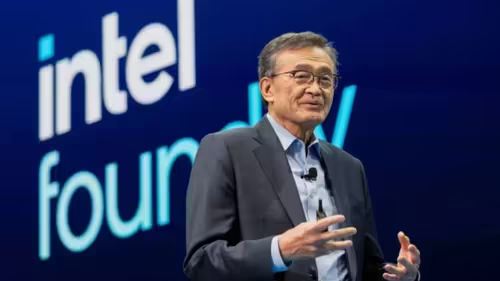
It was supposed to be Intel’s comeback story. With billions in U.S. government subsidies, a new CEO at the helm, and a rallying stock price, the legendary chipmaker appeared poised for a historic revival. But in a sobering update to investors, **Intel CEO Lip-Bu Tan** delivered what he himself called “disappointing” news: the company simply can’t keep up with customer demand.
This isn’t just a minor hiccup—it’s a major red flag for a company betting its future on regaining leadership in semiconductor manufacturing. The announcement comes alongside a significant quarterly loss and a bleak forecast for continued financial strain, casting doubt on whether Intel’s ambitious turnaround strategy can survive its own execution challenges.
Table of Contents
- CEO’s Candid Admission: ‘Not Able to Meet Demands’
- The Financial Fallout: Losses Mount Despite Optimism
- Root Causes: Supply Shortages and Yield Woes
- The $8.5 Billion Government Bet—and Rising Stakes
- Market Reaction: Stock Surge vs. Operational Reality
- Can Intel’s Turnaround Survive These Execution Hurdles?
- Conclusion: A Pivotal Moment for the Chip Giant
- Sources
CEO’s Candid Admission: ‘Not Able to Meet Demands’
In a rare moment of executive transparency, newly appointed CEO **Lip-Bu Tan** told shareholders that Intel is “not able to meet demands”—a blunt acknowledgment that the company’s production capacity is falling short just as AI and data center markets are exploding .
This admission is especially jarring given the context. Intel has been aggressively marketing itself as America’s answer to TSMC and Samsung in advanced chip manufacturing. Yet, internal bottlenecks are preventing it from capitalizing on one of the strongest demand environments in tech history.
The Financial Fallout: Losses Mount Despite Optimism
The numbers don’t lie. Intel reported a substantial quarterly loss that missed analyst expectations. More concerning, the company projected further losses in the coming quarters—primarily due to the high costs of ramping up its new fabrication plants (fabs) in Arizona, Ohio, and Germany .
While revenue from its core businesses remains stable, the massive investments in manufacturing infrastructure are bleeding cash faster than anticipated. This creates a dangerous paradox: Intel needs scale to become profitable, but it can’t achieve scale because its fabs aren’t producing enough viable chips.
Root Causes: Supply Shortages and Yield Woes
Two interrelated problems are at the heart of Intel’s crisis:
- Supply Chain Constraints: Even with new facilities, Intel faces delays in securing critical equipment and materials needed for advanced-node production.
- Disappointing Fabrication Yields: Perhaps more damaging is the issue of low yields—the percentage of usable chips per wafer. Reports suggest Intel’s yields on its most advanced processes (like Intel 18A) are lagging behind competitors, meaning more waste and higher costs .
Low yields aren’t just a technical problem—they’re a strategic one. They delay product launches, erode customer trust, and inflate the cost per chip, making Intel less competitive in price-sensitive markets.
The $8.5 Billion Government Bet—and Rising Stakes
Intel’s struggles come at a time when the U.S. government has placed a massive bet on its success. Under the CHIPS and Science Act, Intel is set to receive up to $8.5 billion in direct grants, plus tens of billions more in loans and tax credits .
This federal support was predicated on Intel becoming a reliable, high-volume domestic supplier of cutting-edge semiconductors. If the company continues to miss production targets, it risks not only investor confidence but also political goodwill. The stakes extend beyond Wall Street—they touch national security and economic sovereignty.
Market Reaction: Stock Surge vs. Operational Reality
Ironically, Intel’s stock has seen notable surges in recent months, partly fueled by optimism around its new leadership and AI-focused roadmap. However, this market enthusiasm appears increasingly disconnected from operational reality.
Investors may be betting on long-term potential, but Tan’s latest comments signal that the road to recovery will be longer and rockier than hoped. As one analyst noted, “You can’t fund a turnaround on hope alone—you need working factories and satisfied customers.” For more on how semiconductor stocks are reacting to supply chain shifts, see our analysis on [INTERNAL_LINK:semiconductor-market-trends-2026].
Can Intel’s Turnaround Survive These Execution Hurdles?
Lip-Bu Tan, a seasoned semiconductor veteran and former Cadence CEO, was brought in specifically to fix Intel’s manufacturing woes. His expertise is unquestioned—but even the best strategy fails without flawless execution.
The key questions now are:
- Can Intel improve its fabrication yields to industry-competitive levels within 12–18 months?
- Will major customers like Microsoft, Amazon, and NVIDIA continue to wait—or shift orders to TSMC?
- How will the company manage its cash burn while building out global capacity?
Failure on any of these fronts could force Intel to restructure its entire foundry business model, potentially scaling back its “IDM 2.0” vision.
Conclusion: A Pivotal Moment for the Chip Giant
The **Intel CEO disappointing news** isn’t just a quarterly blip—it’s a warning sign for one of America’s most iconic tech companies. While government backing and market optimism provide breathing room, they won’t solve the core problem: Intel must start producing high-quality chips at scale, and fast.
For shareholders, employees, and U.S. policymakers alike, the next six months will be critical. The world is watching to see if Intel can turn its promise into performance—or if this latest stumble marks the beginning of a deeper unraveling.
Sources
- Times of India: Intel CEO gives shareholders ‘disappointing’ news
- U.S. Department of Commerce: CHIPS Program Office – Intel Award Announcement