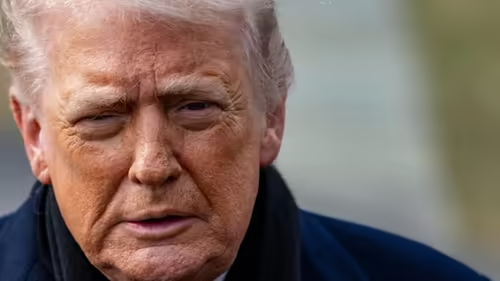
Trump Dismisses Using Insurrection Act in Minnesota—But the Law Itself Raises Big Questions
In a recent statement that drew national attention, former President Donald Trump said there’s “no reason right now” to invoke the Insurrection Act in response to protests in Minnesota . On the surface, it sounds like a measured take. But given Trump’s past rhetoric—and his infamous 2020 threat to deploy active-duty troops to “dominate the streets”—his comments have reignited a fierce debate about one of America’s most powerful yet rarely used legal tools.
So, what exactly is the Insurrection Act? Why does it matter today? And should Americans be worried when politicians—even former ones—talk about it?
Table of Contents
- What Is the Insurrection Act? A 217-Year-Old Law Explained
- Trump’s Minnesota Comments: Context and Controversy
- When Has the Insurrection Act Been Used Before?
- Legal Safeguards and Limitations
- Why the Insurrection Act Matters in Today’s Political Climate
- Conclusion: A Tool of Last Resort—or a Threat to Democracy?
What Is the Insurrection Act? A 217-Year-Old Law Explained
Enacted in 1807 under President Thomas Jefferson, the Insurrection Act is a federal law that allows the U.S. president to deploy the military domestically to suppress civil disorder, insurrection, or rebellion—without the consent of a state’s governor [[External Link: https://www.law.cornell.edu/uscode/text/10/subtitle-A/part-I/chapter-13]].
This is a major exception to the Posse Comitatus Act of 1878, which generally prohibits the use of federal military personnel for law enforcement within the United States. The Insurrection Act essentially carves out a constitutional emergency lane for military intervention when civilian authorities are overwhelmed.
Key triggers include:
- An insurrection against U.S. authority,
- A state government unable to protect constitutional rights,
- Or a situation where public order has completely broken down.
Trump’s Minnesota Comments: Context and Controversy
Trump’s latest remarks come amid renewed protests in Minnesota following a local incident involving police use of force. While current President Joe Biden and Minnesota Governor Tim Walz have opted for state-level National Guard deployment (which requires gubernatorial approval), Trump was asked whether he’d consider invoking the Insurrection Act if he were still in office.
He responded: “No reason right now… but if things got out of hand, you’d have to look at it” . This conditional phrasing—“if things got out of hand”—echoes his 2020 stance during the George Floyd protests, when he threatened to use the Act after clashes in Washington, D.C., and called governors “weak” for not “dominating” their streets .
When Has the Insurrection Act Been Used Before?
Despite its age, the Act has been invoked fewer than 20 times in U.S. history. Notable examples include:
- 1957 – Little Rock Nine: President Eisenhower sent the 101st Airborne to enforce school desegregation in Arkansas after the governor blocked Black students.
- 1962 – University of Mississippi: JFK deployed troops to quell riots over James Meredith’s enrollment.
- 1992 – Los Angeles Riots: George H.W. Bush invoked the Act after days of violence following the Rodney King verdict.
- 2020 – Potential Use: Trump considered it during nationwide protests but ultimately did not formally invoke it.
Each use was highly controversial but framed as necessary to uphold federal law or protect civil rights.
Legal Safeguards and Limitations
While the president has broad discretion, the Insurrection Act isn’t a blank check:
- It requires a formal presidential proclamation ordering insurgents to disperse before troops can be sent.
- Congress can terminate the deployment via a joint resolution (though this is politically difficult).
- Courts have rarely intervened, but legal scholars argue excessive or unjustified use could face judicial review.
For more on presidential emergency powers, see our explainer on [INTERNAL_LINK:presidential-emergency-powers-us].
Why the Insurrection Act Matters in Today’s Political Climate
In an era of deep polarization, election disputes, and rising political violence, the mere discussion of the Insurrection Act carries symbolic weight. Critics worry that normalizing its mention—even hypothetically—erodes trust in civilian governance.
Moreover, with the 2024 election approaching, concerns are growing about how such powers might be used—or abused—in a contested outcome. Legal experts at the Brennan Center for Justice warn that “the line between restoring order and enabling authoritarianism is thinner than many realize” [[External Link: https://www.brennancenter.org/]].
Conclusion: A Tool of Last Resort—or a Threat to Democracy?
The Insurrection Act exists for a reason: to preserve the Union in moments of existential crisis. But its power demands extreme caution. Trump’s dismissal of its use in Minnesota may seem reassuring, but his past flirtations with military deployment against American citizens underscore a broader tension in U.S. democracy—between security and liberty, order and protest, federal power and states’ rights. As protests continue and elections loom, understanding this law isn’t just academic; it’s essential for every citizen who values both safety and freedom.
Sources
- ‘Insurrection Act’: Trump dismisses ‘need’ for military use in Minnesota – Times of India
- Trump threatens to deploy military during 2020 protests – CNN
- Cornell Legal Information Institute – Insurrection Act: https://www.law.cornell.edu/uscode/text/10/subtitle-A/part-I/chapter-13
- Brennan Center for Justice – Emergency Powers and Democracy: https://www.brennancenter.org/