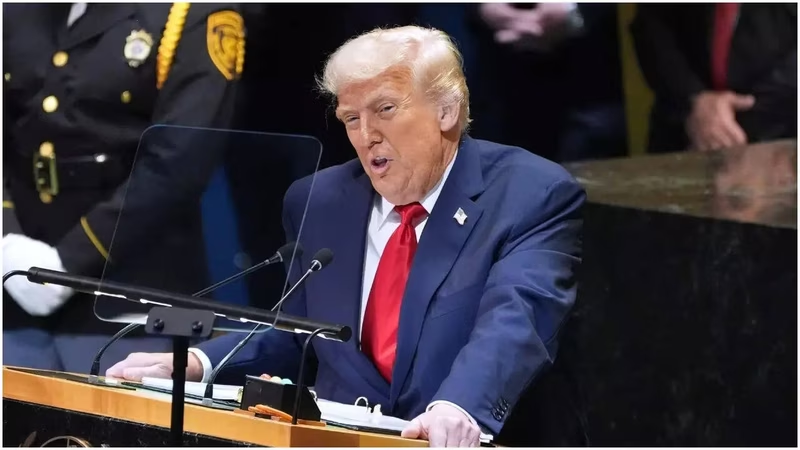
In a move that has sent shockwaves through legal and political circles, former President Donald Trump has publicly threatened to invoke the Insurrection Act to deploy active-duty U.S. military troops in Minnesota. The statement comes amid escalating protests over the fatal shooting of Renee Good, an unarmed Black woman, by a federal Immigration and Customs Enforcement (ICE) agent during a botched raid in St. Paul .
While Trump is not currently in office, his remarks—amplified across social media and conservative news outlets—have reignited urgent conversations about presidential power, civil liberties, and the thin line between public safety and martial law in America.
Table of Contents
- What Is the Insurrection Act?
- The Minnesota Crisis: What Sparked the Unrest?
- Insurrection Act: Trump’s Threat and Its Legal Implications
- Historical Precedents: When Has It Been Used?
- Public and Expert Reactions to Trump’s Statement
- Why This Matters for American Democracy
- Conclusion: A Warning Bell for Civil Liberties
- Sources
What Is the Insurrection Act?
Enacted in 1807 and codified under 10 U.S. Code § 251–255, the Insurrection Act is a federal law that allows the President of the United States to deploy the U.S. military and federalized National Guard within the country to suppress rebellion, domestic violence, or insurrection that hinders the execution of state or federal law .
Crucially, it overrides the Posse Comitatus Act of 1878, which generally prohibits the use of federal military personnel for domestic law enforcement. The Insurrection Act is one of the few legal exceptions to this long-standing principle.
The Minnesota Crisis: What Sparked the Unrest?
Tensions erupted after ICE agents conducted a pre-dawn raid at a St. Paul residence linked to an immigration case. According to witnesses, 42-year-old Renee Good—who was not the target—approached the door to ask questions when agents opened fire, striking her multiple times. She died at the scene .
The incident triggered days of protests, with demonstrators demanding accountability, transparency, and an end to aggressive ICE tactics. Clashes between protesters and local police have intensified, with reports of property damage and arrests. In this volatile climate, Trump’s call for military intervention has been seen by many as inflammatory—and by others as a necessary show of strength.
Insurrection Act: Trump’s Threat and Its Legal Implications
Although Trump made the statement as a private citizen, it carries significant weight given his status as the presumptive 2026 Republican presidential nominee. His exact words, posted on Truth Social, read: “If I were President, I’d invoke the Insurrection Act and send in the military to restore order immediately.”
Legally, invoking the Act requires specific conditions:
- A state government must request federal assistance (unless the president determines that unlawful obstructions make it impossible to enforce federal law).
- The situation must involve “any insurrection, domestic violence, unlawful combination, or conspiracy” that deprives people of constitutional rights.
- Congress can terminate the deployment via a concurrent resolution.
Critics argue that current protests—while intense—do not meet the threshold for military intervention. “Peaceful assembly, even when it turns disruptive, is not insurrection,” said constitutional scholar Laurence Tribe [INTERNAL_LINK:us-emergency-powers-explained].
Historical Precedents: When Has It Been Used?
The Insurrection Act has been invoked sparingly but significantly:
- 1957 – Little Rock, Arkansas: President Eisenhower deployed the 101st Airborne to enforce school desegregation.
- 1962 – University of Mississippi: JFK used it to quell riots over James Meredith’s enrollment.
- 1992 – Los Angeles: George H.W. Bush invoked it during the Rodney King riots.
- 2020 – Washington D.C.: Trump considered using it during George Floyd protests but faced strong pushback from Defense Secretary Mark Esper and military leaders.
Each use remains deeply controversial, often viewed through the lens of race, federalism, and civil rights.
Public and Expert Reactions to Trump’s Statement
Reactions have been sharply divided:
- Civil rights groups like the ACLU called the threat “dangerous and undemocratic.”
- Legal scholars warned it could normalize military policing of dissent.
- Supporters argue that “law and order” justifies extraordinary measures in chaotic situations.
Minnesota Governor Tim Walz stated, “Our state police and National Guard are fully capable. We do not need federal troops turning our streets into a battlefield.”
Why This Matters for American Democracy
Beyond the immediate crisis, Trump’s rhetoric raises fundamental questions: Should the military ever be used to manage civil protest? Who defines “insurrection”? And how do we balance security with the right to dissent?
In an election year, such statements aren’t just policy—they’re political signals. They test the boundaries of executive power and force voters to confront what kind of leadership they want in times of crisis.
Conclusion: A Warning Bell for Civil Liberties
The Insurrection Act exists for extreme emergencies—not political theater. While Minnesota grapples with legitimate grief and anger over a tragic death, the solution lies in transparent investigations, community dialogue, and accountable governance—not tanks on Main Street. As history shows, once the military steps onto domestic soil, the path back to normalcy is never simple. And in a democracy, that line should be crossed only with the gravest caution—if at all.
Sources
- Times of India: ‘Insurrection Act’: Trump threatens to deploy military to quash anti-ICE stirs
- Cornell Law School – Legal Information Institute: Text of the Insurrection Act – 10 U.S. Code §§ 251–255
- ACLU: Military Use in Domestic Law Enforcement – ACLU
- U.S. Department of Justice: Federal Response to Civil Unrest Guidelines