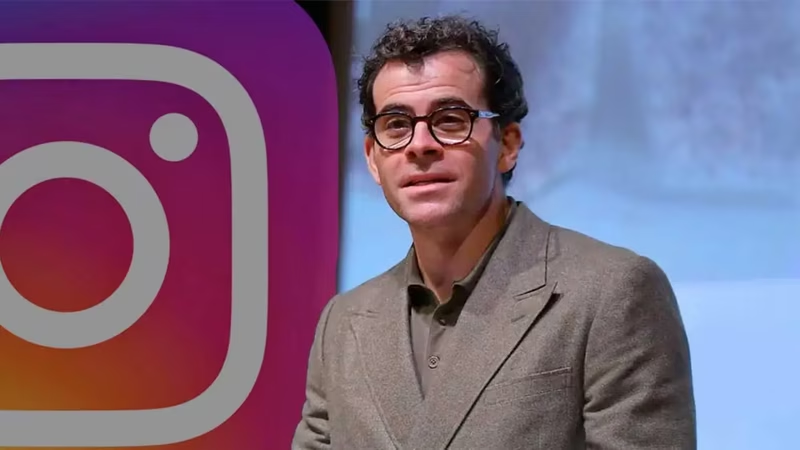
Forget the perfectly curated grids and the overly filtered sunsets. Instagram, the platform that once defined digital aesthetics, is sounding the alarm. Its chief, Adam Mosseri, has made a startling admission: in the race against AI, Instagram AI authenticity is losing—and fast .
Mosseri’s candid message isn’t just a corporate mea culpa; it’s a desperate plea for a return to genuine human connection before AI-generated content completely blurs the line between reality and fiction. He’s calling on users to get “raw,” and on the tech world to build a better system for verifying truth online.
Table of Contents
- The CEO’s Stark Warning on Instagram AI Authenticity
- Why Meta is Losing the AI Detection Arms Race
- The Plea for “Raw” Content: A New Era of Instagram
- A Bold Solution: Camera Manufacturers to the Rescue?
- What This Means for You, The Instagram User
- Conclusion: The Future of Trust on Instagram
- Sources
The CEO’s Stark Warning on Instagram AI Authenticity
Adam Mosseri didn’t mince words. In a recent statement that has sent ripples through the digital world, he declared that the platform is “failing to” adapt quickly enough to the seismic shifts driven by artificial intelligence . His core concern? The impending deluge of synthetic content—images and videos created by AI that are virtually indistinguishable from reality.
“The world is changing more quickly than we are,” Mosseri admitted, highlighting a vulnerability at the heart of a company that prides itself on being at the cutting edge of tech . He went so far as to advise users to be deeply skeptical of any image they see on the internet, underscoring the profound threat AI poses to our shared understanding of truth . This isn’t just about fake celebrity photos; it’s about the erosion of a foundational trust that social media platforms rely on to function.
Why Meta is Losing the AI Detection Arms Race
Perhaps the most revealing part of Mosseri’s admission was his candid assessment of Meta’s own capabilities. He openly conceded that the company is struggling to build technology that can reliably detect AI-generated images at scale . This is a significant problem. While Meta has announced efforts to identify AI content from other platforms , and plans for a new image and video AI model in 2026 , the reality is that these systems are playing catch-up against an ever-evolving field of generative AI.
The challenge is immense. AI models are becoming more sophisticated by the day, and the sheer volume of content uploaded to Instagram makes real-time, accurate detection a monumental technical task. Internal reports suggest even Meta’s own advanced AI projects, like its Llama series, have faced significant technical hurdles . This gap between the speed of AI creation and the speed of AI detection is the core of the crisis Mosseri is describing.
The Plea for “Raw” Content: A New Era of Instagram
In the face of this technological uncertainty, Mosseri is advocating for a cultural shift. He declared the era of the hyper-polished, meticulously curated Instagram feed to be effectively over . In its place, he champions “raw” and unproduced content as the new gold standard for authenticity.
Why? Because in a world where a perfect, AI-generated image can be created in seconds, the true signal of a real human experience is its imperfection. The shaky video, the unfiltered photo, the candid moment—these are now the markers of genuineness that users can actually trust. This shift represents a direct response to the AI threat, a way for users to reclaim a sense of reality on the platform. It’s a move that could redefine what “successful” content looks like on Instagram, favoring genuine connection over artificial perfection .
A Bold Solution: Camera Manufacturers to the Rescue?
Mosseri didn’t just stop at asking users to change their behavior. He pointed to a potential long-term, systemic fix: a call to action for camera and smartphone manufacturers. His proposal is for these companies to cryptographically sign every photo and video at the moment of capture, creating a tamper-proof “chain of custody” that proves an image is real and unaltered .
This idea is based on emerging technical standards like the Coalition for Content Provenance and Authenticity (C2PA), which provides a framework for such digital signatures . Some companies, like Sony and Leica, have already started embedding this technology into their high-end cameras [[11], [14]]. Mosseri’s “raw” request is for this technology to become a universal standard, integrated into every smartphone on the planet. If implemented, this would give platforms like Instagram a reliable way to verify the authenticity of a photo, instantly separating real media from AI-generated fakes.
What This Means for You, The Instagram User
This isn’t just a problem for Meta’s engineers; it affects every single person who uses the platform.
- Be a Critical Consumer: Mosseri’s advice is clear: trust your eyes less. Question the images you see, especially those that seem too perfect or unbelievable. The burden of skepticism is now on the user .
- Embrace Your Imperfections: For creators, the message is to lean into your humanity. Share the behind-the-scenes, the unfiltered moments, and the genuine stories. This “raw” content is your best defense against the sea of AI sameness and is likely to be favored by an audience craving realness .
- Stay Informed on Tech: Keep an eye on your phone’s camera settings. In the future, you might see options related to content credentials or provenance. Understanding these features will be key to verifying your own content’s authenticity.
Conclusion: The Future of Trust on Instagram
Adam Mosseri’s warning is a watershed moment. It’s an acknowledgment from the very top that the tools and norms that have governed social media for over a decade are being fundamentally upended by AI. The path forward is two-pronged: a cultural embrace of raw, human-centric content from its users, and a technological overhaul driven by the entire hardware ecosystem. The future of Instagram AI authenticity hinges on whether these two forces can align in time to rebuild a foundation of trust. The polished feed is dead; long live the authentic, imperfect, and real. For more on how other platforms are handling this crisis, check out our deep dive on [INTERNAL_LINK:ai_on_social_media].
Sources
- Times of India: CEO Adam Mosseri ‘admits’ as the world changes more quickly, Instagram is failing to
- Digital Information World: Instagram’s Adam Mosseri Says AI Will Broaden Creativity but Demands Caution
- The Verge: Instagram’s Adam Mosseri urges critical thinking in the AI era
- Coalition for Content Provenance and Authenticity (C2PA): Official Website
- Meta Newsroom: Meta working on technology to detect AI images