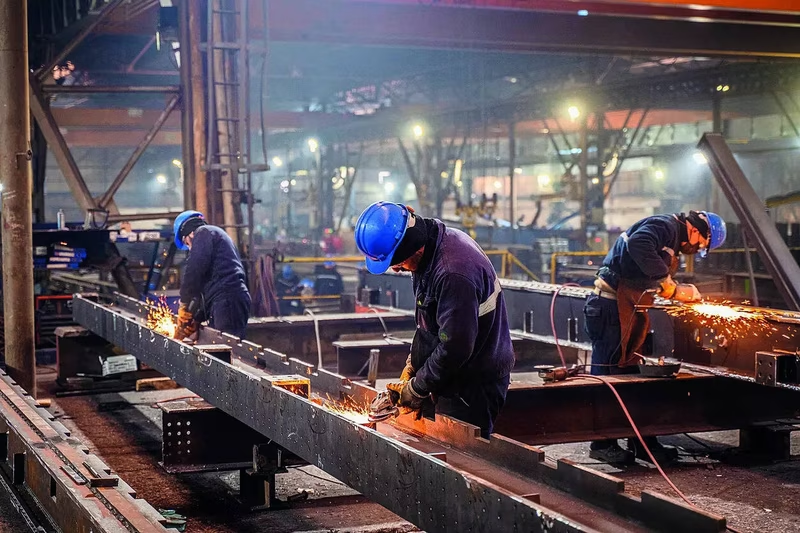
India’s economic engine is showing signs of a powerful comeback. According to the latest data released by the Ministry of Statistics and Programme Implementation (MoSPI), the Index of Industrial Production (IIP) surged by **6.7% in November 2025**—marking its highest growth rate in over two years .
This impressive rebound in industrial output growth isn’t just a number. It’s a signal that factories are humming, mines are active, and consumers are spending—with both durables like refrigerators and non-durables like food products flying off shelves. Even more encouraging? Capital goods output remains strong, hinting that businesses aren’t just surviving—they’re investing for the future.
After months of cautious optimism, this data could be the confirmation investors and policymakers have been waiting for: India’s domestic-led recovery is gaining real traction.
Table of Contents
- Breaking Down the November IIP Data
- Industrial Output Growth by Sector: Who’s Leading the Charge?
- What This Means for Consumption and Investment
- Is This Sustainable—or Just a Temporary Spike?
- Implications for RBI Policy and Financial Markets
- Sources
Breaking Down the November IIP Data
The IIP is a key short-term indicator of industrial activity in India, tracking output across mining, manufacturing, and electricity. November’s 6.7% year-on-year increase is the strongest since October 2023—when growth stood at 6.8% .
To put this in perspective:
- October 2025 growth: 4.2%
- September 2025 growth: 3.9%
- November 2024 growth: 2.1%
The acceleration is both sharp and broad-based. Unlike previous months—where gains were often concentrated in one segment—November saw synchronized expansion across nearly all categories, suggesting a genuine upswing in economic activity.
Industrial Output Growth by Sector: Who’s Leading the Charge?
Three key sectors powered this resurgence:
1. Manufacturing (Up 7.1%)
Manufacturing, which accounts for nearly 78% of the IIP basket, delivered its best performance in over two years. Sub-sectors like pharmaceuticals, motor vehicles, and food products posted double-digit gains. Analysts attribute this to festive demand, inventory restocking, and improved supply chains .
2. Mining (Up 5.8%)
Mining activity rebounded strongly after a sluggish monsoon season. Coal and crude oil production picked up, supported by government infrastructure projects and rising power demand during winter.
3. Electricity (Up 6.0%)
Robust electricity generation reflects higher industrial and household consumption—another positive sign for overall economic health.
What This Means for Consumption and Investment
Perhaps the most telling detail lies in the consumer and capital goods data:
- Consumer Durables: Up 9.3% — indicating strong demand for items like TVs, washing machines, and two-wheelers.
- Consumer Non-Durables: Up 6.5% — covering essentials like food, clothing, and toiletries, pointing to broad-based rural and urban spending.
- Capital Goods: Up 8.2% — a critical proxy for investment. When businesses buy machinery and equipment, they’re betting on future growth.
This trifecta—rising consumption, healthy investment, and strong manufacturing—creates a virtuous cycle that can sustain GDP growth well into 2026.
[INTERNAL_LINK:india-gdp-forecast-2026] “This isn’t just a festive blip,” says Dr. Priya Mehta, Chief Economist at Mumbai-based IndEcon Advisors. “The breadth of the recovery suggests pent-up demand has turned into real, sustained spending.”
Is This Sustainable—or Just a Temporary Spike?
While the data is encouraging, experts urge caution. A few factors could test the momentum:
- Global Slowdown: Weak demand in Europe and the U.S. could impact India’s export-oriented industries.
- Monsoon Variability: Rural consumption—still tied to agricultural income—remains vulnerable to erratic rainfall patterns.
- Input Costs: Rising crude oil prices could squeeze margins and fuel inflation, forcing the RBI to stay hawkish.
That said, India’s domestic consumption base is now large enough to absorb external shocks better than in the past. With urban employment rising and government capex continuing (think roads, railways, and defense), the foundation appears solid.
Implications for RBI Policy and Financial Markets
The strong industrial output growth complicates the Reserve Bank of India’s (RBI) next move. On one hand, robust activity supports a pause in rate cuts. On the other, softening core inflation could still allow a 25-basis-point cut in early 2026 .
Markets reacted positively to the data, with the Sensex closing 1.2% higher on the day of the announcement. Sectors like autos, capital goods, and FMCG are expected to benefit most from this trend.
For investors, the takeaway is clear: India’s economic story is shifting from “potential” to “performance.”
Conclusion
November’s 6.7% industrial output growth is more than a statistical rebound—it’s evidence that India’s economic engine is firing on multiple cylinders. From kitchen appliances to factory machinery, demand is rising across the board. While global headwinds remain, the strength of domestic consumption and investment offers a powerful buffer. If this momentum holds, 2026 could be the year India cements its status as the world’s fastest-growing major economy.