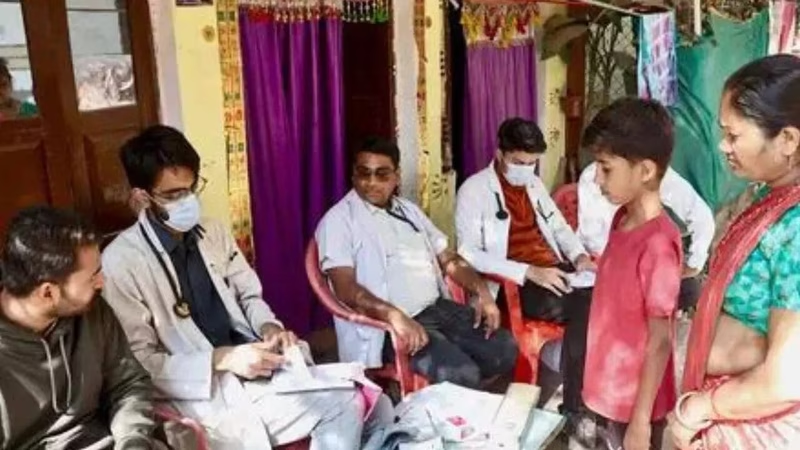
In a devastating blow to public trust in civic infrastructure, the city of Indore—often hailed as India’s ‘cleanest city’—is now at the center of a harrowing public health disaster. The Indore water tragedy in Bhagirathpura has claimed the lives of 10 residents, all suspected to have died from consuming drinking water contaminated with raw sewage. And the alleged source? A police outpost toilet built without a proper septic tank, allowing human waste to seep directly into the groundwater and, ultimately, the community’s water supply.
Table of Contents
- The Tragedy: How Did It Happen?
- Indore Water Tragedy: The Police Loo Link
- Public Outrage and Demands for Justice
- Systemic Failures in Urban Infrastructure
- What Must Change to Prevent Future Catastrophes?
- Conclusion: A Blemish on Indore’s ‘Clean City’ Image
- Sources
The Tragedy: How Did It Happen?
The nightmare in Bhagirathpura unfolded over several days, as residents began falling violently ill with symptoms of severe gastroenteritis—vomiting, diarrhea, and high fever. Within a short span, 10 people, including elderly citizens and at least one child, succumbed to the illness .
Preliminary medical reports confirmed the presence of dangerous bacterial contamination in their systems, consistent with exposure to fecal matter in drinking water. Water samples from local hand pumps and pipelines tested positive for coliform bacteria, a definitive marker of sewage pollution .
As panic spread, locals began tracing the contamination source—and their investigation led them to a nearby police outpost.
Indore Water Tragedy: The Police Loo Link
According to local residents and initial engineering assessments, the toilet at the police outpost was constructed without a septic tank—a basic and mandatory requirement under the National Building Code of India . Instead, waste was being discharged directly into the soil through an open drain or soak pit, located dangerously close to the underground drinking water pipeline.
Over time, especially during recent rains or high groundwater levels, this untreated sewage infiltrated the water supply, turning a basic necessity into a deadly toxin. “It’s not a natural disaster—it’s murder by negligence,” said a grieving family member, echoing the sentiment of many in the community .
The fact that a government facility—meant to uphold law and order—became the epicenter of this man-made disaster has only deepened public anger and sense of betrayal.
Public Outrage and Demands for Justice
The community’s grief has quickly turned into fury. Residents of Bhagirathpura are now demanding that authorities file charges of culpable homicide not amounting to murder (Section 304 of the Indian Penal Code) against those responsible for the faulty construction and oversight.
“They knew the rules. They cut corners. And now our loved ones are dead,” shouted protesters during a demonstration outside the Indore Municipal Corporation (IMC) office .
Local leaders and civil society groups have joined the outcry, calling for immediate suspension of involved officials, including those from the public works department and the police housing authority. An independent judicial inquiry has also been demanded to ensure transparency and prevent a whitewash.
Systemic Failures in Urban Infrastructure
While the Indore water tragedy is shocking in its specifics, it is not an isolated case. It reflects a broader, systemic failure in India’s urban infrastructure development:
- Poor Enforcement: Building codes exist on paper, but inspections are often lax or corrupt.
- Siloed Governance: Water supply, sanitation, and construction are managed by different departments, leading to accountability gaps.
- Rapid Urbanization: Cities expand faster than infrastructure can keep up, resulting in ad-hoc, unsafe constructions .
Even Indore, which has won the Swachh Survekshan award multiple times, appears to have a stark gap between its public image and on-the-ground realities in peripheral areas like Bhagirathpura.
What Must Change to Prevent Future Catastrophes?
To prevent another Indore water tragedy, experts recommend the following urgent measures:
- Mandatory Third-Party Audits: All government construction projects must undergo independent engineering and environmental safety reviews.
- Real-Time Water Quality Monitoring: Install IoT-enabled sensors in municipal pipelines to detect contamination instantly [INTERNAL_LINK:smart-water-monitoring-india].
- Whistleblower Protection: Empower citizens and frontline workers to report violations without fear of retaliation.
- Strict Liability Laws: Introduce legal frameworks that hold contractors and approving officers personally liable for public harm caused by negligence.
Conclusion: A Blemish on Indore’s ‘Clean City’ Image
The Indore water tragedy is more than a local news story—it’s a national wake-up call. It exposes the dangerous illusion that awards and rankings can substitute for genuine, equitable, and safe urban planning. Behind the glossy brochures of ‘smart cities’ and ‘clean campaigns’ lie vulnerable communities whose lives are put at risk by corner-cutting and apathy. The 10 lives lost in Bhagirathpura must not be in vain. They must become the catalyst for a zero-tolerance policy on infrastructure negligence across India.
Sources
- ‘Negligence in toilet construction’: How police outpost loo leak caused Indore water tragedy. Times of India. https://timesofindia.indiatimes.com/…
- Water testing confirms fecal contamination in Bhagirathpura. The Hindu.
- National Building Code of India – Plumbing and Sanitation Guidelines. Bureau of Indian Standards (BIS). https://www.bis.gov.in/
- Bhagirathpura residents demand criminal case. Nai Dunia (Indore). [INTERNAL_LINK:indore-local-news]
- Urban Infrastructure Challenges in India. World Bank Report. https://www.worldbank.org/