In what is now being called the Indore water crisis, a devastating public health emergency has gripped the city, leaving a trail of grief, anger, and a fierce political firestorm. The death toll from contaminated water in the Bhagirathpura area has climbed to at least 10, with hundreds more hospitalized, and the blame game has reached a fever pitch.
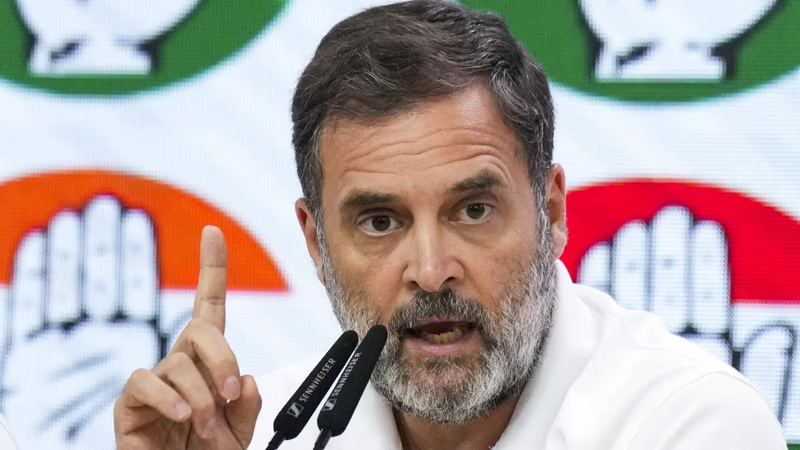
Congress leader Rahul Gandhi has seized the moment, delivering a blistering critique of the ruling BJP government in Madhya Pradesh. His words were stark: the administration wasn’t just negligent; it was actively distributing “poison,” not water, to its own people .
Table of Contents
- The Crisis Unfolds: From Complaints to Tragedy
- Rahul Gandhi’s Scathing Attack on the ‘Double-Engine’ Govt
- What’s Behind the Indore Water Crisis?
- Government Response and Public Anger
- Conclusion: A Crisis of Governance
- Sources
The Crisis Unfolds: From Complaints to Tragedy
The Indore water crisis began as a series of local complaints in the Bhagirathpura locality. Residents reported foul-smelling and discolored water coming from their taps, a common but often ignored issue in many urban pockets. However, this time, the consequences were catastrophic.
A rapid outbreak of severe diarrhoea and vomiting swept through the community. Hospitals were quickly overwhelmed. As of January 2, 2026, the official death toll stands at 10, with over 200 patients still receiving treatment across 27 different hospitals [[2], [6]]. Locals, distrustful of the official figures, claim the number of fatalities is even higher .
Laboratory tests have since confirmed the worst: 26 out of 50 water samples from the area tested positive for dangerous bacterial contamination . The source? A critical failure in the city’s aging infrastructure.
Rahul Gandhi’s Scathing Attack on the ‘Double-Engine’ Govt
In his most direct and forceful statement on the issue, Rahul Gandhi did not mince words. He labeled Indore the “epicentre of misgovernance” and took a pointed jab at the BJP’s much-touted “double-engine government”—a term used to describe the party’s control of both the central and state governments.
“In Indore, not water but poison was distributed, and the administration remained in deep sleep,” Gandhi declared on social media . He went on to make a fundamental argument that cuts to the heart of the issue: “Clean water isn’t a favour; it’s a right to life” . This statement reframes the crisis not as an unfortunate accident, but as a gross violation of a basic human right by a negligent state.
His “Kumbhakarna” dig—a reference to the mythical figure known for his long, deep sleep—was a clear allegory for what he sees as the government’s willful ignorance and inaction in the face of a preventable disaster.
What’s Behind the Indore Water Crisis?
The immediate technical cause appears to be a breach in the drinking water supply pipeline. Officials have confirmed that a leak was found in the main pipeline near a police outpost in Bhagirathpura. Crucially, this leak occurred at a spot where a toilet had been built directly over the water line, creating a direct pathway for sewage to infiltrate the potable water supply [[22], [27]].
This incident is not an isolated one. It points to systemic, long-standing failures in urban planning and infrastructure management. A 2017 study published on PubMed Central noted that “more than 20% of sewage waste is dumped untreated into Indore’s water supply,” highlighting a chronic problem with the city’s sanitation systems . Years of ignored complaints from residents about water quality and unsafe pipelines have now culminated in this tragedy .
This failure is a textbook example of what public health experts warn against: the deadly intersection of poor infrastructure, lax oversight, and bureaucratic apathy.
Key Factors in the Contamination
- Infrastructure Failure: A major leak in the main drinking water pipeline.
- Sewage Infiltration: The pipeline breach was located directly under a toilet, allowing raw sewage to mix with drinking water.
- Ignored Warnings: Local residents had reportedly filed multiple complaints about water quality prior to the crisis .
- Systemic Neglect: Broader issues with Indore’s water and sewage management systems have been documented for years .
Government Response and Public Anger
The Madhya Pradesh government, led by Chief Minister Mohan Yadav, has scrambled to respond. The Deputy Chief Minister, Rajendra Shukla, stated that the situation is being “closely monitored” [[12], [14]]. The Chief Minister himself visited affected hospitals and announced measures including the replacement of damaged pipelines, free medical treatment for victims, and the promise of “strict action” based on an ongoing investigation [[18], [25]].
However, these assurances have done little to quell public outrage. The National Human Rights Commission (NHRC) has taken suo motu cognizance of the incident and has demanded a detailed report from the state government within two weeks, adding to the pressure .
Meanwhile, public trust in the water supply has evaporated. Locals are now terrified to use even the water from government tankers, fearing further contamination . This crisis has created a deep-seated fear that will be hard to overcome, regardless of immediate fixes.
Conclusion: A Crisis of Governance
The Indore water crisis is far more than a public health emergency; it is a stark and tragic indictment of governance failure. The loss of life is a direct result of a chain of events that began with ignored citizen complaints, moved through neglected infrastructure, and ended in a catastrophic, and entirely preventable, breach of the most basic civic duty: providing safe drinking water.
Rahul Gandhi’s framing of the issue as one of distributing “poison” may be politically charged, but it resonates because it captures the profound sense of betrayal felt by Indore’s residents. As the city grapples with its grief and the government with its accountability, this event serves as a chilling reminder for every urban center in the country of the deadly cost of turning a blind eye to civic infrastructure.
Sources
- Times of India: ‘Epicentre of misgovernance’: Rahul slams MP govt on Indore water issue
- FirstIndia: MP: Locals fear using tanker water after contaminated water incident in Indore’s Bhagirathpura
- PubMed Central: Sewage Pollution in Water Supply in Indore by A Tahir (2017)
- Various news reports on the death toll and official statements from January 1-2, 2026, as cited in the web search results [[1]-[27]].