Table of Contents
- Tragedy in India’s “Cleanest City”
- Chief Minister Mohan Yadav’s Sweeping Actions
- What Went Wrong: The Infrastructure Failure
- Health Risks and Symptoms of Contaminated Water
- The Road Ahead for Indore’s Water Security
- Conclusion: A City in Crisis and a Search for Answers
- Sources
Tragedy in India’s “Cleanest City”
The title of India’s “cleanest city” now carries a devastating irony for the residents of Indore. In late December 2025, a catastrophic case of Indore water contamination in the Bhagirathpura area unleashed a public health emergency. What began as isolated cases of illness rapidly escalated into a full-blown crisis, with over 1,400 people falling sick and, tragically, at least 11 lives lost .
This wasn’t just a minor lapse; it was a systemic failure that turned a basic necessity—clean drinking water—into a vector for disease and death. The crisis has sent shockwaves through the community, shattering the city’s carefully curated image and raising urgent questions about the state of its civic infrastructure .
Chief Minister Mohan Yadav’s Sweeping Actions
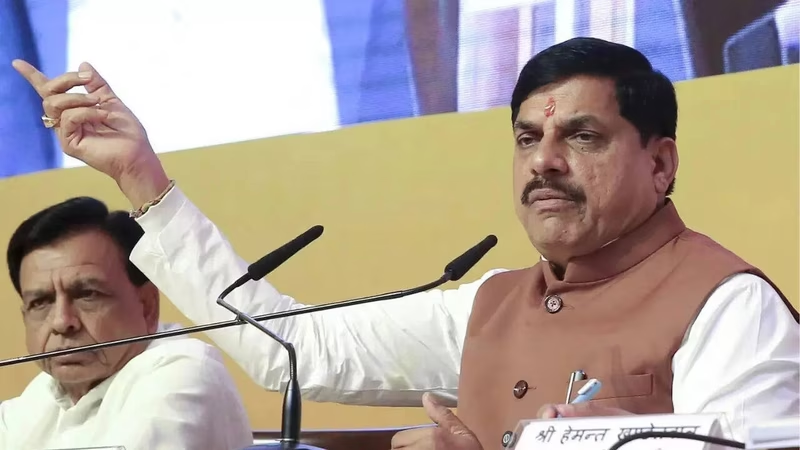
In direct response to the public outrage and the scale of the disaster, Madhya Pradesh Chief Minister Mohan Yadav has taken a hardline stance against those deemed responsible. His visit to Indore to meet with affected families in hospitals signaled a commitment to accountability .
CM Yadav’s orders were swift and severe:
- The removal of the Indore Municipal Commissioner from his post.
- The suspension of two senior civic officials, including the Additional Commissioner and the in-charge of the Bhagirathpura zone .
- A directive for immediate appointments to fill critical roles within the municipal corporation to manage the ongoing crisis .
This decisive action, coming under intense political and public pressure, aims to demonstrate that negligence at the highest levels of the civic administration will not be tolerated .
What Went Wrong: The Infrastructure Failure
The root cause of the contamination has been traced to a critical and alarming failure in the city’s water supply network. Investigations revealed that a leakage in the main water supply pipeline in Bhagirathpura allowed sewage and drainage water to infiltrate the potable water supply .
This deadly mix of untreated sewage with drinking water created the perfect breeding ground for waterborne pathogens, leading to the rapid outbreak of severe diarrhoea and vomiting among residents . Initial lab tests confirmed that a significant portion of water samples from the area were contaminated with harmful bacteria . This incident is not an isolated one but points to a deeper, chronic problem with the city’s aging and potentially under-maintained infrastructure .
Health Risks and Symptoms of Contaminated Water
The Indore water contamination outbreak serves as a stark reminder of the severe health consequences of consuming polluted water. The primary health effects are gastrointestinal, but the risks can be far more serious.
Residents affected by the crisis reported a range of symptoms, which are common indicators of waterborne illness :
- Severe and persistent diarrhoea
- Nausea and vomiting
- Stomach cramps and pain
- Flu-like symptoms, including fever
- Skin rashes or irritations from contact with contaminated water
For vulnerable populations like children, the elderly, and those with compromised immune systems, these symptoms can quickly become life-threatening, as tragically seen in Bhagirathpura. The World Health Organization provides extensive resources on the health risks of unsafe water and sanitation, underscoring the global nature of this challenge.
The Road Ahead for Indore’s Water Security
While the immediate punitive actions against officials are a necessary step, they are just the beginning. The long-term solution requires a comprehensive overhaul of Indore’s water management systems. This includes regular, rigorous testing of water quality, proactive maintenance of pipelines to prevent leaks, and a complete separation of sewage and potable water networks .
The crisis has also highlighted the need for greater transparency and a robust, rapid-response public health protocol for such emergencies. The Madhya Pradesh High Court has already stepped in, ordering free treatment for all affected individuals, which is a crucial measure for immediate relief . However, preventing a recurrence is the ultimate test of the government’s resolve. [INTERNAL_LINK:public-health-infrastructure-india] and [INTERNAL_LINK:water-safety-standards] will be key topics moving forward.
Conclusion: A City in Crisis and a Search for Answers
The Indore water contamination tragedy is a profound human disaster that has shaken a city known for its cleanliness. The swift action by CM Mohan Yadav to suspend and remove senior civic officials is a clear message about accountability. Yet, the real work lies ahead in rebuilding public trust and ensuring that such a catastrophic failure of basic civic duty never happens again. The families of Bhagirathpura, and indeed all citizens of Indore, deserve a water supply system that is not just functional, but fundamentally safe and reliable.
Sources
- Indore water contamination: CM Mohan Yadav suspends civic officials; orders removal of municipal commissioner. Times of India. https://timesofindia.indiatimes.com/india/…
- Stalled Contracts, Contamination: How 11 Died In Indore. The Quint. https://www.thequint.com/news/india/…
- Indore water contamination: MP HC orders free treatment, seeks status report. Hindustan Times. https://www.hindustantimes.com/cities/indore-news/…
- Water Contamination Symptoms: What to Watch Out For. Healthline. https://www.healthline.com/health/water-contamination-symptoms
- Water, sanitation, hygiene, and health. World Health Organization. https://www.who.int/health-topics/water-sanitation-and-health