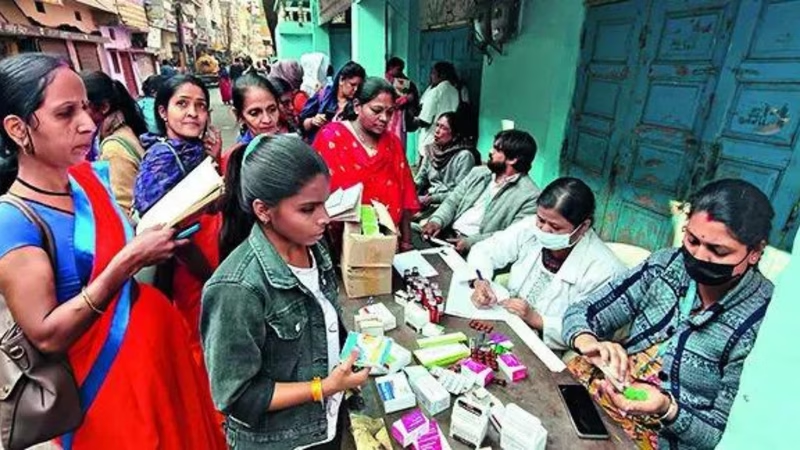
It’s a story that reads like a cruel irony. Indore, the city that has proudly held the ‘Swachh Survekshan’ title of India’s Cleanest City for a record eight consecutive years, is now grappling with a public health nightmare caused by its own tap water. In the Bhagirathpura locality, what should have been a safe, life-giving resource became a silent killer. At least seven residents have lost their lives, and a staggering 1,100 others have been hospitalized with severe diarrhoea and vomiting—all traced back to water straight from their kitchen taps . The municipal corporation has admitted to “lapses” in its water treatment process, leading to the immediate suspension of several officials . But for the grieving families of Bhagirathpura, apologies and suspensions are a hollow consolation. The real question on everyone’s mind is this: How could a city so obsessed with public cleanliness fail so catastrophically at its most fundamental duty—providing safe drinking water?
Table of Contents
- The Bhagirathpura Tragedy: A Timeline of Failure
- The ‘Cleanest City’ Paradox: Aesthetics vs. Essentials
- How Does Water Get Contaminated? The Science Behind the Crisis
- The Human Cost: Beyond the Statistics
- What Residents Can Do to Protect Themselves
- The Road Ahead for Indore and Indian Cities
- Summary: A Wake-Up Call for Urban India
- Sources
The Bhagirathpura Tragedy: A Timeline of Failure
The crisis in Bhagirathpura didn’t happen overnight. It was the result of a cascade of systemic failures:
- Early Warnings Ignored: Residents had been complaining for weeks about the foul smell and strange taste of their tap water. These warnings, a classic red flag for contamination, were reportedly dismissed by local authorities .
- Critical Oversight Lapse: The water for the area is supplied from the Kanh River. An official probe revealed that the crucial chlorination process at the treatment plant was not being monitored properly. In some reports, it was claimed that no chlorine had been added for several days, leaving the water vulnerable to bacterial infection .
- Rapid Spread, Slow Response: Once the outbreak began, the sheer number of cases—over 1,100 in a short span—overwhelmed local health facilities. The delayed official response allowed the crisis to spiral out of control before it was finally acknowledged .
The ‘Cleanest City’ Paradox: Aesthetics vs. Essentials
This tragedy exposes a dangerous flaw in how urban success is often measured in India. The ‘Swachh Survekshan’ survey, while well-intentioned, heavily emphasizes visible cleanliness—sweeping streets, public toilet availability, and waste collection. It pays far less attention to the invisible but critical infrastructure: water quality testing, sewage treatment, and pipeline maintenance. Indore mastered the art of the visible, winning accolades for its spotless roads and efficient garbage disposal. But, as this incident proves, a city can look immaculate on the outside while its core public health systems are rotting from within. The focus on a ‘clean’ image may have diverted resources and attention away from the unglamorous but vital task of ensuring every drop of water is safe to drink.
How Does Water Get Contaminated? The Science Behind the Crisis
Water contamination in urban settings like Indore typically occurs through a process called ‘back-siphonage’ or from a direct breach in the pipeline. When there’s a drop in water pressure in the main supply line, it can create a vacuum that sucks in contaminated groundwater or sewage from nearby leaking drains or septic tanks through cracks in the aging pipeline. Without adequate chlorination—a disinfectant that kills bacteria like E. coli and Salmonella—the contaminated water flows directly into homes. According to the World Health Organization (WHO), safe drinking water should be free from any form of microbial contamination, a standard that was clearly violated in this case .
The Human Cost: Beyond the Statistics
Behind the grim numbers are real human stories of loss and suffering. Families have lost elderly relatives and young children to a disease that is entirely preventable with safe water. The financial burden of hospitalization has pushed many into debt. The psychological trauma of not being able to trust the water from their own taps has created a climate of fear and suspicion. This is not just a failure of engineering; it’s a profound betrayal of public trust.
What Residents Can Do to Protect Themselves
While the onus is entirely on the civic body to provide safe water, residents can take some precautionary measures in the immediate aftermath of such a crisis:
- Boil All Water: Boil water for at least one minute before using it for drinking or cooking.
- Use Certified Filters: Install a water purifier with a UF (Ultrafiltration) or RO (Reverse Osmosis) membrane, which can effectively remove bacteria and other pathogens. [INTERNAL_LINK:best-water-purifiers-for-bacteria] can guide your choice.
- Stay Informed: Demand regular, transparent water quality reports from your local municipal corporation.
The Road Ahead for Indore and Indian Cities
The path to redemption for Indore must begin with a complete overhaul of its water management system. This includes replacing old pipelines, implementing 24/7 online water quality monitoring, and establishing an independent grievance redressal cell for water complaints. More importantly, this incident must serve as a national wake-up call. Urban development policies must shift from celebrating superficial cleanliness to investing in and rigorously auditing the health of essential services. The ‘Cleanest City’ title should be redefined to include stringent, verifiable metrics for water and air quality, not just the absence of litter.
Summary: A Wake-Up Call for Urban India
The Indore water contamination crisis is a devastating reminder that a city’s true cleanliness is measured not by the shine on its streets, but by the safety of the water in its taps. The deaths in Bhagirathpura are a direct result of a system that prioritized a trophy over the trust of its citizens. For Indore to reclaim its reputation, it must move beyond photo-ops and perform a deep, honest cleanse of its civic governance. For the rest of urban India, it’s a stark lesson: without safe water, no amount of sweeping can make a city truly clean.
Sources
- Times of India: Water contamination kills 7: Crowned cleanest city 8 times, Indore now faces tap-water crisis
- The Hindu: Seven dead, 1,100 ill in Indore water contamination case
- NDTV: Indore Water Poisoning: 7 Dead, Over 1000 Fall Ill
- World Health Organization (WHO): Water Quality and Health Guidelines
- Swachh Bharat Mission: Official Swachh Survekshan Framework