Indore Water Contamination: A Preventable Tragedy Unfolds
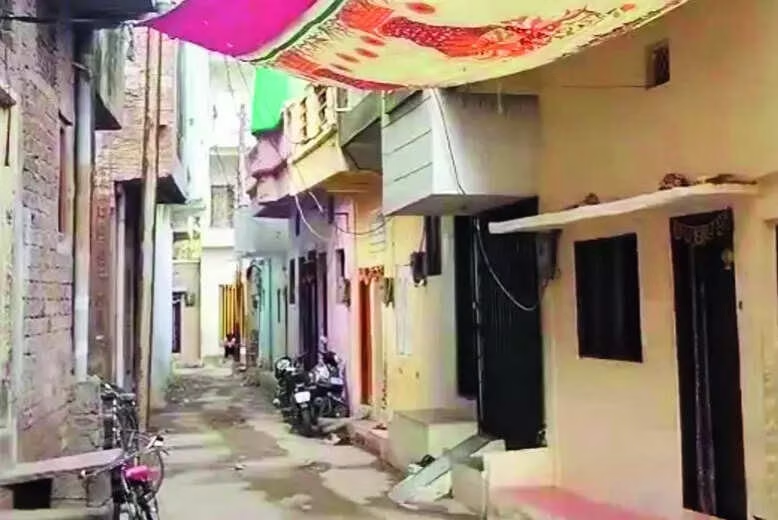
In the quiet lanes of Bhagirathpura, a neighborhood in Indore, Madhya Pradesh, silence has replaced the usual bustle of daily life. But it’s not peaceful—it’s the deathly hush of grief. As of January 2026, Indore water contamination has claimed nine lives, including a six-month-old infant, and sent more than 200 residents to hospitals with severe diarrhoea and dehydration.
The cause? Shockingly mundane—and entirely preventable. Investigators confirm that a leaking toilet waste pit, situated alarmingly close to a municipal drinking water pipeline, allowed raw sewage to seep into the water supply. For weeks, families unknowingly consumed water laced with deadly pathogens like E. coli, Vibrio cholerae, and rotavirus.
This isn’t just a local incident—it’s a national wake-up call about urban water safety in India’s fast-growing cities. Here’s what happened, how it could have been avoided, and what must change now.
Table of Contents
- The Bhagirathpura Outbreak: Timeline and Impact
- How Did the Water Get Contaminated?
- Heartbreaking Stories from the Ground
- Official Response: Too Little, Too Late?
- How to Prevent Future Water Contamination Crises
- Conclusion: Justice, Accountability, and Safe Water for All
- Sources
The Bhagirathpura Outbreak: Timeline and Impact
The first cases of acute diarrhoea were reported in late December 2025. By New Year’s Day, local clinics were overwhelmed. By January 2, 2026, the death toll had climbed to nine, with dozens in critical condition .
Key facts about the outbreak:
- 📍 Location: Bhagirathpura, Indore, Madhya Pradesh
- 💀 Deaths: 9 confirmed (including infants and elderly)
- 🏥 Hospitalizations: Over 200 residents treated
- 🦠 Pathogens suspected: E. coli, rotavirus, possibly cholera
- 💧 Source: Cross-contamination from septic tank to water main
Local doctors report symptoms appearing within 6–24 hours of consumption—violent vomiting, watery diarrhoea, and rapid dehydration, especially dangerous for children and seniors.
How Did the Water Get Contaminated?
According to a joint probe by the Indore Municipal Corporation (IMC) and state health officials, a private household’s septic tank developed a crack. This tank was located less than 3 feet from a pressurized municipal water pipeline. When water pressure dropped during routine maintenance, sewage backflowed into the drinking water line—a phenomenon known as ‘back-siphonage’ .
This violates basic public health engineering standards. The World Health Organization’s Guidelines for Drinking-water Quality explicitly require a minimum 10-foot separation between sewage and potable water lines, along with backflow prevention devices—none of which were present here.
Heartbreaking Stories from the Ground
Behind the numbers are real families shattered by loss. One of the most devastating cases involves a local schoolteacher who lost her six-month-old son after he developed severe dehydration from diarrhoea. “We gave him water from the tap—just like always,” she told reporters, her voice breaking. “We never imagined it would kill him” .
Another resident, Rajesh Verma, described taking his elderly father to three different hospitals before finding a bed. “They said his kidneys were failing. All because of the water we’ve been drinking for years,” he said.
These aren’t isolated incidents—they’re symptoms of a systemic failure.
Official Response: Too Little, Too Late?
The Indore Municipal Corporation has since shut off the contaminated line, distributed bottled water, and promised a full audit of all pipelines in Bhagirathpura. Officials have also announced compensation of ₹2 lakh to families of the deceased .
But residents are furious. “They knew about the cracked septic tank months ago,” alleged a local community leader. “Complaints were filed, but nothing was done.”
This raises serious questions about accountability. Indore has been repeatedly awarded “India’s Cleanest City” under the Swachh Bharat Mission—but cleanliness awards mean little if basic water safety is ignored.
How to Prevent Future Water Contamination Crises
This tragedy didn’t have to happen. Here are actionable steps cities like Indore must take immediately:
- Enforce separation distances: Mandate minimum 10-foot buffer between sewage and water lines, per WHO standards.
- Install backflow preventers: Require these devices at every household and municipal junction.
- Regular water testing: Conduct monthly microbiological tests in high-density neighborhoods.
- Transparent public alerts: Create SMS-based warning systems for contamination events.
- Community oversight: Train local “water safety volunteers” to report infrastructure risks.
[INTERNAL_LINK:india-urban-water-safety] For more on national water safety protocols, see our guide on urban infrastructure in Indian cities.
Conclusion: Justice, Accountability, and Safe Water for All
The Indore water contamination disaster is more than a public health failure—it’s a betrayal of public trust. When a city markets itself as “clean” while families drink sewage, something is deeply wrong. The nine lives lost in Bhagirathpura must not be in vain. Authorities must act swiftly to hold negligent parties accountable, overhaul aging water infrastructure, and ensure that safe drinking water—a basic human right—is never again compromised for political accolades or bureaucratic indifference.
Sources
Times of India. “Indore water contamination: Kin tending to ill, deathly silence in Bhagirathpura.” January 2, 2026. https://timesofindia.indiatimes.com/…
World Health Organization. “Guidelines for Drinking-water Quality, Fourth Edition.” 2017. https://www.who.int/…
Central Public Health and Environmental Engineering Organisation (CPHEEO). “Manual on Water Supply Systems in India.” Ministry of Housing and Urban Affairs.