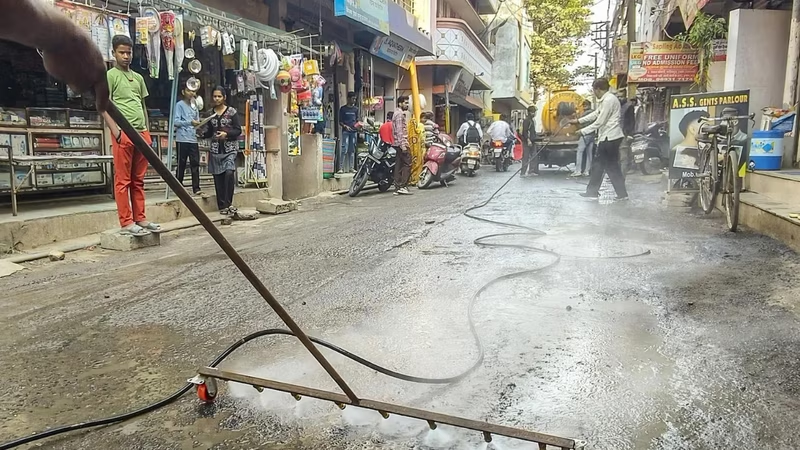
Indore Water Contamination: Lab Report Confirms Deadly Bacterial Breach
In a grim confirmation that has sent shockwaves through Madhya Pradesh, government laboratories have officially verified that the recent Indore water contamination was caused by bacterial pathogens in the city’s drinking supply. The contamination sparked a severe diarrhoea outbreak that has claimed four lives—including vulnerable children and elderly—and left more than 1,400 residents seeking emergency medical care .
The epicenter has been traced to Bhagirathpura, a densely populated neighborhood where a critical leak in the main water pipeline allowed raw sewage to infiltrate the potable water network. Despite Indore’s repeated accolades as “India’s Cleanest City,” this public health disaster exposes dangerous cracks in its urban infrastructure and regulatory oversight.
With families still reeling and hospitals overwhelmed, questions are mounting: How did this happen? Who is accountable? And could it happen again?
Table of Contents
- Outbreak Timeline and Human Impact
- Lab Findings Confirmed: What Bacteria Were Detected?
- How Sewage Entered the Drinking Water Supply
- Official Response: Compensation, Water Trucks, and Promises
- Why Did This Happen in India’s ‘Cleanest City’?
- How to Stay Safe During a Water Contamination Crisis
- Conclusion: Clean Awards Mean Nothing Without Safe Water
- Sources
Outbreak Timeline and Human Impact
The crisis unfolded rapidly in late December 2025:
- Dec 27–28: Surge in patients reporting acute watery diarrhoea, vomiting, and dehydration at local clinics.
- Dec 29: District hospital declares emergency; over 500 cases in 48 hours.
- Dec 30: First fatality reported—a 68-year-old man with diabetes.
- Jan 1, 2026: Death toll rises to 4; total affected crosses 1,400 .
- Jan 2: State health department confirms water contamination via lab report.
Most victims are from low-income households in Bhagirathpura, where access to private water purifiers is limited. “We drink directly from the tap,” said Ramesh Patel, whose two children were hospitalized. “We never thought it would poison us.”
Lab Findings Confirmed: What Bacteria Were Detected?
According to the Madhya Pradesh Public Health Laboratory, water samples from Bhagirathpura tested positive for high levels of fecal coliform bacteria—indicating recent sewage contamination . While the specific pathogen (e.g., E. coli, Shigella, or Vibrio cholerae) is still being identified via PCR testing, the presence of fecal matter confirms the water was unsafe for human consumption.
The World Health Organization (WHO) states that any detectable fecal coliform in drinking water constitutes a “serious health risk,” especially for children under five and the elderly .
How Sewage Entered the Drinking Water Supply
Initial investigations by the Indore Municipal Corporation (IMC) point to a corroded section of the main water pipeline running beneath a poorly maintained sewer line in Bhagirathpura. When water pressure dropped during routine maintenance on December 26, the compromised pipe created negative pressure—sucking sewage into the drinking water line through a crack, a phenomenon known as back-siphonage.
This violates fundamental public health engineering standards:
- Water and sewage lines must be separated by at least 3 meters (10 feet).
- Potable lines must maintain positive pressure at all times.
- Backflow prevention devices are mandatory in high-risk zones.
None of these safeguards appear to have been in place.
Official Response: Compensation, Water Trucks, and Promises
In damage-control mode, authorities have:
- Announced ₹2 lakh compensation to each deceased family.
- Deployed 50 water tankers with purified water to Bhagirathpura.
- Launched door-to-door ORS and medical camps.
- Promised a full pipeline audit across Indore within 30 days .
However, residents remain skeptical. “They give money after lives are lost,” said community leader Sunita Devi. “Why not check the pipes before?”
Why Did This Happen in India’s ‘Cleanest City’?
Indore has won the Swachh Bharat “Cleanest City” award six years in a row. But critics argue the ranking focuses heavily on waste collection and street cleanliness—not on invisible, life-threatening issues like water quality.
“You can sweep streets while your water supply rots underground,” said urban policy expert Dr. Anjali Rao. “This tragedy reveals the limits of cosmetic urbanism.”
[INTERNAL_LINK:urban-infrastructure-india] For a deeper look at India’s hidden infrastructure gaps, read our investigation into municipal water systems in top-ranked cities.
How to Stay Safe During a Water Contamination Crisis
If you suspect water contamination, follow these WHO-recommended steps:
- Boil water for at least 1 minute (3 minutes at high altitudes).
- Use certified household water filters (NSF/ANSI Standard 53 or 58).
- Avoid ice, uncooked foods, and brushing teeth with tap water.
- Report unusual taste, smell, or color to local authorities immediately.
Conclusion: Clean Awards Mean Nothing Without Safe Water
The Indore water contamination disaster is a brutal reminder that public health depends on more than photo-friendly garbage bins—it requires robust, transparent, and accountable infrastructure. Until cities prioritize underground safety over surface-level aesthetics, tragedies like Bhagirathpura will keep repeating. The four lives lost must catalyze real reform, not just press releases and compensation checks.
Sources
Times of India. “Indore tragedy: Lab report confirms bacterial ‘contamination’ in water behind 4 diarrhoea deaths.” January 2, 2026. https://timesofindia.indiatimes.com/…
World Health Organization (WHO). “Drinking-water Fact Sheet.” Updated 2025. https://www.who.int/…
Central Public Health and Environmental Engineering Organisation (CPHEEO). “Manual on Water Supply and Treatment,” Ministry of Housing and Urban Affairs, Government of India.
Madhya Pradesh Public Health Department. Preliminary Outbreak Report, January 2, 2026.