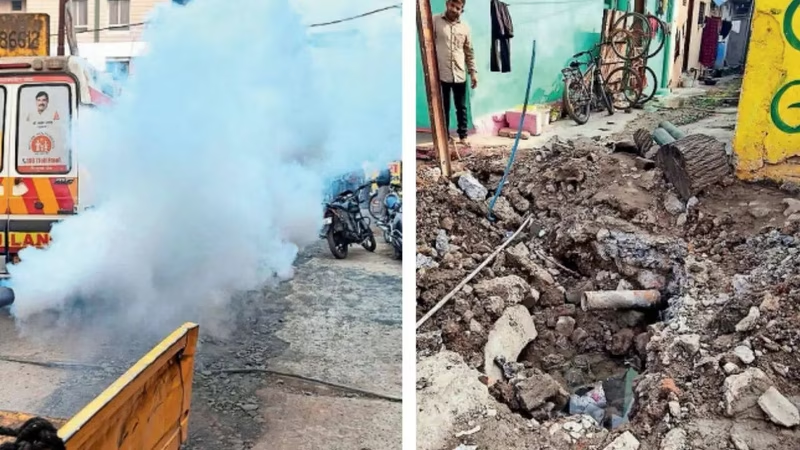
For nearly a decade, Indore has worn its ‘India’s Cleanest City’ crown like a badge of honor—winning the Swachh Survekshan title six years straight. But in early January 2026, that gleaming reputation began to crack under the weight of a horrifying reality: a deadly Indore diarrhea outbreak in the Bhagirathpura area that has claimed lives and exposed deep rot within the city’s much-praised civic machinery.
What’s worse? Instead of a unified response, elected officials and municipal leaders are locked in a public blame game—pointing fingers while citizens suffer. The fallout has been swift: the Indore Municipal Corporation (IMC) commissioner and other top officials have been suspended following direct intervention by Madhya Pradesh Chief Minister Mohan Yadav. This isn’t just a public health emergency—it’s a crisis of governance that threatens to sink Indore’s carefully curated image.
Table of Contents
- The Outbreak That Shook Indore
- How the Blame Game Unfolded
- ‘Cleanest City’ or Clean Facade?
- Administrative Failures and High-Level Suspensions
- What Citizens Need Now: Accountability & Action
- Summary: A Reputation on the Brink
- Sources
The Outbreak That Shook Indore
In late December 2025 and early January 2026, residents of Bhagirathpura—a densely populated locality on Indore’s outskirts—began falling ill with severe diarrhea and dehydration. By early January, multiple deaths were reported, mostly among children and the elderly . Local clinics were overwhelmed, and panic spread as families rushed loved ones to hospitals.
Preliminary investigations pointed to contaminated drinking water as the likely cause. Residents alleged that sewage had mixed with the municipal water supply due to neglected pipelines and poor waste management—ironic in a city globally celebrated for its sanitation systems . Despite repeated complaints over months about foul-smelling water and clogged drains, no preventive action was taken by the IMC .
How the Blame Game Unfolded
Instead of a coordinated crisis response, city officials launched into a public squabble. Local BJP corporators accused the IMC of willful negligence, claiming infrastructure funds were misused. The IMC, in turn, blamed elected representatives for blocking sanitation projects in the area .
Even state ministers traded barbs. One minister implied that the municipal leadership had become complacent due to repeated ‘cleanest city’ accolades, while another cited “local political interference” as the root cause . This infighting not only delayed emergency relief but also eroded public trust at a time when swift leadership was most needed.
‘Cleanest City’ or Clean Facade?
The Indore diarrhea outbreak has sparked a national debate: is Indore’s ‘cleanest city’ status earned—or engineered for optics?
Critics have long argued that Indore’s sanitation success was concentrated in high-visibility zones, while peripheral areas like Bhagirathpura were ignored . Data from the Centre for Science and Environment (CSE) shows that while central Indore boasts modern sewage treatment plants, many outlying wards still rely on open drains and aging pipelines .
This disparity suggests a troubling pattern: urban branding over equitable public health. When awards become the end goal, systemic vulnerabilities in marginalized neighborhoods are often overlooked—until tragedy strikes.
The Swachh Survekshan Paradox
Indore’s repeated wins in the Swachh Survekshan survey, backed by the Ministry of Housing and Urban Affairs, have been both a blessing and a curse:
- Pro: Boosted civic pride, tourism, and investment.
- Con: Created pressure to maintain image at all costs, potentially discouraging honest reporting of failures.
- Risk: Over-reliance on spot assessments that may miss chronic issues in less-monitored areas.
For a deeper look at how urban cleanliness metrics can sometimes mask underlying problems, the Centre for Science and Environment offers critical insights into India’s sanitation policies .
Administrative Failures and High-Level Suspensions
The public outcry forced Chief Minister Mohan Yadav to step in. On January 2, 2026, he ordered immediate action against those responsible. Within 24 hours:
- The IMC Commissioner was suspended.
- The Chief Engineer of the Water Works Department was placed on leave.
- A high-level inquiry committee was formed to investigate systemic lapses .
These moves signal that the state government is trying to contain the political fallout. But many residents ask: why did it take deaths to trigger accountability? [INTERNAL_LINK:indore-urban-governance-challenges] explores this pattern in other Indian smart cities.
What Citizens Need Now: Accountability & Action
Beyond suspensions, Bhagirathpura’s residents need concrete solutions:
- Emergency water testing and distribution of safe drinking water.
- Transparent public reporting of water quality data across all wards.
- Community oversight committees to monitor sanitation infrastructure in marginalized areas.
- Long-term investment in pipeline upgrades and sewage treatment, not just photo-op clean-ups.
Without these, Indore’s ‘cleanest’ tag may become a hollow slogan—a reminder of what was promised, not what was delivered.
Summary: A Reputation on the Brink
The Indore diarrhea outbreak is more than a public health failure—it’s a governance wake-up call. A city celebrated for its cleanliness allowed preventable contamination to turn deadly, then responded with blame instead of urgency. While suspensions offer a semblance of accountability, true redemption lies in fixing the system, not just the headlines. If Indore fails to act equitably and transparently, its ‘cleanest city’ legacy may be remembered not for its spotless streets, but for the lives lost in its shadows.
Sources
- Times of India: Defaced, Indore’s ‘cleanest’ tag drowning? Officials point ‘dirty’ fingers at each other
- The Hindu: Indore diarrhea cases surge amid water contamination fears
- NDTV: IMC Commissioner Suspended in Wake of Indore Health Crisis
- Centre for Science and Environment (CSE): Swachh Bharat Mission: Gaps in Urban Sanitation Equity