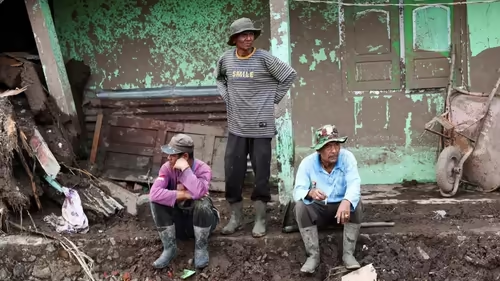
A wall of mud and debris tore through the quiet village of Pasirlangu in Indonesia’s West Java province on January 24, 2026, leaving a trail of unimaginable destruction. The official death toll from the Indonesia landslide has now risen to 17, with a staggering 80 people still unaccounted for . As rescue teams battle difficult terrain and the threat of further rain, the world watches a community’s desperate fight for survival unfold.
Table of Contents
- The Devastation in Pasirlangu Village
- Race Against Time: Rescue Efforts Underway
- Why is West Java So Vulnerable to Landslides?
- A Pattern of Tragedy: Indonesia’s Ongoing Battle with Natural Disasters
- How You Can Help the Victims of the Indonesia Landslide
- Conclusion: A Community in Mourning and a Nation on Alert
- Sources
The Devastation in Pasirlangu Village
The sleepy hamlet of Pasirlangu, located in the West Bandung regency, was transformed into a scene of chaos in an instant. Heavy rainfall, a common precursor to such disasters in the region, saturated the hillsides until they gave way . The resulting landslide buried homes under meters of thick, heavy mud and rock, trapping families who were likely asleep or just beginning their day.
Initial reports confirmed the recovery of 16 bodies, but that number has since climbed to 17 as search teams painstakingly sift through the wreckage [[1], [5]]. The most harrowing statistic, however, is the number of those still missing: approximately 80 souls whose fate remains unknown. Local authorities have been working tirelessly to establish a definitive list of the missing, a task made difficult by the sheer scale of the destruction.
Race Against Time: Rescue Efforts Underway
Rescue operations in the aftermath of the Indonesia landslide have been described as extremely challenging. Teams from Indonesia’s National Search and Rescue Agency (Basarnas) and local volunteers are on the ground, but their progress is severely hampered by several factors:
- Difficult Terrain: The remote location and the unstable, muddy ground make it dangerous for rescuers to operate heavy machinery or even move freely.
- Thick Landslide Material: The debris field is composed of dense, compacted earth and rock, making it slow and laborious to dig through by hand.
- Risk of Further Rainfall: Weather forecasts indicating more rain have raised fears of secondary landslides, which could endanger both survivors and the rescue personnel themselves .
Despite these obstacles, the search continues with unwavering determination. Every hour is critical, as the chances of finding survivors diminish rapidly with time.
Why is West Java So Vulnerable to Landslides?
This tragedy is not an isolated incident. West Java, with its mountainous terrain, volcanic soil, and high annual rainfall, is notoriously prone to landslides, especially during the monsoon season. The region’s geology is a key factor; volcanic soil, while fertile for agriculture, can become dangerously unstable when waterlogged.
Human activity also plays a significant role. Deforestation for farming or development removes the tree roots that help bind the soil together, significantly increasing the risk of slope failure. In many cases, communities are forced to build on these precarious slopes due to a lack of available flat land, placing them directly in harm’s way. This deadly combination of natural and man-made factors creates a recurring cycle of disaster in the region.
A Pattern of Tragedy: Indonesia’s Ongoing Battle with Natural Disasters
The Pasirlangu disaster is a stark reminder of Indonesia’s position on the Pacific ‘Ring of Fire,’ making it one of the most disaster-prone countries in the world. The nation faces a constant barrage of earthquakes, volcanic eruptions, tsunamis, floods, and landslides.
In fact, data from ReliefWeb shows that from November 2025 to early January 2026 alone, floods and landslides across Indonesia have claimed a horrifying 1,180 lives and displaced nearly a quarter of a million people . This context underscores the immense pressure on Indonesia’s disaster management infrastructure and the urgent need for long-term mitigation strategies, including better early warning systems and sustainable land-use planning.
How You Can Help the Victims of the Indonesia Landslide
While the immediate focus is on search and rescue, the long road to recovery for the survivors of Pasirlangu will require significant support. Reputable international aid organizations like the International Federation of Red Cross and Red Crescent Societies (IFRC) often mobilize quickly in response to such crises. Donating to these established groups is one of the most effective ways to provide food, clean water, medical care, and shelter to those who have lost everything.
Conclusion: A Community in Mourning and a Nation on Alert
The Indonesia landslide in Pasirlangu village is a heart-wrenching human tragedy that has left a community shattered and a nation in mourning. As the search for the missing continues, this event serves as a powerful and urgent call to action. It highlights the critical need to address the underlying causes of such disasters, from climate change adaptation to smarter urban and rural planning, to prevent future generations from enduring similar suffering. Our thoughts are with the families of the victims and the brave rescuers on the front lines.
Sources
- The Straits Times: “Death toll from landslide in Indonesia’s West Java rises to 17”
- RTL Today: “Indonesia landslide death toll rises to 17, dozens missing”
- ReliefWeb: “Indonesia: Floods and Landslides – Nov 2025”
- Xinhua News: “8 killed as landslide, flash floods hit Indonesia’s West Java”
- Xinhua News: “Death toll rises to 16 following landslide in Indonesia’s West Java”