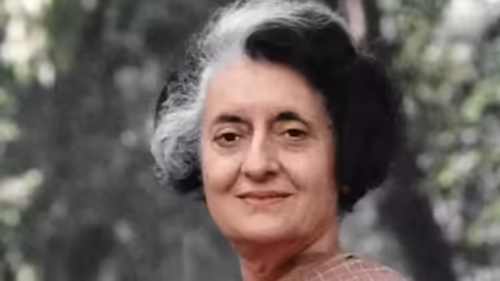
It was a cold January morning in New Delhi, but the corridors of power were burning with tension. On January 19, 1966, history was made—not with fanfare or public rallies, but in a quiet yet fiercely contested ballot inside the Congress Parliamentary Party. That day, Indira Gandhi emerged victorious in a nail-biting vote against veteran leader Morarji Desai, becoming India’s first woman Prime Minister .
This wasn’t just a symbolic milestone. It was a seismic shift in Indian politics—a moment where dynastic legacy, internal party maneuvering, and Cold War-era pragmatism collided to install a leader who would go on to define a generation. Let’s unpack how this pivotal chapter unfolded.
Table of Contents
- The Vacuum After Shastri
- Indira Gandhi First Woman PM: The Contenders
- The Four-Hour Drama Inside Congress
- Why She Won: The ‘Syndicate’ Factor
- The Legacy of January 19, 1966
- Conclusion: More Than a ‘First’
- Sources
The Vacuum After Shastri
The sudden death of Prime Minister Lal Bahadur Shastri in Tashkent on January 11, 1066, left the nation in shock—and the Congress Party without a clear successor . Shastri had led India through the 1965 war with Pakistan and coined the iconic slogan “Jai Jawan Jai Kisan,” but his untimely passing created a leadership crisis.
Two main factions emerged: the old guard, led by Gujarat’s Morarji Desai—a stern, principled, and deeply conservative figure—and the younger, more progressive wing that saw potential in Indira Gandhi, daughter of India’s first PM, Jawaharlal Nehru.
Though relatively inexperienced in executive governance, Indira had served as Minister of Information and Broadcasting and carried the immense symbolic weight of the Nehru-Gandhi legacy. For many, she represented continuity in uncertain times.
Indira Gandhi First Woman PM: The Contenders
The race came down to two starkly different personalities:
- Morarji Desai: A veteran of the independence movement, known for his austerity, integrity, and rigid adherence to Gandhian principles. He had been Finance Minister and Chief Minister of Bombay State. Many senior leaders backed him as the “safe” choice.
- Indira Gandhi: Seen as more modern, media-savvy, and aligned with the masses. Though critics dismissed her as a “goongi gudiya” (dumb doll), her lineage and perceived pliability made her attractive to party bosses seeking influence.
What many didn’t realize was that beneath her calm exterior, Indira possessed a steely resolve that would soon reshape Indian democracy itself.
The Four-Hour Drama Inside Congress
The vote took place on January 19, 1966, in a closed-door session of the Congress Parliamentary Party. What followed was a tense, four-hour deliberation filled with lobbying, last-minute switches, and high-stakes negotiations .
In the end, Indira Gandhi secured 355 votes to Desai’s 169—a decisive margin that stunned observers . The result wasn’t just about popularity; it was a calculated move by the so-called “Syndicate”—a group of powerful regional Congress bosses including K. Kamaraj, S. Nijalingappa, and Atulya Ghosh—who believed they could control her more easily than the stubborn Desai.
They were wrong.
Why She Won: The ‘Syndicate’ Factor
The real story behind Indira’s victory lies in the machinations of the Syndicate. These kingmakers saw her as a figurehead—someone who would lend legitimacy to their agenda while allowing them to pull the strings from behind the scenes .
But Indira Gandhi quickly proved she was no puppet. Within two years, she would nationalize banks, abolish privy purses, and eventually split the Congress Party in 1969 to form her own faction—Consolidating power in a way no one anticipated in January 1966.
This moment, therefore, wasn’t just about gender. It was about the beginning of a new style of centralized, populist leadership in India—one that continues to influence politics today.
The Legacy of January 19, 1966
Indira Gandhi’s ascension broke a massive barrier in a largely patriarchal society. She became not only India’s first female PM but also one of the most powerful women in global politics during the 20th century.
Her tenure included landmark events like the 1971 Bangladesh Liberation War, the Green Revolution, and the controversial Emergency (1975–77). Love her or loathe her, her impact is undeniable.
For context on women’s political representation globally, the UN Women organization provides valuable insights into the historical and ongoing challenges faced by female leaders worldwide.
Conclusion: More Than a ‘First’
Calling Indira Gandhi simply “India’s first woman Prime Minister” undersells her significance. Her victory on January 19, 1966, was the spark that ignited a transformative era in Indian politics. It showed that leadership could come from unexpected places—and that perceived weakness could mask extraordinary strength. As we reflect on this historic day, it’s clear: Indira Gandhi didn’t just enter the office—she redefined what it meant to hold it.
Sources
- Times of India: How India got its first woman PM this day in 1966
- Bhatia, S. (2002). Indira Gandhi: The Tryst with Power. Penguin Books. [[3], [4]]
- Frank, K. (2001). Indira: The Life of Indira Nehru Gandhi. Houghton Mifflin.
- UN Women – Global Leadership and Political Participation