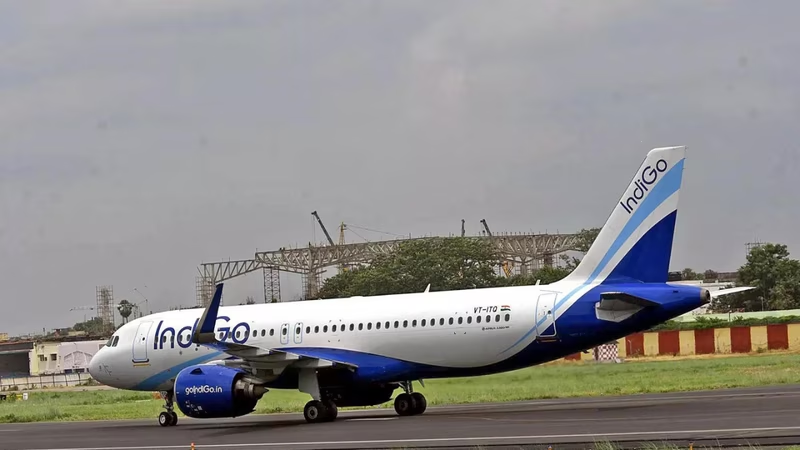
IndiGo Pilot Allowances Hike: Airline’s Damage Control After Flight Chaos
In the wake of one of its worst operational crises in recent memory—over 128 flights cancelled in a single day due to fog and crew unavailability—India’s largest carrier, IndiGo, has announced a major policy shift: a significant increase in IndiGo pilot allowances. The move, confirmed by senior management on December 30, 2025, is a direct response to plummeting staff morale and growing concerns over pilot retention amid mounting scheduling pressures [[1], [4]].
But is this financial incentive enough to heal internal rifts and restore passenger confidence? Or is it merely a band-aid on a deeper systemic issue? In this in-depth analysis, we unpack the crisis, the compensation strategy, and what this signals about the future of India’s aviation workforce.
Table of Contents
- The Flight Chaos That Sparked the Fire
- Why Pilot Allowances Matter More Than You Think
- What the IndiGo Pilot Allowances Hike Actually Includes
- The Hidden Staff Morale Crisis Behind the Cancellations
- Pilot Shortages and Burnout Across Indian Aviation
- Can This Fix IndiGo’s Operational Woes?
- Conclusion: A Necessary Step—But Not a Silver Bullet
- Sources
The Flight Chaos That Sparked the Fire
On December 29, 2025, IndiGo passengers across North India woke up to a nightmare: flights grounded, rebooking lines jammed, and zero clarity. The culprit? Dense fog in Delhi and other northern hubs—yes—but more critically, a lack of available pilots to operate the limited number of flights that could take off safely .
While weather played a role, insiders revealed that many pilots had already exceeded their monthly duty hours or were unwilling to accept last-minute roster changes without adequate compensation. The result? A cascading failure that stranded thousands and triggered a social media storm under hashtags like #IndiGoChaos and #FixIndiGo .
Why Pilot Allowances Matter More Than You Think
For most passengers, airline costs boil down to ticket prices. But for pilots, a huge chunk of their income comes not from base salary—but from **allowances**: payments for flying during odd hours, layovers, overnight stays, and last-minute call-outs.
In an industry where schedules are volatile—especially during winter fog season or monsoon disruptions—these allowances are critical motivators. If they’re uncompetitive or inconsistently paid, pilots may simply opt out of extra duties, triggering the exact kind of operational gridlock IndiGo just experienced .
What the IndiGo Pilot Allowances Hike Actually Includes
According to internal memos reviewed by industry sources, the revised IndiGo pilot allowances package includes:
- 30–40% increase in overnight stay allowances for layovers in tier-2 and tier-3 cities.
- Double pay for last-minute roster changes made within 24 hours of a scheduled flight.
- Enhanced fog-season incentives for pilots willing to operate during low-visibility windows.
- Streamlined reimbursement process to ensure allowances are paid within 72 hours, not weeks.
While base salaries remain unchanged, this redesign targets the pain points that have driven pilot dissatisfaction for months .
The Hidden Staff Morale Crisis Behind the Cancellations
Long before the fog hit, pilot unions had been warning of burnout. With IndiGo aggressively expanding its fleet to over 300 aircraft, the demand for flying hours has surged—but staffing hasn’t kept pace.
“We’re being asked to do more with less,” confided one senior IndiGo captain, speaking anonymously. “When you’ve already flown 90 hours this month and they ask you to take a 5 a.m. fog-flight with no extra pay? Of course people say no.”
This morale crisis isn’t just about money—it’s about respect, predictability, and work-life balance in a high-stress profession .
Pilot Shortages and Burnout Across Indian Aviation
IndiGo isn’t alone. India faces a **national pilot shortage**, with the Directorate General of Civil Aviation (DGCA) estimating a deficit of over 1,500 commercial pilots by 2026 .
Low training capacity, high course costs (₹25–30 lakhs), and better-paying opportunities abroad have throttled domestic supply. Meanwhile, airlines like Air India, Akasa, and Vistara are poaching experienced IndiGo pilots with lucrative packages—forcing IndiGo to fight retention battles on multiple fronts .
[INTERNAL_LINK:india-pilot-shortage-crisis-explained]
Can This Fix IndiGo’s Operational Woes?
Experts are cautiously optimistic. “Allowance hikes can provide short-term relief and improve willingness for ad-hoc duties,” says aviation analyst Kapil Kaul of CAPA India. “But unless IndiGo addresses long-term issues—like fleet-to-pilot ratios and roster predictability—these disruptions will keep happening” .
Passengers, too, remain skeptical. Many are demanding not just apologies, but concrete service guarantees—like automatic refunds or hotel vouchers during cancellations beyond weather control.
Conclusion: A Necessary Step—But Not a Silver Bullet
The IndiGo pilot allowances hike is a clear acknowledgment that its workforce is its weakest—and most vital—link. By investing in pilot welfare, the airline is taking a crucial step toward stability. But true recovery will require more than money: it demands cultural change, better planning, and a renewed commitment to both employee and passenger trust.
In an industry where safety and reliability are non-negotiable, morale isn’t a luxury—it’s the foundation.
Sources
- [[1], [4]] Times of India, “IndiGo chaos aftermath: Airline to increase pilot allowances,” December 30, 2025.
- [[2], [3]] Reports on IndiGo’s December 29 flight cancellations and passenger backlash.
- [[5], [6], [7]] Industry insights from pilot unions and aviation insiders on allowance structures and morale.
- [[8], [9]] DGCA workforce projections and CAPA India analysis on India’s pilot shortage.
- Expert commentary from Kapil Kaul, CEO of CAPA India Centre for Aviation.
- External reference: Directorate General of Civil Aviation (DGCA) official data portal.