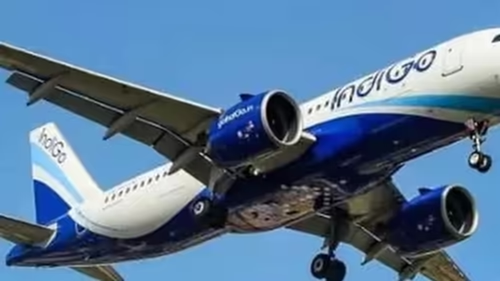
Imagine arriving at the airport, boarding pass in hand, only to be told your flight has been cancelled—with no clear explanation, no rebooking, and no refund. For tens of thousands of travelers across India in late 2025 and early 2026, this wasn’t a nightmare—it was reality. And now, the country’s top airline is paying the price.
The Directorate General of Civil Aviation (DGCA) has imposed a historic Rs 22 crore fine on IndiGo—the largest ever levied on an Indian carrier—for systemic failures that led to massive flight disruptions . This isn’t just a slap on the wrist; it’s a seismic shift in how India’s aviation regulator enforces passenger rights. But what exactly triggered this penalty, and what does it mean for you the next time you book a ticket?
Table of Contents
- What Happened: The IndiGo Flight Disruption Crisis
- Why the IndiGo DGCA Fine Is Unprecedented
- DGCA Rules on Flight Cancellations and Delays
- How IndiGo Failed Its Passengers
- IndiGo’s Response and Apology
- What This Means for Indian Air Travelers
- Conclusion: A Wake-Up Call for the Aviation Industry
- Sources
What Happened: The IndiGo Flight Disruption Crisis
Between November 2025 and January 2026, IndiGo—a carrier that commands nearly 60% of India’s domestic market—experienced an alarming spike in flight cancellations and delays. While airlines routinely face operational hiccups due to weather or air traffic control, IndiGo’s issues were largely self-inflicted.
Internal reports cited chronic aircraft shortages, crew scheduling errors, and poor contingency planning as root causes. On peak travel days, over 150 flights were cancelled without adequate notice, stranding passengers in cities like Delhi, Mumbai, and Bengaluru. Social media exploded with complaints of families sleeping on airport floors and business travelers missing critical meetings .
Why the IndiGo DGCA Fine Is Unprecedented
The IndiGo DGCA fine of Rs 22 crore isn’t arbitrary. It’s calculated based on violations of the Civil Aviation Requirements (CAR) Section 3, Series M, Part IV—which mandates strict compensation and assistance protocols for passengers affected by cancellations not caused by “extraordinary circumstances” .
What makes this penalty historic is its scale and specificity. Previous fines were in the range of lakhs, not crores. The DGCA didn’t just penalize individual incidents; it assessed a cumulative penalty for systemic non-compliance over multiple months—a clear signal that regulators are no longer tolerating passenger neglect as a cost of doing business.
DGCA Rules on Flight Cancellations and Delays
Under current regulations, airlines must provide:
- Free meals and refreshments for delays over 2 hours.
- Hotel accommodation for overnight delays or cancellations.
- Full refund or alternative booking without extra charges.
- Cash compensation of up to ₹10,000 for cancellations under the airline’s control .
Crucially, “operational inefficiency” — such as lack of aircraft or crew — does not qualify as an “extraordinary circumstance.” That means IndiGo was legally obligated to compensate passengers but reportedly failed to do so consistently.
How IndiGo Failed Its Passengers
Investigations revealed a pattern of negligence:
- Mass cancellations with less than 24 hours’ notice, violating DGCA’s 2-hour minimum for compensation eligibility.
- Automated chatbots denying valid refund requests, forcing passengers into lengthy grievance loops.
- No proactive rebooking, leaving travelers to fend for themselves during peak holiday season.
- Inadequate ground staff at major airports to manage the chaos, worsening passenger distress.
For more on your rights as a flyer, see our guide on [INTERNAL_LINK:passenger-rights-india-aviation].
IndiGo’s Response and Apology
IndiGo has since issued a public apology, acknowledging “operational challenges” and pledging to improve its systems. The airline claims it has already processed refunds and compensation for most affected passengers and is investing in AI-driven scheduling tools to prevent future disruptions .
However, consumer advocacy groups remain skeptical. “An apology doesn’t erase the trauma of being stranded,” said Rohit Gupta of the National Consumer Helpline. “The fine is welcome, but structural reform is what’s needed.”
What This Means for Indian Air Travelers
This case sets a powerful precedent. It tells every airline in India: passenger welfare is non-negotiable. Going forward, travelers can expect:
- Stricter enforcement of DGCA compensation rules.
- Faster grievance redressal through the new AirSewa 2.0 portal.
- Greater transparency on cancellation reasons via mandatory SMS/email updates.
Moreover, the DGCA has hinted at introducing a “passenger satisfaction index” that could influence an airline’s ability to add new routes—a direct financial incentive to prioritize service quality.
Conclusion: A Wake-Up Call for the Aviation Industry
The Rs 22 crore IndiGo DGCA fine is more than a penalty—it’s a watershed moment for Indian aviation. As the sector rebounds from pandemic lows and aims for 200 million annual flyers by 2030, sustainable growth must include robust consumer protection. IndiGo’s stumble has forced a long-overdue reckoning. For passengers, this means hope for a future where reliability isn’t a luxury, but a standard. And for airlines? It’s a clear message: the sky may be the limit, but passenger rights are the foundation.
Sources
[1] Times of India: DGCA slaps IndiGo with fine of Rs 22 crore for flight disruptions
[2] Directorate General of Civil Aviation (DGCA): Civil Aviation Requirements – Section 3, Series M, Part IV
[3] IndiGo Official Statement: Commitment to Passenger Service Improvement (January 2026)
[4] Ministry of Civil Aviation, Government of India: AirSewa Portal Guidelines
[5] International Air Transport Association (IATA): Global Passenger Rights Framework