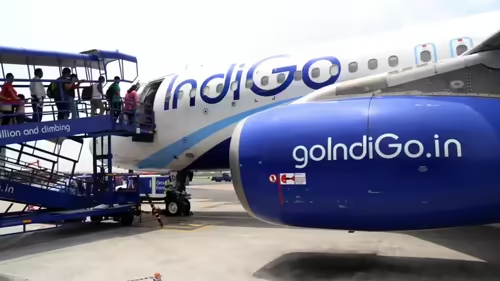
India’s skies are holding their breath. After a holiday season marred by unprecedented chaos and thousands of cancelled flights, IndiGo now faces its most critical test yet. The airline has until this week to formally inform the Directorate General of Civil Aviation (DGCA) whether it can viably operate its massive network of over 2,000 daily flights while complying with the country’s new, stricter Flight Duty Time Limitations (FDTL) rules . This isn’t just a bureaucratic formality—it’s a high-stakes gamble that will determine if passengers can finally trust their tickets again.
Table of Contents
- The Looming Deadline: What IndiGo Must Decide
- What Are the New FDTL Rules and Why Do They Matter?
- A Ghost of December Past: The Cancellation Crisis
- IndiGo’s Plan B: Dry Runs, Allowances, and Exemptions
- What This Means for Your Next Flight
- The Bottom Line for IndiGo and Indian Aviation
- Sources
The Looming Deadline: What IndiGo Must Decide
The clock is ticking. As of January 19, 2026, IndiGo is under a formal obligation to notify the DGCA about its ability to sustain its current flight schedule of more than 2,000 daily departures in full compliance with the new safety regulations . This decision point is the direct result of a temporary exemption granted by the Ministry of Civil Aviation in December 2025, which was designed to give the airline breathing room to stabilize its operations after a massive meltdown . That exemption expires on February 10, 2026, making this week’s declaration absolutely pivotal . If IndiGo admits it cannot meet the requirements, it will be forced to proactively cut its schedule, a move that would be a major blow to its reputation and market dominance.
What Are the New FDTL Rules and Why Do They Matter?
The root of this entire crisis lies in India’s updated Flight Duty Time Limitations (FDTL). These rules, which came into effect in November 2025, were designed to enhance aviation safety by directly addressing pilot fatigue—a well-documented global risk factor in air accidents . The new FDTL framework mandates increased weekly rest periods for pilots and imposes stricter limits on their working hours, especially during night operations .
While these regulations align with international best practices promoted by bodies like the International Civil Aviation Organization (ICAO), they have created a significant operational challenge for airlines with lean staffing models. For an airline like IndiGo, which operates one of the world’s largest single-type fleets (Airbus A320 family), the margin for error is razor-thin. The new rules essentially require more pilots to fly the same number of flights, a resource the airline has been scrambling to secure.
A Ghost of December Past: The Cancellation Crisis
This isn’t a theoretical problem. Last December, the initial implementation of these very rules triggered a catastrophic chain reaction at IndiGo. The airline was forced to cancel over 1,000 flights in a single week, stranding tens of thousands of passengers during the peak holiday travel season . The chaos was a perfect storm of the new FDTL rules, a tight pilot roster, and what many industry experts described as inadequate contingency planning. The fallout was immense, damaging customer trust and prompting a swift, but temporary, government intervention in the form of the aforementioned exemption .
IndiGo’s Plan B: Dry Runs, Allowances, and Exemptions
To avoid a repeat disaster, IndiGo has been running a series of “dry runs”—simulated operational scenarios—to test its ability to manage the 2,000-flight schedule under the full FDTL regime . This internal stress test is crucial for understanding where bottlenecks might occur.
Beyond simulations, the airline has also taken concrete steps to shore up its pilot resources and morale. In a significant move effective January 1, 2026, IndiGo announced a substantial increase in pilot allowances, a direct effort to improve retention and attract new talent to its ranks [[3], [5]]. This financial incentive is a clear acknowledgment that its human capital is the linchpin of its entire operation.
However, the most critical element remains the temporary exemption. Its existence has been a lifeline, but it’s a short-term fix. The airline’s communication to the DGCA this week will reveal whether these measures—allowance hikes, dry runs, and accelerated hiring—have been enough to build a sustainable model, or if a painful reduction in its flight network is inevitable.
What This Means for Your Next Flight
If you’re planning to fly IndiGo in the coming weeks, here’s what you need to know:
- Short-term stability: Thanks to the exemption lasting until February 10, your flight in the next three weeks is likely safe.
- Long-term uncertainty: If IndiGo announces it cannot comply post-exemption, expect a revised, smaller schedule to be published for travel beyond mid-February.
- Proactive communication: Keep an eye on your email and the IndiGo app. The airline is under immense pressure to communicate any changes clearly and early to avoid another PR disaster.
The Bottom Line for IndiGo and Indian Aviation
The IndiGo 2000 flights dilemma is more than just a corporate challenge; it’s a defining moment for India’s aviation sector. On one side is the non-negotiable priority of passenger and crew safety, enshrined in the new FDTL rules. On the other is the economic reality of running a low-cost carrier in a hyper-competitive market. IndiGo’s decision this week will set a precedent. If it successfully adapts, it will emerge stronger and safer. If it fails, it could trigger a domino effect, forcing other carriers to re-evaluate their own operations. For now, all eyes are on Gurgaon, waiting for the official word that will shape the future of air travel in India.
Sources
- Times of India: “IndiGo faces test on 2000-flight schedule as pilot duty rule deadline looms” (January 19, 2026)
- Official sources on Ministry of Civil Aviation exemption for IndiGo (December 7, 2025)
- Reports on IndiGo’s pilot allowance revision (January 1, 2026)
- Times of India: “IndiGo to inform if it can fly 2k flights daily”
- Industry reports on IndiGo’s staff morale initiatives (January 2026)
- Analysis of the December 2025 IndiGo cancellation crisis and FDTL rules (December 24, 2025)
- Reports on the DGCA’s one-time exemption for IndiGo (December 16, 2025)