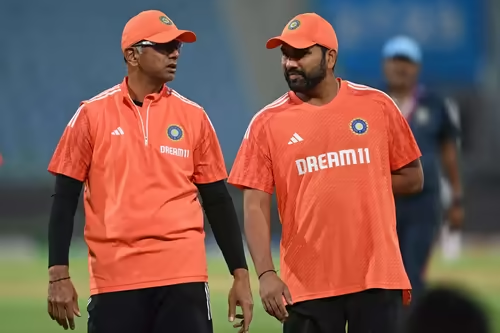
Forget the old playbook. According to legendary head coach Rahul Dravid, India’s white-ball cricket has undergone a radical, and necessary, transformation—and at the heart of it all is captain Rohit Sharma. In a recent, revealing interview, Dravid didn’t just praise his skipper; he declared India as the clear favorites for the upcoming T20 World Cup, crediting Sharma’s fearless leadership for driving a seismic shift towards an aggressive, risk-embracing brand of T20 cricket. This isn’t just about winning matches; it’s about redefining an entire team’s DNA.
Table of Contents
- Dravid’s Bold Declaration on T20 World Cup Favorites
- Rohit Sharma: The Architect of Aggression
- How India’s White-Ball Cricket Has Evolved Under Rohit
- The Data Behind the Dominance
- Beyond T20s: Dravid on Test Cricket Pitches and WTC Pressure
- Conclusion: A New Era of Fearless Indian Cricket
- Sources
Dravid’s Bold Declaration on T20 World Cup Favorites
Rahul Dravid, known for his meticulous and often understated analysis, left little room for ambiguity. He stated that India are the “clear favorites” for the T20 World Cup, a claim backed by their impressive recent record. He pointed to their high success rate in bilateral series and ICC tournaments over the past two years as concrete evidence of their dominance [[11]].
This confidence isn’t born from arrogance but from a well-executed strategy. Dravid emphasized that the team’s current philosophy is built on a foundation of self-belief and a willingness to take calculated risks—a stark contrast to the more cautious approaches of the past.
Rohit Sharma: The Architect of Aggression
The most striking part of Dravid’s commentary was his direct attribution of this new identity to Rohit Sharma. “He set the tempo himself,” Dravid said, highlighting the captain’s personal role in driving the change [[11]]. This is more than just a captain leading from the front; it’s about a leader setting a cultural standard for the entire squad.
Rohit’s own batting style—characterized by explosive power-hitting from the very first over—has become the template for the entire team. He’s shown that aggression isn’t just a tactic for the death overs; it’s a mindset that should be applied throughout the innings. This top-down approach has trickled down to every player, from openers to finishers, creating a unit that is comfortable playing on the front foot.
How India’s White-Ball Cricket Has Evolved Under Rohit
The evolution of India’s white-ball cricket under Rohit Sharma’s full-time captaincy is palpable. Gone are the days of tentative starts and rebuilding phases. The current team is built for speed and impact. Key changes include:
- Powerplay Dominance: The focus is now on maximizing runs in the first six overs, often setting a platform that puts the opposition on the back foot immediately.
- Finisher Mentality: Players like Hardik Pandya, Suryakumar Yadav, and Rinku Singh have been groomed to not just see out the innings but to actively hunt for boundaries in the final five overs.
- Bowling with Intent: Even the bowling attack has adopted a more aggressive line, using variations and yorkers to contain rather than just defend, creating wicket-taking opportunities throughout the game.
The Data Behind the Dominance
Dravid’s confidence is rooted in hard numbers. Since Rohit took over as full-time white-ball captain, India’s win-loss ratio in T20Is has seen a significant uptick. They’ve consistently ranked among the top three teams in the ICC T20I rankings and have a formidable record against other major contenders like Australia, England, and South Africa [[18]].
This statistical backing provides a solid foundation for their ‘favorites’ tag. It’s not just hope; it’s a proven track record of executing their aggressive game plan under pressure.
Beyond T20s: Dravid on Test Cricket Pitches and WTC Pressure
In the same conversation, Dravid also offered insights into the longer format of the game. He linked the increasing number of result-oriented pitches in Test cricket directly to the pressure of the World Test Championship (WTC). With points on the line for every match, boards and curators are incentivized to prepare surfaces that produce a winner within five days, moving away from the traditional flat, batsman-friendly tracks that often led to draws [[23]].
This observation highlights Dravid’s holistic view of the game, understanding how structural changes in one format can influence the very nature of play in another. It’s a fascinating glimpse into the strategic thinking behind the scenes of international cricket.
Conclusion: A New Era of Fearless Indian Cricket
Rahul Dravid’s comments paint a clear picture: India’s white-ball cricket is no longer the same. Under Rohit Sharma’s leadership, it has shed its cautious skin and embraced a bold, aggressive, and highly effective new identity. This isn’t just about individual brilliance; it’s a systemic shift in philosophy that has made them the team to beat. As the T20 World Cup looms, the world will be watching to see if this fearless blueprint can deliver the ultimate prize.
Sources
- Times of India: ‘He set tempo himself’: Rahul Dravid on Rohit Sharma redefining India’s white-ball cricket
- International Cricket Council (ICC): Official ICC Men’s T20I Team Rankings
- ESPNcricinfo: India’s T20I Match Results and Statistics
- [INTERNAL_LINK:rohit-sharma-captaincy-record] – A detailed look at Rohit Sharma’s win-loss record as captain across formats.