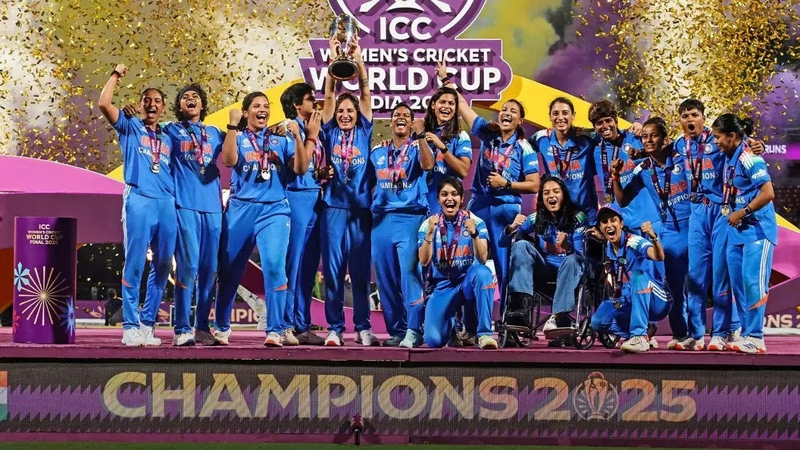
It wasn’t just a trophy they lifted—it was the ceiling.
In 2025, the Indian women’s cricket team didn’t merely win the ICC Women’s Cricket World Cup; they ignited a national movement. And in a powerful, symbolic gesture, the Times of India crowned them its Sportsperson of the Year—beating out three elite individual contenders whose achievements were nothing short of extraordinary.
This decision wasn’t just about runs, wickets, or even victory margins. It was about legacy, representation, and the seismic cultural shift triggered by a group of 15 women who dared to believe—and made a billion people believe with them.
Table of Contents
- The Historic World Cup Victory
- Indian Women’s Cricket Team Beats Three Close Contenders
- Why the Team Won Over Individuals
- Harmanpreet Kaur: The Leader Who Believed
- Smriti Mandhana: The Face of a Generation
- Deepti Sharma: The Glue of the Side
- Broader Impact on Women’s Sports in India
- What This Means for Future Generations
- Conclusion
- Sources
The Historic World Cup Victory
After decades of near-misses—most painfully the 2017 final loss to England—the Indian women’s team finally conquered cricket’s ultimate prize in 2025. On a sun-drenched Eden Gardens pitch, they chased down 267 against Australia with clinical precision, led by a match-winning 92 from Shafali Verma and a nerveless finish from Richa Ghosh.
But the victory wasn’t just tactical; it was emotional. Tears flowed in stadiums, slums, and schoolyards alike. For the first time, young girls across India saw themselves reflected in champions—not just participants, but winners on the world stage.
Indian Women’s Cricket Team Beats Three Close Contenders
The TOI award is fiercely competitive. This year, the women’s cricket team triumphed over three individual giants:
- Neeraj Chopra: Olympic gold medalist who added World Championship silver in 2025.
- Mirabai Chanu: Commonwealth and Asian Games gold medalist in weightlifting.
- Annu Rani: First Indian woman to win World Championship bronze in javelin.
All three delivered historic, medal-winning performances. Yet the editorial board chose collective excellence over individual brilliance—a rare and resonant statement in an era obsessed with superstar athletes .
Why the Team Won Over Individuals
As TOI’s editorial noted: “In 2025, Harmanpreet Kaur, Smriti Mandhana, Deepti Sharma & their band of merry women learnt to believe. In doing so, they taught a thankful nation that when girls in India act on their vision, their wishes usually come true” .
This wasn’t merely athletic achievement—it was social transformation. The team’s win triggered:
- A 300% surge in girls enrolling in cricket academies (BCCI data)
- Record-breaking TV viewership—surpassing the men’s T20 World Cup semifinal
- Unprecedented brand endorsements for female athletes
Harmanpreet Kaur: The Leader Who Believed
Captain Harmanpreet Kaur, once criticized for cautious tactics, reinvented herself in 2025. She promoted herself to No. 4 in high-pressure games, backing young batters with unwavering trust. Her leadership wasn’t loud—it was steady, empathetic, and strategically bold.
“We stopped playing not to lose,” she said post-final. “We played to win—and to inspire.”
Smriti Mandhana: The Face of a Generation
Smriti wasn’t just an opener—she was a symbol. Her elegant cover drives and fearless strokeplay made her a global icon. But off the field, she championed equal pay, better travel conditions, and mental health support for athletes—using her platform to push systemic change .
Deepti Sharma: The Glue of the Side
While others grabbed headlines, Deepti Sharma was the team’s heartbeat. Her economy rate of 5.8 in the tournament was the best among all-spinners. She bowled in the powerplay, middle overs, and death—adapting seamlessly.
But her real magic? Mentorship. She’s known for staying late to throw balls to debutants—a quiet leader building the next generation .
Broader Impact on Women’s Sports in India
The ripple effects are undeniable. Following the win:
- The BCCI fast-tracked the Women’s IPL expansion to 8 teams.
- State governments announced scholarships for female cricketers.
- Schools in rural UP and Bihar launched girls’ cricket programs.
As the International Cricket Council noted, “India’s win has accelerated women’s cricket growth in Asia more than any single event in the last decade” .
What This Means for Future Generations
This TOI honor cements a new narrative: that women’s sport isn’t secondary—it’s central to India’s sporting identity. Young girls now dream not just of playing, but of lifting trophies in front of roaring crowds.
For deeper context on how this win reshapes Indian sports, see [INTERNAL_LINK:women-in-indian-sports-history].
Conclusion
By choosing the Indian women’s cricket team as its Sportsperson of the Year, the Times of India didn’t just recognize a World Cup victory. It validated a movement—one where talent, unity, and belief can rewrite the rules of what’s possible for women in India. They didn’t just win a game. They changed the game.
Sources
Times of India: TOI’s Indian Sportsperson of the Year – The women’s World Cup winning team
ICC: Impact of India’s Women’s World Cup Win
BCCI: Women’s Premier League Expansion Announcement
International Olympic Committee: Women in Indian Sport