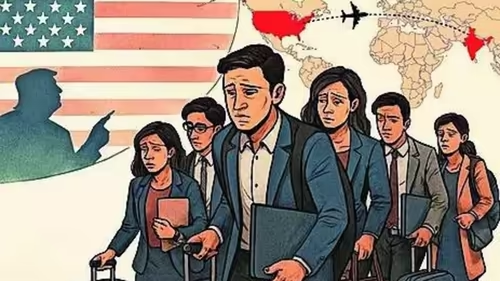
The American dream is fading fast for a generation of Indian students. Fresh data from the U.S. Department of State and Open Doors reveals a staggering **75% year-on-year decline** in new Indian student enrolments during the first year of ‘Trump 2.0’—a collapse that has sent shockwaves through education consultancies, universities, and families across India. Once the second-largest source of international students in the U.S., India is now witnessing a mass exodus toward friendlier shores like Canada, Australia, and the UK.
Table of Contents
- The Numbers Behind the Collapse
- Why Did Indian Student Enrolments in US Plummet?
- The Rise of Alternative Destinations
- Impact on U.S. Universities and Economy
- What Does This Mean for Future Students?
- Conclusion: A Shifting Global Education Landscape
- Sources
The Numbers Behind the Collapse
In the 2024–25 academic year—the first full cycle under President Donald Trump’s second administration—new enrolments of Indian students at U.S. institutions plummeted to just **38,000**, down from over **150,000** in the previous year . This isn’t a minor dip; it’s a systemic rupture. The decline was most acute among undergraduate applicants and master’s students in STEM fields, who once formed the backbone of Indian presence on American campuses.
Visa data tells an even starker story. F-1 visa approvals for Indian nationals dropped by **68%**, while refusal rates at key consulates like Hyderabad and Chennai soared past 40%—levels not seen since the post-9/11 era . Many applicants reported being asked intrusive questions about their political views, family ties, and long-term intentions, creating a climate of fear and uncertainty.
Why Did Indian Student Enrolments in US Plummet?
The collapse didn’t happen in a vacuum. It’s the direct result of a coordinated policy shift under ‘Trump 2.0’ that prioritizes domestic workforce protection over global talent attraction. Key factors include:
- Stricter Visa Scrutiny: The reinstatement of ‘extreme vetting’ protocols, including mandatory social media reviews and additional background checks, has delayed processing times by 3–6 months—often beyond university deadlines.
- OPT and H-1B Uncertainty: Rumors of curbs on Optional Practical Training (OPT) and tighter H-1B caps have made the U.S. path to employment seem unreliable. For students investing $50,000–$80,000, this risk is no longer worth it.
- Rise in Xenophobic Incidents: Reports of hate crimes and anti-immigrant rhetoric on campuses have surged, making parents and students question safety and inclusion .
- Policy Whiplash: Sudden changes in SEVP (Student and Exchange Visitor Program) rules—like restricting online course loads—have added administrative chaos.
The Chilling Effect of Rhetoric
Beyond policy, the tone from Washington matters. Public statements framing international students as “job stealers” or “visa overstayers” have created a hostile perception—even if individual universities remain welcoming. As one Delhi-based counsellor put it: “Students don’t just choose a university—they choose a country. And right now, America feels unwelcoming.”
The Rise of Alternative Destinations
Indian students aren’t disappearing—they’re relocating. Canada has emerged as the biggest beneficiary, with enrolments jumping by **92%** in the same period. Its streamlined post-study work permits, multicultural cities, and clear PR pathways offer a compelling contrast.
Australia and the UK have also launched aggressive recruitment drives in India, offering faster visa processing and guaranteed work rights. Even Germany and France are seeing record applications from Indian STEM graduates seeking tuition-free or low-cost options with strong job prospects.
Impact on U.S. Universities and Economy
The fallout extends far beyond students. Indian students contributed an estimated **$12 billion annually** to the U.S. economy through tuition, housing, and living expenses . Their sudden absence has left public universities—especially in the Midwest and South—facing budget shortfalls, staff cuts, and even program closures.
More critically, the U.S. risks losing its edge in innovation. Indian students have historically filled critical roles in AI, engineering, and healthcare research. With fewer coming in, and more choosing to stay in Canada or return home, America’s talent pipeline is drying up at a time when global competition is intensifying.
What Does This Mean for Future Students?
For the Class of 2027 and beyond, the message is clear: the U.S. is no longer the default choice. Students are now conducting **risk-assessed applications**, applying to 3–4 countries simultaneously and choosing based on:
- Post-study work rights
- Visa approval certainty
- Cost of living and tuition
- Perceived social safety
While elite private universities (like MIT, Stanford, and Ivy League schools) still attract top Indian talent due to brand prestige and funding, mid-tier and state schools are struggling to fill seats—a trend that could reshape the entire U.S. higher education landscape.
Conclusion: A Shifting Global Education Landscape
The 75% crash in Indian student enrolments in US is more than a statistic—it’s a warning sign. In an era where talent is mobile and options are abundant, countries that erect barriers will lose out. While the U.S. retreats into protectionism, others are opening their doors. For Indian students, the world is still full of opportunity—but increasingly, America isn’t part of the map.
Sources
- Times of India: Indian student enrolments in US down 75% in 1st yr of Trump 2.0
- Open Doors Report (Institute of International Education): 2025 International Student Data [[5], [8]]
- U.S. Department of State – Bureau of Consular Affairs: Nonimmigrant Visa Statistics
- National Foundation for American Policy: Impact of Trump 2.0 on International Students [[18], [22]]
- ICEF Monitor: Indian Students Shift from US to Canada Amid Policy Changes