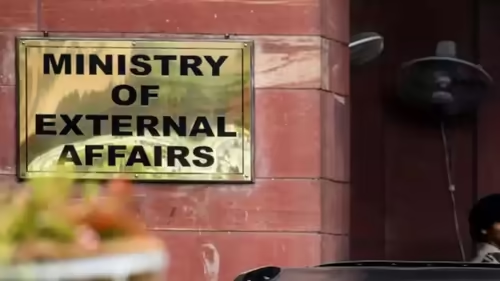
A quiet street in Zagreb, Croatia, became the scene of a shocking international incident this week when unidentified individuals trespassed onto the premises of the **Indian embassy vandalism** and defaced its property with anti-India slogans. The act—described by New Delhi as “deeply disturbing”—has triggered a swift and firm response from the Ministry of External Affairs (MEA), which has formally urged Croatian authorities to bring the perpetrators to justice without delay .
This isn’t an isolated event. It echoes a similar attack on the Indian Consulate in Seattle in 2025, where Khalistani elements breached security and spray-painted separatist symbols . With rising geopolitical tensions and transnational activism, India’s diplomatic outposts are increasingly becoming soft targets for politically motivated vandalism. But under international law, such acts aren’t just crimes—they’re violations of sacred diplomatic norms.
Table of Contents
- What Happened at the Indian Embassy in Zagreb?
- MEA’s Strong Response and Diplomatic Demands
- Why Diplomatic Premises Are Inviolable: The Vienna Convention
- A Pattern of Attacks? Global Context of Anti-India Protests
- Croatia’s Obligations and Next Steps
- How India Is Boosting Diplomatic Security Worldwide
- Conclusion: A Test for the International Order
- Sources
What Happened at the Indian Embassy in Zagreb?
According to preliminary reports, a group of individuals—believed to be linked to anti-India or pro-separatist groups—scaled the perimeter fence of the Indian Embassy in Zagreb during the early hours of January 21, 2026. Once inside, they spray-painted derogatory slogans on the embassy walls and damaged external fixtures before fleeing the scene .
Thankfully, no staff were injured, and the breach was contained quickly by local security. However, the symbolic damage is profound. Embassies are not just buildings; they are sovereign extensions of the nation they represent. An attack on one is, by definition, an attack on the state itself.
MEA’s Strong Response and Diplomatic Demands
The Ministry of External Affairs wasted no time. In an official statement released on January 22, 2026, the MEA said the incident had been “taken up strongly” with the Croatian government through diplomatic channels .
“The Government of India has conveyed its serious concern over the trespassing and vandalism at its Embassy in Zagreb,” the statement read. “It has urged the Croatian authorities to ensure the inviolability of Indian diplomatic premises and to hold the perpetrators accountable in accordance with the law.”
This language is deliberate and steeped in diplomatic protocol. By invoking “inviolability,” the MEA is reminding Croatia of its binding obligations under the 1961 Vienna Convention on Diplomatic Relations—a cornerstone of modern international diplomacy [INTERNAL_LINK:vienna-convention-explained].
Why Diplomatic Premises Are Inviolable: The Vienna Convention
Article 22 of the Vienna Convention on Diplomatic Relations states unequivocally: “The premises of the mission shall be inviolable. The agents of the receiving State may not enter them, except with the consent of the head of the mission.” It further obliges the host country to “take all appropriate steps to protect the premises of the mission against any intrusion or damage” .
This means Croatia isn’t just expected to investigate—it’s legally bound to prevent such incidents and punish those responsible. Failure to do so could strain bilateral relations and set a dangerous precedent for other nations.
For context, the United Nations Treaty Collection lists 193 states as parties to the Vienna Convention, making it one of the most universally accepted legal frameworks in existence .
A Pattern of Attacks? Global Context of Anti-India Protests
The Zagreb incident is deeply concerning because it fits into a worrying trend. In June 2025, the Indian Consulate in Seattle was similarly vandalized by individuals allegedly linked to Khalistani separatist groups . That attack involved breaking windows and painting slogans calling for “Khalistan.”
Other recent incidents include:
- London, UK (2024): Graffiti on the High Commission walls during a protest.
- Vancouver, Canada (2023): Repeated demonstrations outside consular offices with inflammatory rhetoric.
- Melbourne, Australia (2025): Attempted arson at a cultural center linked to Indian diaspora events.
While peaceful protest is a democratic right, crossing into trespassing, vandalism, or intimidation crosses a red line—especially when directed at sovereign diplomatic property.
Croatia’s Obligations and Next Steps
Croatia, as a responsible member of the European Union and a signatory to the Vienna Convention, now faces a critical test. Its response will be closely watched by New Delhi and the broader international community.
Expected actions include:
- Launching a swift and transparent police investigation.
- Identifying and prosecuting the perpetrators under Croatian criminal law.
- Enhancing physical security around the Indian Embassy, possibly in coordination with Indian security advisors.
- Issuing a formal apology or assurance at the ministerial level.
Any delay or perceived leniency could lead India to escalate the matter bilaterally or even raise it at multilateral forums like the UN.
How India Is Boosting Diplomatic Security Worldwide
In light of these recurring threats, India has quietly intensified its diplomatic security protocols. The Ministry of External Affairs, in collaboration with the Intelligence Bureau and local police forces, has implemented several measures since 2024:
- Upgrading CCTV and perimeter intrusion detection systems at high-risk missions.
- Deploying additional Central Industrial Security Force (CISF) personnel to sensitive posts.
- Conducting regular threat assessments and emergency drills.
- Strengthening intelligence-sharing with host countries on potential extremist activities [INTERNAL_LINK:india-diplomatic-security-measures].
Conclusion: A Test for the International Order
The **Indian embassy vandalism** in Zagreb is more than a local crime—it’s a challenge to the very foundation of international diplomacy. When embassies are violated, it undermines trust between nations and endangers the global system that allows countries to coexist peacefully. India’s firm stance is not just about protecting its own interests; it’s about defending a principle that benefits every sovereign state. The world will be watching how Croatia responds—not just to this incident, but to the rule of law itself.
Sources
- Times of India. “‘Taken up strongly’: Trespassing and vandalism at Indian embassy in Croatia— what MEA said.” https://timesofindia.indiatimes.com/…
- United Nations. “Vienna Convention on Diplomatic Relations, 1961.” https://treaties.un.org/…
- UN Treaty Collection. Status of the Vienna Convention. https://treaties.un.org/…
- The Hindu. “Vandalism at Indian Consulate in Seattle: MEA summons Canadian envoy.” June 2025.