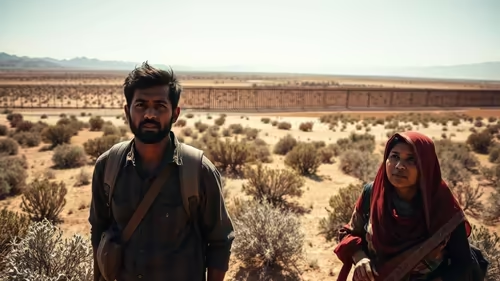
It’s a story playing out far from the headlines but with profound human and geopolitical consequences: even as the United States tightens its grip on immigration, people from India keep coming—in droves. New data from US Customs and Border Protection (CBP) reveals a startling reality for 2025: on average, one Indian was caught at the US border every 20 minutes.
That’s roughly 72 individuals per day, or over 26,000 in a single year—despite aggressive crackdowns, high-profile ICE raids, and increasingly perilous smuggling routes. What’s driving this relentless flow? And why, in the face of deportation, detention, and danger, does the American dream still hold such magnetic power for so many Indians?
Table of Contents
- The Numbers Behind the Trend
- Who Is Coming—and Why?
- How Smugglers Are Adapting
- The Alarming Rise of Unaccompanied Minors
- Do US Crackdowns Actually Work?
- Conclusion: A Dream That Won’t Die
- Sources
The Numbers Behind the Trend
According to CBP statistics cited by The Times of India, while the total number of Indian nationals apprehended at the US-Mexico border in 2025 was lower than the record-breaking surge seen in 2024, it remains alarmingly high [[1]].
In 2024, over 85,000 Indians were encountered at the border. In 2025, that figure dropped—but still hovered around 26,000 to 28,000. That translates to one apprehension every 20 minutes, 24/7, all year long.
This persistence is notable because it comes amid unprecedented enforcement:
- Expanded ICE workplace raids targeting undocumented workers
- Expedited removal processes under Title 8 authority
- Stricter visa screening for Indian applicants
- Increased cooperation with Mexican authorities to intercept migrants en route
Yet, the flow continues—proof that supply (desperation) often outpaces demand (enforcement).
Who Is Coming—and Why?
The profile of Indian migrants has shifted in recent years. While earlier waves included families or asylum seekers fleeing religious persecution, today’s arrivals are dominated by two groups:
- Single adult men from rural Punjab, Haryana, and Gujarat: Many are economic migrants seeking construction, restaurant, or gig economy jobs. They often sell land or take high-interest loans to fund the $30,000–$50,000 journey arranged by smugglers.
- Unaccompanied minors: A deeply troubling trend is the rise in children—some as young as 10—sent alone across continents. Parents believe their kids have a better chance of being released into the US child welfare system and eventually gaining legal status.
For many, the calculation is simple: even if caught, they may be released pending immigration court dates that can take years—a de facto “catch and release” loophole they’re willing to gamble on.
How Smugglers Are Adapting
As traditional routes become riskier, smuggling networks—often linked to transnational criminal organizations—are innovating. Gone are the days of straightforward flights to Ecuador followed by a northward trek.
Now, common tactics include:
- Multi-country layovers: Routing through Russia, Serbia, or Nicaragua to avoid detection.
- Fake documents: Using forged passports from countries in the Visa Waiver Program.
- “Dropping off” near ports of entry: Instructing migrants to surrender immediately to claim asylum, knowing processing backlogs work in their favor.
These evolving strategies make interdiction harder and journeys deadlier—yet demand remains strong, fueled by social media videos glorifying life in the US and promises from local agents who guarantee success for a fee.
The Alarming Rise of Unaccompanied Minors
Perhaps the most heartbreaking aspect of this migration wave is the surge in unaccompanied Indian children. According to the US Department of Health and Human Services (HHS), referrals of Indian minors to the Office of Refugee Resettlement (ORR) rose by over 40% in early 2025 compared to the previous year [[4]].
These children often travel with nothing but a phone number scribbled on paper. Once in US custody, they’re placed in shelters while authorities search for sponsors—usually distant relatives already in the country. Advocates warn this practice exploits vulnerable kids and places immense strain on an already overwhelmed child welfare system.
Meanwhile, parents back in India see it as a last resort: “If my child makes it, our whole family’s future is secure,” said one father from Amritsar, speaking anonymously to a BBC reporter [[5]].
Do US Crackdowns Actually Work?
The Biden administration has walked a tightrope—balancing humanitarian concerns with political pressure to “secure the border.” Policies like fast-track deportations and expanded detention aim to deter arrivals, but evidence suggests limited success when it comes to Indian migrants.
Why? Because unlike some nationalities, many Indians cannot be easily deported. India has historically been slow to issue travel documents for its citizens ordered removed, creating a legal limbo. As a result, some detained Indians are eventually released on supervision—reinforcing the perception that “trying is worth it.”
Experts at the Migration Policy Institute argue that without addressing root causes—like unemployment, agrarian distress, and aspirational pressures in India—enforcement alone will keep failing [[6]].
Conclusion: A Dream That Won’t Die
The fact that an Indian is caught at the US border every 20 minutes in 2025 speaks volumes about the depth of global inequality and the mythos of the American dream. No wall, raid, or policy tweak can fully stop people who are willing to risk everything for a chance at a better life.
What’s needed is a dual approach: smarter, more humane enforcement paired with international cooperation to tackle the economic and social drivers pushing people out of India in the first place. Until then, the journey will continue—one desperate step at a time. For more on global migration trends, see our deep dive on [INTERNAL_LINK:global-migration-crisis].
Sources
- The Times of India: “One Indian caught at US border every 20 mins”
- US Customs and Border Protection (CBP): Fiscal Year 2025 Southwest Border Encounters Data
- US Department of Homeland Security (DHS): ICE Enforcement and Removal Operations Reports
- US Department of Health and Human Services (HHS): ORR Unaccompanied Children Data
- BBC News: “Why Indian families are sending children alone to the US border”
- Migration Policy Institute: “Indian Migration to the United States: Trends and Policy Challenges”