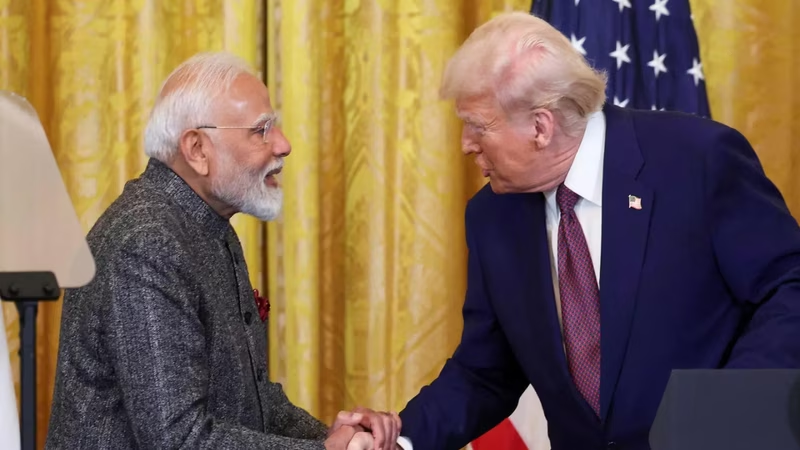
Just when Indo-US relations seemed to be cruising on a high—buoyed by defense deals, tech partnerships, and shared democratic values—a familiar voice from Mar-a-Lago has thrown a diplomatic curveball. Former US President Donald Trump recently claimed that Prime Minister Narendra Modi is “not that happy” with him, all because of steep US tariffs imposed on India over its energy ties with Russia. The comment, made during a campaign rally, has once again spotlighted the delicate balancing act India performs between its long-standing partner Russia and its strategic ally, the United States.
But there’s more beneath the surface. The India-US trade row isn’t just about oil—it’s entangled with defense procurement delays, geopolitical alignments, and the looming shadow of US sanctions under the Countering America’s Adversaries Through Sanctions Act (CAATSA). As India reduces its Russian oil imports in response to US pressure, frustrations are simmering on both sides. Let’s unpack what’s really going on.
Table of Contents
- Trump’s Claim: What He Said and Why It Matters
- The Russian Oil Dilemma: India’s Energy Realpolitik
- US Tariffs and Sanctions: The Legal and Economic Leverage
- Beyond Oil: Apache Helicopter Delivery Delays Fuel Indian Concerns
- Can the Indo-US Strategic Partnership Weather This Storm?
- Conclusion: Walking a Tightrope Between Moscow and Washington
- Sources
Trump’s Claim: What He Said and Why It Matters
Speaking to supporters in Florida, Trump asserted: “Modi is not that happy with me right now because of the tariffs we put on them… because they were buying a lot of oil from Russia.” He added that India has since “cut it way down,” implying that US pressure worked. While framed as a boast, the remark carries significant diplomatic weight.
What makes this noteworthy is the context: Trump is no longer in office, yet his statements influence market sentiment and political narratives. More importantly, they reflect a persistent US stance—shared by the Biden administration—that countries aiding Russia’s war economy through energy purchases must face consequences. By naming Modi directly, Trump turned a technical trade issue into a personal diplomatic slight, raising eyebrows in New Delhi.
The Russian Oil Dilemma: India’s Energy Realpolitik
India’s surge in Russian oil imports—jumping from under 2% of total imports pre-2022 to over 35% in 2023–24—was never about ideology. It was a pragmatic response to discounted barrels that helped stabilize domestic fuel prices and shield the economy from global volatility.
However, this move put India in the crosshairs of US sanctions policy. While Washington granted India a waiver from CAATSA penalties (largely due to its strategic value in countering China), it didn’t come without strings. The US has consistently urged India to diversify its energy sources and reduce reliance on Moscow.
And India has listened. According to data from the US Department of Energy and Indian oil ministry reports, India’s Russian crude purchases have steadily declined since mid-2025. By late 2025, the share had dropped to around 18–20%, as India increased imports from the US, Iraq, and Saudi Arabia. This shift shows New Delhi is keenly aware of the diplomatic cost of its Moscow ties.
US Tariffs and Sanctions: The Legal and Economic Leverage
While Trump spoke of “tariffs,” the actual US pressure on India has been more nuanced. The Biden administration has avoided blanket tariffs on Indian goods. Instead, it’s used targeted measures and the threat of secondary sanctions to influence behavior.
Key tools in the US arsenal include:
- Generalized System of Preferences (GSP) suspension: The US revoked India’s GSP benefits in 2019, affecting $5.6 billion in exports.
- CAATSA monitoring: Though India hasn’t been sanctioned for the S-400 missile deal, every major defense transaction with Russia is scrutinized.
- Section 301 investigations: The US Trade Representative has probed Indian digital services taxes and market access barriers.
Trump’s reference to “tariffs” may be a simplification, but it points to a real concern in New Delhi: that future US administrations could impose punitive duties on Indian pharmaceuticals, textiles, or IT services if geopolitical alignment falters.
Beyond Oil: Apache Helicopter Delivery Delays Fuel Indian Concerns
Adding to the friction is a separate but equally sensitive issue: the delayed delivery of Boeing AH-64E Apache helicopters to the Indian Air Force. India signed a $900 million deal for six Apaches in 2015, with deliveries expected to conclude by 2020. Yet, as of early 2026, logistical and bureaucratic bottlenecks—some tied to US export licensing and component sourcing—have caused frustrating delays.
Indian defense officials have privately expressed disappointment, noting that timely delivery of such critical platforms is essential for mountainous border operations, particularly along the Line of Actual Control with China. This frustration, combined with trade tensions, creates a perception in India that its strategic partnership with the US comes with unspoken conditions and unreliable timelines.
For more on defense procurement challenges, see our analysis on [INTERNAL_LINK:india-us-defense-deals-delays-2026].
Can the Indo-US Strategic Partnership Weather This Storm?
Despite these tensions, experts agree the broader Indo-US relationship remains fundamentally strong. The two nations share deep interests in countering Chinese assertiveness, advancing semiconductor supply chains, and promoting clean energy.
The India-US trade row is less a rupture and more a stress test of a maturing partnership. Unlike transactional relationships, strategic alliances involve negotiation, compromise, and occasional friction. India’s ability to reduce Russian oil imports while maintaining defense autonomy shows diplomatic dexterity. Meanwhile, the US continues to view India as a cornerstone of its Indo-Pacific strategy.
As former US Ambassador to India Kenneth Juster once noted, “The US-India relationship is not frictionless, but it is resilient.” That resilience will be key in the months ahead, especially with a potential Trump return in 2028 looming large over policy continuity.
Conclusion: Walking a Tightrope Between Moscow and Washington
The India-US trade row sparked by Trump’s comments is a reminder that even the strongest alliances require constant calibration. India is navigating a near-impossible trinity: energy security, strategic autonomy, and great-power alignment. Its gradual pivot away from Russian oil demonstrates responsiveness to US concerns, while its complaints over Apache delays underscore legitimate expectations from a defense partner.
For Prime Minister Modi, the challenge is clear: maintain India’s independent foreign policy without alienating Washington. For the US, the task is equally delicate: apply pressure without pushing India back into Russia’s orbit. In this high-stakes game of geopolitical chess, both sides know that cooperation—not confrontation—is the only path forward.
Sources
- Trump’s remarks and trade context: Times of India
- India’s oil import data: U.S. Energy Information Administration (EIA)
- CAATSA and defense policy: U.S. Department of State
- Indo-US strategic framework: The White House