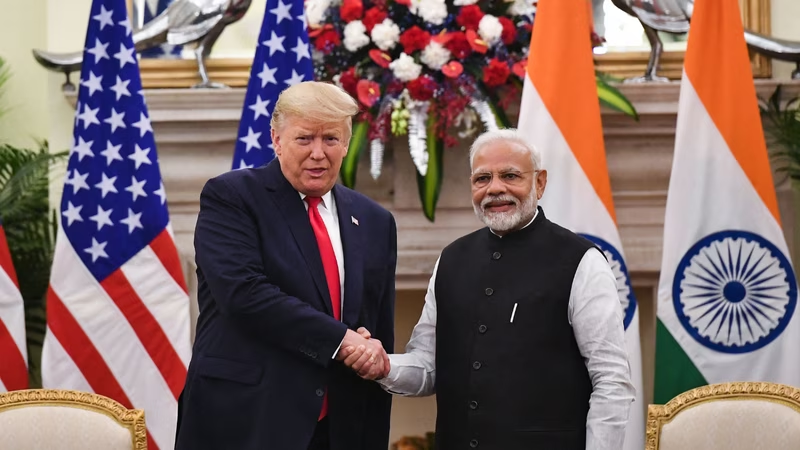
Forget the photo ops and handshakes. When it comes to the high-stakes relationship between the world’s oldest and largest democracies, is there genuine trust beneath the surface? According to Sergio Gor—a key figure in Donald Trump’s 2024 presidential campaign and former national finance chair—the answer is a resounding yes.
“The friendship between President Trump and Prime Minister Modi is real,” Gor stated emphatically during a recent interaction in New Delhi, cutting through years of speculation about whether their bromance was merely performative . His comments come at a pivotal moment: as both nations navigate complex geopolitical shifts and attempt to revive long-stalled negotiations on a comprehensive India-US trade deal.
Table of Contents
- Who Is Sergio Gor—and Why His Words Matter
- The Trump-Modi Bond: More Than Just Handshakes?
- Current Status of the India-US Trade Deal
- Key Sticking Points in Bilateral Trade Talks
- Geopolitical Context: Why This Alliance Is Critical Now
- What a Trump 2025 Win Could Mean for India
- Conclusion: Beyond Personalities to Partnership
- Sources
Who Is Sergio Gor—and Why His Words Matter
Sergio Gor isn’t just another political operative. As National Finance Chair for Trump’s 2024 campaign and a senior advisor with deep ties to Republican foreign policy circles, he wields significant influence. His role gives him direct access to the former president’s thinking on global affairs—including his views on India.
Gor’s visit to India wasn’t ceremonial. He engaged with business leaders, think tanks, and policymakers, signaling sustained US interest in strengthening ties regardless of who wins the November 2024 election. His public endorsement of the Trump-Modi rapport carries weight because it reflects internal GOP sentiment at a time when India is being courted by both Washington and Beijing.
The Trump-Modi Bond: More Than Just Handshakes?
Their chemistry has been undeniable since their first meeting in 2017. From “Howdy, Modi!” in Houston to Trump calling Modi a “friend” during tense UN debates, the two leaders have cultivated a relationship that defies typical diplomatic protocol.
Critics dismiss it as optics—but Gor insists it’s substantive. “They speak candidly, directly, and with mutual respect,” he noted. This personal channel, he argues, helped de-escalate tensions during trade disputes and facilitated cooperation on defense (like the GE-HAL jet engine deal) and tech partnerships under the iCET framework .
Current Status of the India-US Trade Deal
Despite warm rhetoric, a full-fledged India-US trade deal remains elusive. Negotiations have been stuck since 2019, when the Trump administration removed India from the Generalized System of Preferences (GSP), citing unfair trade barriers.
Gor acknowledged the challenges but expressed optimism: “Both sides recognize the strategic imperative. A deal isn’t just about tariffs—it’s about supply chain resilience, critical minerals, and countering economic coercion.” While no timeline was given, he confirmed that technical teams are quietly re-engaging on sectoral agreements—particularly in agriculture, pharmaceuticals, and digital trade.
Progress on Minilateral Cooperation
Even without a bilateral pact, India and the US are advancing trade through groups like the Indo-Pacific Economic Framework (IPEF) and the Quad. These platforms allow incremental progress on standards, clean energy, and semiconductor supply chains—areas where a grand bargain might be too politically fraught .
Key Sticking Points in Bilateral Trade Talks
Several issues continue to block a comprehensive agreement:
- Agricultural Tariffs: The US wants lower duties on dairy, almonds, and apples; India resists to protect its farmers.
- Data Localization: American tech firms oppose India’s strict data storage rules.
- Medical Devices & Pharma: Price controls and patent regulations remain contentious.
- Digital Services Tax: The US opposes India’s equalization levy on foreign tech companies.
As the Office of the US Trade Representative notes, resolving these requires “creative flexibility” from both capitals.
Geopolitical Context: Why This Alliance Is Critical Now
Beyond commerce, the India-US partnership is a cornerstone of democratic stability in Asia. With China expanding its military footprint and Russia deepening ties with Beijing, Washington sees India as an indispensable counterweight.
Gor emphasized that any future US administration—Republican or Democrat—will prioritize this alliance. “This isn’t partisan,” he said. “It’s strategic necessity.” For India, closer US ties offer access to advanced defense tech, investment, and a seat at the table in shaping 21st-century rules.
What a Trump 2025 Win Could Mean for India
If Trump returns to the White House, experts predict a more transactional but potentially faster-moving approach:
- Deal-focused diplomacy: Less emphasis on human rights, more on quick trade wins.
- Stronger anti-China alignment: Expect tighter coordination on tech decoupling and naval patrols.
- Visa policy uncertainty: H-1B restrictions could return, affecting Indian IT workers.
However, Gor hinted that Trump respects Modi’s sovereignty: “He won’t lecture India on domestic policy. He’ll focus on what benefits America—and sees India as a partner who delivers.”
Conclusion: Beyond Personalities to Partnership
Whether the Trump-Modi “friendship” is genuine or not matters less than the structural alignment between India and the US. As Sergio Gor’s remarks underscore, the relationship has matured beyond individual leaders. The push for an India-US trade deal is now embedded in a broader strategic vision—one that prioritizes democratic resilience, economic security, and technological sovereignty. Personal rapport may open doors, but shared interests will keep them open.
Sources
- Times of India: ‘Trump friendship with PM Modi real’: Sergio Gor underscores India-US bond
- Ministry of External Affairs, India: Statements on US-India Comprehensive Global Strategic Partnership
- Office of the United States Trade Representative (USTR): India Trade Relations
- Carnegie Endowment for International Peace: “The Future of US-India Trade Under a Second Trump Term” (2025)
- Brookings Institution: “Why the US-India Alliance Matters in a Multipolar World”