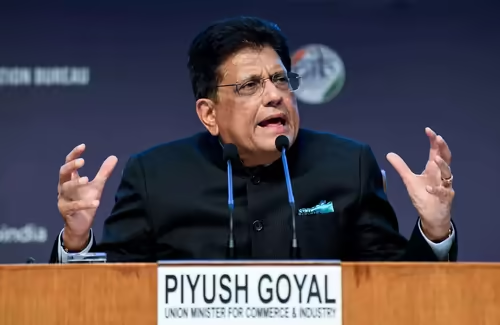
The long, winding road to a comprehensive India-US trade deal might just be reaching its destination. In a recent statement that has reignited market optimism, India’s Commerce and Industry Minister, Piyush Goyal, offered a refreshingly candid yet hopeful perspective on the state of negotiations.
Goyal’s message was clear: while there’s no disappointment over past delays, both nations are firmly committed to their own economic interests. This isn’t a sign of friction, he insists, but a hallmark of mature diplomacy between two of the world’s largest democracies [[2]].
Table of Contents
- The Current State of Play
- Why the India-US Trade Deal Matters
- Key Sticking Points in the Negotiations
- India’s Broader FTA Strategy
- What a Final Deal Could Mean
- Conclusion
- Sources
The Current State of Play
Minister Goyal confirmed that negotiations with the United States remain “friendly” and are very much active. His comments come on the heels of the Economic Survey 2026, which also suggested that a deal could be sealed within the year [[4]]. Even former President Donald Trump has weighed in, stating that an agreement could conclude in the first half of 2026 [[1]].
This marks a significant shift from the often-stalled talks of previous years. The core principle guiding India’s stance is one of fair trade that doesn’t compromise its economic sensitivities. As Goyal put it, “every country has to look after its own interests,” a pragmatic view that underpins India’s entire foreign trade policy.
Why the India-US Trade Deal Matters
A successful India-US trade deal would be a geopolitical and economic game-changer. It would formalize and deepen a relationship that has already seen tremendous growth in sectors like technology, defense, and pharmaceuticals.
For businesses on both sides of the Pacific, it promises:
- Reduced Tariffs: Lowering or eliminating duties on a wide range of goods, making products more competitive.
- Predictable Market Access: Creating a stable and transparent regulatory environment for investors.
- Enhanced Supply Chain Resilience: Diversifying sources away from single regions, a key strategic priority for both nations.
This deal isn’t just about economics; it’s a strategic alignment against a backdrop of global uncertainty. For more on how global trade is evolving, see our deep dive on [INTERNAL_LINK:global-supply-chain-trends].
Key Sticking Points in the Negotiations
Despite the positive momentum, several complex issues remain on the table. Historical tensions have often centered around market access and tariffs [[17]].
The primary areas of negotiation include:
Agricultural Market Access
The US has long sought greater access to India’s vast agricultural market, particularly for dairy and poultry products. India, however, is cautious about protecting its millions of small-scale farmers from a potential influx of heavily subsidized American produce [[22]].
Digital Trade and Data Privacy
As two tech giants, rules governing data flows, digital services taxes, and intellectual property in the digital space are critical. Finding common ground on data localization requirements has been a persistent challenge [[24]].
Medical Devices and Pharmaceuticals
India is a global pharmacy, but the US seeks better price transparency and patent protections. Conversely, India wants easier pathways for its generic drugs and medical devices to enter the American market.
India’s Broader FTA Strategy
It’s crucial to view the India-US trade deal within the context of India’s aggressive and highly successful FTA diplomacy in recent years. 2025 was a landmark year, with India signing major agreements with the UK, the European Union, New Zealand, and Oman [[11], [15]].
This strategy demonstrates that India is not waiting for a single deal to drive its global trade ambitions. Instead, it’s building a network of high-quality partnerships. A deal with the US, however, remains the “crown jewel” due to the sheer scale and strategic depth of the relationship.
| Recent Indian FTAs (Signed/Implemented) | Year |
|---|---|
| India-United Kingdom CECA | 2025 |
| India-European Union FTA | 2026 (Implementation) |
| India-New Zealand FTA | 2025 |
| India-Oman CEPA | 2025 |
What a Final Deal Could Mean
If successfully concluded, the pact is expected to significantly boost bilateral trade, which already stands at over $190 billion. It would send a powerful signal to global markets about the strength of the Indo-Pacific partnership.
For the average consumer, it could mean a wider variety of goods at potentially lower prices. For businesses, it would unlock new avenues for growth and collaboration. According to early reports, India is willing to selectively reduce tariff duties to improve US market access, a sign of serious intent [[20]].
Conclusion
Piyush Goyal’s latest update is more than just diplomatic speak; it’s a strong indicator that the political will exists on both sides to finally close the India-US trade deal. While challenges remain, the shared strategic interests and the maturity of the relationship suggest that 2026 could indeed be the breakthrough year everyone has been waiting for. The world will be watching closely as these two economic powerhouses move towards a historic agreement.
Sources
- Times of India: India-US trade deal: Piyush Goyal shares update [[2]]
- Economic Survey 2026: Will India-US trade deal be sealed this year? [[4]]
- USISPF: Trade at a Crossroads: US-India Trade Relationship [[17]]
- India Today: India’s 2025 trade deals: Full list of countries [[11]]
- ClearTax: Free Trade Agreements (FTA): Bilateral, Multilateral and [[12]]