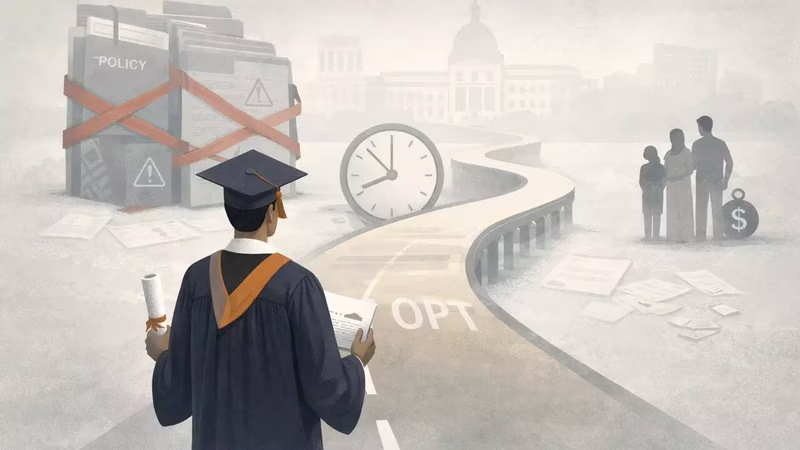
For over a decade, a quiet pact has fueled one of the largest educational migrations in history: Indian students head to the United States for world-class degrees, and in return, they get a shot at real-world experience through **Optional Practical Training (OPT)**—a post-graduation work permit that often serves as a stepping stone to H-1B visas and long-term careers. This arrangement powered the India US education boom, with over 330,000 Indian students now enrolled in American universities—the second-largest international cohort after China .
But that unwritten contract is under serious threat. In Washington, OPT is increasingly being recast not as a student benefit, but as a “backdoor” immigration loophole. Proposals are now circulating to **cut, tax, or time-limit** this critical post-study runway. For Indian families who’ve mortgaged homes and drained savings to fund $50,000–$80,000 annual degrees, the risk is stark: the degree stays costly, but the payoff window is rapidly shrinking.
Table of Contents
- What Is OPT and Why It Matters
- Why Indian Students Depend on OPT More Than Others
- The Washington Crackdown: New Proposals Targeting OPT
- The Financial Impact on Indian Families
- Are Alternatives Like Canada or Germany Rising?
- What Indian Students Can Do Now
- Conclusion: A Self-Inflicted Talent Drain?
- Sources
What Is OPT and Why It Matters
OPT allows F-1 student visa holders to work in the U.S. for up to **12 months** after graduation—extendable to **36 months** for STEM (Science, Technology, Engineering, Math) majors. It’s not a visa, but a temporary employment authorization tied to the student’s field of study.
For Indian students, OPT is far more than a resume booster. It’s the **only legal pathway** to gain U.S. work experience without an employer-sponsored H-1B visa—which has a notoriously low lottery success rate (around 10–15% in recent years) . Without OPT, most graduates would have to leave the country immediately after commencement, rendering their expensive degrees largely theoretical in the American job market.
Why Indian Students Depend on OPT More Than Others
While students from many countries use OPT, Indians are uniquely reliant due to three structural factors:
- H-1B bottleneck: With over 70% of H-1B petitions filed by Indian nationals, competition is fierce—and the annual cap of 85,000 is woefully inadequate .
- No direct work visas: Unlike some European nations, the U.S. offers no post-study work visa independent of employer sponsorship.
- High ROI expectations: Indian families view U.S. education as a long-term investment; OPT is the bridge to recouping that cost through U.S. salaries.
“For us, OPT isn’t optional—it’s essential,” says Priya M., a computer science graduate from Purdue University. “Without it, my $200,000 degree would’ve been a luxury, not an investment.”
The Washington Crackdown: New Proposals Targeting OPT
Recent political rhetoric has painted OPT as a system ripe for abuse. Lawmakers from both parties have introduced measures that could drastically alter its landscape:
- Time limits: Proposals to cap OPT at 12 months for *all* majors, eliminating the 24-month STEM extension.
- New taxes: Draft bills suggest imposing a “foreign worker fee” on OPT employers—potentially discouraging hiring.
- Stricter eligibility: Requiring higher GPA thresholds or limiting OPT to only top-tier universities.
While none have passed yet, the mere discussion has created uncertainty—a currency that devalues the perceived value of a U.S. degree in India .
The Financial Impact on Indian Families
The stakes couldn’t be higher. The average Indian family spends **₹35–50 lakh** ($42,000–$60,000) per year on U.S. tuition and living costs. Many take high-interest education loans with 10–12% rates, betting on post-OPT salaries of $80,000–$120,000 to repay debt within 3–5 years.
If OPT is curtailed, that math collapses. Without U.S. work experience, graduates returning to India often face starting salaries of ₹6–12 lakh—making loan repayment stretch over a decade or more. “We’re not just risking money—we’re risking our child’s future,” says Rajesh K., a father from Hyderabad.
Are Alternatives Like Canada or Germany Rising?
Yes—and fast. Countries like **Canada**, **Australia**, and **Germany** are actively marketing themselves as more welcoming alternatives:
- Canada: Offers a 3-year post-graduation work permit (PGWP) with a clear path to permanent residency.
- Germany: Allows 18 months of job-seeking time post-graduation, with low or no tuition fees at public universities.
- Australia: Extends post-study work rights up to 6 years for select degrees.
According to ICEF Monitor, Indian student applications to Canada surged by 42% in 2025, while U.S. growth slowed to just 8%—a telling shift in confidence .
What Indian Students Can Do Now
If you’re planning or currently studying in the U.S., consider these proactive steps:
- Choose STEM-designated programs: They still offer the 36-month OPT window—maximize it.
- Apply for CPT early: Curricular Practical Training lets you work during studies, building U.S. experience.
- Explore state-level opportunities: Some states (e.g., Texas, Florida) offer talent retention programs for grads.
- Have a Plan B: Research PR pathways in Canada or Australia as a backup.
[INTERNAL_LINK:best-stem-courses-for-opt-extension] can help you pick the right program.
Conclusion: A Self-Inflicted Talent Drain?
The irony is profound: by restricting OPT, the U.S. may be cutting off its own talent pipeline. Indian students don’t just fill classrooms—they fuel Silicon Valley, healthcare, and research labs. Pushing them away won’t stop immigration; it will simply redirect it to more welcoming shores. The India US education boom was built on mutual benefit. If Washington dismantles its foundation, both nations—and the global innovation ecosystem—will pay the price.
Sources
- Times of India: OPT and the uneasy truth behind India’s US education boom
- U.S. Department of Homeland Security: Official OPT Guidelines
- National Foundation for American Policy: H-1B Visa Statistics 2025
- ICEF Monitor: Global Student Mobility Trends Q4 2025
- [INTERNAL_LINK:us-vs-canada-for-indian-students]
- [INTERNAL_LINK:h1b-lottery-success-tips]