Table of Contents
- The ‘Mother of All Deals’: India-EU FTA
- India’s Trade Blitz Since 2021
- Why This Strategy Matters for India
- Key Sectors Set to Benefit
- Challenges and Next Steps
- Conclusion: A New Era of Economic Diplomacy
- Sources
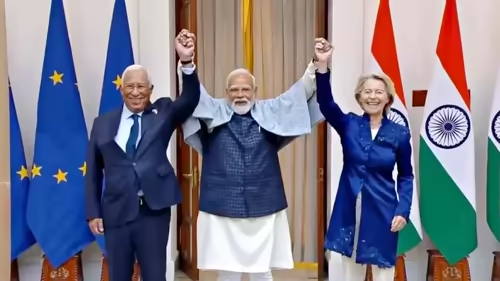
In a defining moment for India’s economic diplomacy, the country has sealed its eighth major trade agreement since 2021—the long-awaited Free Trade Agreement (FTA) with the European Union. Finalized during the Republic Day celebrations, this landmark deal has been hailed as the “mother of all deals” for its sheer scale and potential to transform India’s export landscape [[1]]. But this isn’t an isolated win. It’s the crowning jewel in a meticulously executed series of India trade agreements that signal a bold new chapter in the nation’s global economic strategy.
The ‘Mother of All Deals’: India-EU FTA
The India-EU FTA is more than just another trade pact—it’s a strategic masterstroke. Covering all 27 EU member states, the agreement promises unprecedented market access for Indian goods and services. Key Indian exports like textiles, pharmaceuticals, gems and jewellery, leather, and agricultural products will now face significantly reduced or eliminated tariffs, opening a €15 trillion consumer market to Indian businesses [[3]].
Crucially, the deal also includes strong protections for over 200 Indian Geographical Indications (GIs)—from Darjeeling Tea to Alphonso Mangoes—ensuring their authenticity and premium value in Europe. For Indian MSMEs and startups, this means not just access, but a level playing field in one of the world’s most regulated and lucrative markets.
India’s Trade Blitz Since 2021
The EU deal is the latest in a rapid succession of trade pacts that showcase India’s proactive shift from a defensive to an offensive trade posture. Here’s a look at the seven other major agreements signed since 2021:
- Australia (2022): The India-Australia Economic Cooperation and Trade Agreement (ECTA) slashed tariffs on over 6,000 Indian products, boosting exports of textiles, gems, and pharmaceuticals.
- UAE (2022): The Comprehensive Economic Partnership Agreement (CEPA) with the UAE was India’s fastest-negotiated trade deal, aiming to increase bilateral trade to $100 billion within five years.
- UK (2023 – Provisional): Though still under final ratification, the India-UK FTA is expected to eliminate tariffs on 99% of Indian goods, creating massive opportunities in engineering, food, and beverages.
- Oman (2023): The CEPA with Oman focuses on energy, logistics, and digital services, strengthening India’s footprint in the Gulf region.
- Malaysia (2024): After years of stalled talks, India and Malaysia revived their FTA, targeting growth in electronics, palm oil, and IT services.
- Indonesia (2024): A new trade framework aims to deepen cooperation in critical minerals, EV supply chains, and halal products.
- Mauritius (2021): The Comprehensive Economic Cooperation and Partnership Agreement (CECPA) was India’s first such pact with an African nation, enhancing connectivity and investment flows.
This aggressive expansion reflects a clear strategy: diversify trade partners, reduce reliance on any single market, and embed India firmly into global value chains.
Why This Strategy Matters for India
These India trade agreements are not just about boosting export numbers—they’re about national resilience and strategic autonomy. In a world marked by geopolitical volatility and supply chain disruptions, having multiple high-quality trade corridors is essential. Each new pact:
- Reduces trade deficits by opening new markets for Indian goods.
- Attracts foreign direct investment (FDI) by signaling a stable, open, and rules-based business environment.
- Creates jobs across manufacturing, agriculture, and services sectors.
- Enhances India’s geopolitical leverage by building deep economic interdependence with key democratic and strategic partners.
For more on how trade policy shapes national security, see our analysis on [INTERNAL_LINK:economic-diplomacy-india].
Key Sectors Set to Benefit
While the benefits are economy-wide, certain sectors stand to gain disproportionately from this wave of agreements:
- Pharmaceuticals: With data exclusivity and regulatory alignment in EU and UK deals, Indian generic drug makers can expand their footprint in high-income markets.
- Textiles & Apparel: Tariff-free access to EU, UK, and Australia will revitalize India’s traditional strength in cotton, silk, and handloom exports.
- Information Technology: Enhanced mobility for professionals and mutual recognition of qualifications will boost India’s $250 billion IT services industry.
- Agriculture: GI protections and reduced barriers for spices, tea, and fruits will empower farmers and agri-exporters.
- Renewable Energy: Partnerships with the EU and UAE include green tech collaboration, positioning India as a clean energy hub.
Challenges and Next Steps
Despite the momentum, challenges remain. Domestic industries may face increased competition, requiring robust support mechanisms. Implementation bottlenecks—customs digitization, standards compliance, and logistics—are critical. Moreover, negotiations with Canada, Israel, and the Southern African Customs Union (SACU) are ongoing and could face hurdles.
The next phase will focus on effective implementation, capacity building for exporters, and ensuring that the gains from these deals are inclusive—reaching small farmers, artisans, and rural entrepreneurs, not just large corporations.
Conclusion: A New Era of Economic Diplomacy
From the UAE to the EU, India’s trade blitz since 2021 marks a decisive break from decades of cautious trade policy. The signing of the eighth major pact—the historic EU FTA—cements India’s emergence as a confident, outward-looking economic power. These India trade agreements are more than commercial contracts; they are strategic instruments to secure prosperity, build resilience, and elevate India’s voice in the 21st-century global order. The real test now lies not in signing, but in delivering tangible benefits to every corner of the Indian economy.
Sources
- Times of India. “Not just ‘mother of all deals’: FTA with EU and 7 other trade pacts signed by India since 2021.” https://timesofindia.indiatimes.com/…
- Ministry of Commerce and Industry, Government of India. “List of Signed Trade Agreements.” https://commerce.gov.in/…
- European Commission. “EU-India Trade and Investment Agreement: Key Outcomes.” https://ec.europa.eu/…
- World Bank. “India Development Update: Navigating Global Headwinds.” https://www.worldbank.org/…
- FICCI. “Impact Assessment of India’s Recent FTAs on MSMEs.” https://ficci.in/…