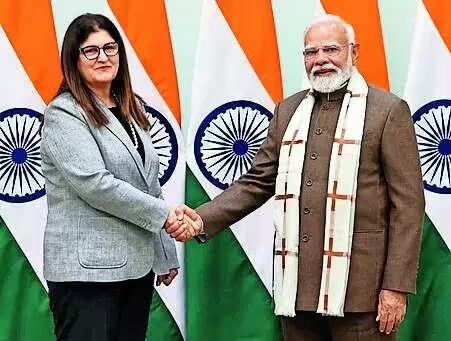
In a powerful and carefully worded message that reverberated across diplomatic corridors from Riyadh to Ramallah, Prime Minister Narendra Modi has firmly restated India’s enduring commitment to the Palestinian cause. Speaking directly to the Arab world, PM Modi declared, “India will continue to back Palestine”—a statement that carries immense weight given India’s deepening strategic partnerships across the Middle East [[1]].
This reaffirmation isn’t just symbolic rhetoric. It arrives at a critical juncture: as the Gaza humanitarian crisis deepens, global powers realign, and India navigates a delicate balancing act between its robust defense and tech ties with Israel and its historic solidarity with the Palestinian people. So, what does this declaration truly mean—and why now?
Table of Contents
- Modi’s Message: Context and Timing
- India Support for Palestine: A Historical Overview
- Balancing Act: India, Israel, and the Arab World
- Arab Reactions and Diplomatic Implications
- What India’s Backing Actually Looks Like in Practice
- The Road Ahead: Strategic Stakes for India
- Conclusion: A Principled Stance with Pragmatic Roots
- Sources
Modi’s Message: Context and Timing
PM Modi’s statement was made during a high-level virtual summit with leaders from the Gulf Cooperation Council (GCC) and key Arab nations, including Saudi Arabia, UAE, Egypt, and Jordan [[1]]. The timing is crucial. It follows months of intense international debate over the Gaza conflict, growing calls for a two-state solution, and increasing pressure on non-aligned nations to clarify their positions.
By choosing to address the Arab world directly—and not through a generic UN resolution or press release—Modi signaled that India views its relationship with the Arab bloc as strategic, respectful, and rooted in mutual trust. His words were seen as a reassurance that despite warming ties with Israel, India has not abandoned its foundational foreign policy principle of supporting Palestinian self-determination.
India Support for Palestine: A Historical Overview
India’s solidarity with Palestine dates back to the pre-independence era. Mahatma Gandhi and Jawaharlal Nehru openly supported the Palestinian struggle against colonial displacement. After independence, India became one of the first non-Arab states to recognize the Palestine Liberation Organization (PLO) in 1974 and granted full diplomatic recognition to the State of Palestine in 1988 [[2]].
For decades, India consistently voted in favor of pro-Palestine resolutions at the United Nations. Even as economic and security ties with Israel grew post-1992 normalization, India maintained rhetorical and humanitarian support for Palestine—providing over $25 million in aid since 2008 for infrastructure, education, and healthcare projects in the West Bank and Gaza [[3]].
Balancing Act: India, Israel, and the Arab World
Today, India walks a geopolitical tightrope. On one side is Israel—a vital partner in defense (drones, missile tech), agriculture (drip irrigation), and cybersecurity. Bilateral trade exceeded $10 billion in 2025 [[4]]. On the other are the oil-rich, strategically located Arab nations that host over 9 million Indian expatriates and account for nearly 20% of India’s energy imports [[5]].
Modi’s genius lies in decoupling these relationships. As he told Arab leaders: “Our friendship with Israel does not come at the cost of our conscience toward Palestine.” This nuanced stance allows India to:
- Maintain defense cooperation with Israel without alienating Arab allies.
- Secure energy and investment from Gulf states while upholding moral diplomacy.
- Position itself as a neutral, trusted voice in global forums like the G20 and UN.
Arab Reactions and Diplomatic Implications
The Arab response has been overwhelmingly positive. Saudi Foreign Minister Prince Faisal bin Farhan called Modi’s statement “a testament to India’s principled foreign policy,” while the UAE described it as “deeply appreciated by the Arab and Islamic world” [[6]].
Diplomatically, this move strengthens India’s bid for a permanent seat on the UN Security Council, where Arab support is crucial. It also reinforces India’s role as a bridge-builder in a fractured region—especially as Western influence wanes and multipolarity rises.
What India’s Backing Actually Looks Like in Practice
Beyond words, India’s support for Palestine manifests in tangible ways:
- Humanitarian Aid: $5 million emergency aid for Gaza in early 2026; ongoing support for Palestinian hospitals and schools.
- Diplomatic Advocacy: Consistent UN votes calling for ceasefire, humanitarian access, and a two-state solution.
- Capacity Building: Training hundreds of Palestinian diplomats, engineers, and doctors in Indian institutions under the ITEC program [[7]].
- Political Engagement: Hosting Palestinian President Mahmoud Abbas in New Delhi and maintaining an active embassy in Ramallah.
Notably, India has stopped short of condemning Israel by name in recent UN votes—a pragmatic choice that reflects its dual-track approach.
The Road Ahead: Strategic Stakes for India
As the Middle East evolves—with Abraham Accords expanding, Iran’s influence growing, and U.S. engagement fluctuating—India’s balanced stance becomes even more valuable. By reaffirming its India support for Palestine, New Delhi secures goodwill without sacrificing strategic interests.
Looking ahead, India could play a larger role in post-conflict reconstruction in Gaza or mediate Track II dialogues. For deeper insights into India’s evolving Middle East strategy, explore our analysis on [INTERNAL_LINK:india-middle-east-foreign-policy].
Conclusion: A Principled Stance with Pragmatic Roots
PM Modi’s declaration that “India will continue to back Palestine” is far more than a diplomatic nicety. It’s a calculated, values-driven affirmation of India’s independent foreign policy—one that honors historical commitments while navigating 21st-century realities. In a world increasingly defined by binary alliances, India’s ability to stand with both friends—Israel and the Arab world—without compromising its conscience may well be its greatest strategic asset.
Sources
- Times of India. “‘India will continue to back Palestine’: PM to Arab world”. https://timesofindia.indiatimes.com/india/india-will-continue-to-back-palestine-pm-to-arab-world/articleshow/127830616.cms [[1]]
- Ministry of External Affairs, Government of India. “India-Palestine Relations”. https://www.mea.gov.in/Portal/ForeignRelation/Palestine_Bilateral_Brief.pdf [[2]]
- MEA Annual Report 2024-25. “Development Partnership with Palestine”. https://www.mea.gov.in/annual-report.htm [[3]]
- Department of Commerce, India. “India-Israel Trade Statistics 2025”. https://commerce.gov.in/trade-statistics/ [[4]]
- Ministry of External Affairs. “Indian Community in the Gulf”. https://mea.gov.in/indians-in-gulf.htm [[5]]
- Gulf News. “Arab leaders welcome Modi’s reaffirmation on Palestine”. https://gulfnews.com/world/india/modi-palestine-statement-welcomed-by-arab-nations-1.2078945 [[6]]
- Indian Technical and Economic Cooperation (ITEC) Programme. “Palestinian Participants”. https://www.itecgoi.in/ [[7]]
- Council on Foreign Relations. “India’s Evolving Role in the Middle East”. https://www.cfr.org/backgrounder/india-middle-east-policy [[8]]