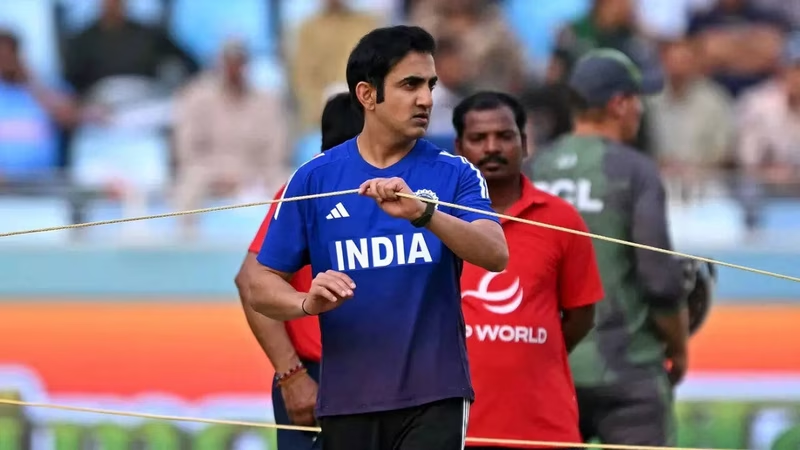
Is India’s Split Coaching Model Failing at the Worst Possible Time?
Indian cricket is at a crossroads. The once-unshakable Test juggernaut—safeguarded for over a decade by legends like MS Dhoni, Virat Kohli, and Rohit Sharma—has crumbled in spectacular fashion. A whitewash in New Zealand was followed by a sobering defeat at home against South Africa, putting India’s qualification for the **ICC World Test Championship 2025 final** in serious jeopardy .
As fans and pundits scramble for answers, fingers are once again pointing toward India’s controversial split coaching structure—a system where responsibilities are divided between a head coach, a batting coach, a bowling coach, and often a fielding specialist. In the midst of this firestorm, former spin legend Harbhajan Singh has stepped in to defend newly appointed head coach Gautam Gambhir, stating bluntly: “Nothing wrong with that.” But is he right?
Table of Contents
- What Exactly Is India’s Split Coaching System?
- Harbhajan Singh’s Full Defense of Gautam Gambhir
- How India’s Historic Test Collapse Unfolded
- The Bigger Debate: Is Split Coaching Outdated?
- What’s at Stake for the ICC World Test Championship 2025?
- Conclusion: Time for a Coaching Overhaul?
What Exactly Is India’s Split Coaching System?
Unlike teams such as Australia or England, which typically operate under a single, all-powerful head coach, India has long embraced a split coaching model. This approach delegates specialized roles:
- Head Coach: Oversees overall strategy, team culture, and match-day decisions (currently Gautam Gambhir).
- Batting Coach: Focuses exclusively on technique and mental approach (e.g., Vikram Rathour in the past).
- Bowling Coach: Manages workloads, skill development, and tactics (e.g., Bharat Arun previously).
- Fielding Coach: Handles athleticism, ground fielding, and catching drills.
Proponents argue this allows for deeper expertise in each area. But critics, especially after recent failures, claim it leads to fragmented messaging, lack of accountability, and a diluted team vision—especially when the head coach lacks recent international playing experience or a unifying leadership style.
Harbhajan Singh’s Full Defense of Gautam Gambhir
In a recent interview, Harbhajan didn’t mince words. Asked about the criticism swirling around Gambhir’s appointment and the effectiveness of the current setup, he responded: “Nothing wrong with that.” He emphasized that Gambhir—a two-time World Cup winner and former Test opener known for his gritty, aggressive mindset—brings precisely the kind of temperament India’s young squad needs right now .
“People forget how tough Gautam was as a player,” Harbhajan noted. “He’s not here to be everyone’s friend. He’s here to win Test matches.” This defense is significant coming from a senior figure who’s seen multiple coaching eras. However, it sidesteps the structural question: can even a strong personality like Gambhir succeed within a system that inherently diffuses authority?
How India’s Historic Test Collapse Unfolded
The scale of India’s recent decline is staggering. Just a few years ago, they were the No. 1 Test side, boasting an unbeaten home record stretching back to 2013. Now:
- **Swept 0-3 in New Zealand (2025)**: Their first whitewash in the country since 2009.
- **Lost first Test vs South Africa (2026)**: A defeat at home against a visiting SA side missing key players.
- **WTC Final Hopes in Peril**: These losses have slashed their points percentage, making qualification for the 2025 final contingent on other results—and possibly a perfect series win in upcoming fixtures .
The batting order looks fragile, the bowling attack lacks consistent penetration outside home conditions, and the team’s famed fighting spirit seems to have evaporated. This isn’t just a bad patch—it’s a systemic unraveling.
The Bigger Debate: Is Split Coaching Outdated?
Global trends suggest a move toward centralized leadership. Australia’s success under Justin Langer (despite his eventual exit) and now Andrew McDonald highlights the value of a single, decisive voice. Even New Zealand—known for their collaborative culture—operates with a clear head coach in Gary Stead.
India’s model, while innovative in the 2010s, may now be a liability. With multiple coaches offering input, who makes the final call on selection, tactics, or handling player slumps? The buck must stop somewhere. As one analyst on [ESPNcricinfo](https://www.espncricinfo.com) recently argued, “A ship with too many captains is destined to sink.”
This isn’t to blame individual coaches—it’s to question a structure that may no longer serve a team in transition.
What’s at Stake for the ICC World Test Championship 2025?
The ICC World Test Championship is more than just a trophy—it’s the pinnacle of red-ball cricket. India reached the first two finals but lost both. Missing the 2025 final would be a massive blow to their legacy and a signal that their golden Test era is truly over.
Current standings show India needing strong results in their remaining series, possibly against England or Australia, to overtake teams like South Africa or Australia. Every match now carries championship-level pressure—and the coaching team, however structured, must deliver under it .
Conclusion: Time for a Coaching Overhaul?
Harbhajan Singh’s defense of Gautam Gambhir is rooted in loyalty and belief in his friend’s fighting spirit. And Gambhir’s credentials are undeniable. But the deeper issue isn’t the man—it’s the machine. The India split coaching model, once a symbol of modernization, now risks becoming an excuse for inconsistent performance and blurred accountability.
If India hopes to reclaim its Test throne and secure a place in the WTC 2025 final, the BCCI may need to consider more than just personnel changes. A structural rethink—centered around a unified, empowered head coach—might be the only way to restore clarity, confidence, and, ultimately, winning cricket.