Confusion swirled online when news broke that India had opted out of a recent naval exercise involving several BRICS countries. Critics speculated about diplomatic rifts or strategic realignments. But the truth is far more procedural—and revealing of how India navigates multilateral defense engagements.
The Ministry of External Affairs (MEA) has now stepped in to clear the air: India skipped BRICS naval drills because the exercise simply wasn’t an official BRICS event. According to the MEA, the drill was a South African initiative—inviting select partners—but not endorsed or organized under the BRICS banner .
This clarification matters. With India currently holding the chairmanship of the expanded BRICS bloc (which now includes Egypt, Ethiopia, Iran, Saudi Arabia, and the UAE), every move is scrutinized for signals about New Delhi’s foreign and defense policy priorities.
Table of Contents
- What Happened? The South African Naval Exercise
- Why India Skipped BRICS Naval Drills: MEA Explains
- The IBSAMAR Alternative: India’s Trusted Trilateral
- BRICS and Defense Cooperation: A Complex Landscape
- India’s Strategic Balancing Act as BRICS Chair
- Conclusion: Procedure Over Politics
- Sources
What Happened? The South African Naval Exercise
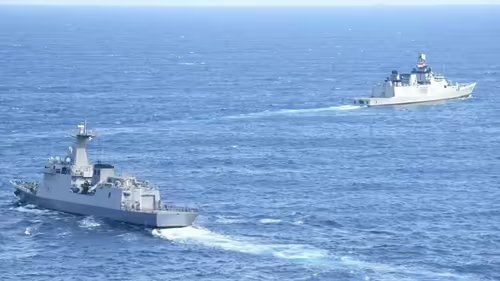
In early January 2026, South Africa hosted a naval exercise off its eastern coast, reportedly involving ships from Russia and China—both core BRICS members. Media outlets initially framed this as a “BRICS naval drill,” sparking headlines about India’s conspicuous absence .
However, the Indian government quickly pushed back on this characterization. Officials emphasized that while the exercise included BRICS nations, it was **not** a formal BRICS activity. There was no consensus among all BRICS members to conduct such a drill, nor was it coordinated through official BRICS defense or security channels.
South Africa, as a sovereign nation, has the right to host bilateral or multilateral exercises with any country it chooses. But labeling it a “BRICS drill” without collective agreement risks misrepresenting the bloc’s unified stance—a nuance India was keen to correct.
Why India Skipped BRICS Naval Drills: MEA Explains
During a press briefing, MEA spokesperson Arindam Bagchi stated plainly: “This was not a regular activity. It was a South African initiative.” He added that India participates in exercises based on strategic alignment, operational compatibility, and mutual interest—not merely because other BRICS members are involved .
Crucially, the MEA highlighted that India **does** engage in regular naval cooperation with both Brazil and South Africa through the **IBSAMAR** exercise—a trilateral maritime drill that has been held since 2008. This longstanding partnership, rooted in shared democratic values and maritime security concerns in the Indian and Atlantic Oceans, remains India’s preferred framework for naval collaboration with these two nations.
By drawing this distinction, India is signaling that it will not be drawn into ad hoc military groupings that could be perceived as anti-Western or aligned against specific powers—especially given its strategic autonomy doctrine and deep defense ties with the U.S., France, and Japan.
The IBSAMAR Alternative: India’s Trusted Trilateral
While the recent South African drill grabbed headlines, India’s real naval engagement with BRICS partners happens quietly through IBSAMAR. Here’s why it matters:
- Established Track Record: First held in 2008, IBSAMAR has seen seven editions, with the most recent in 2023 near Simon’s Town, South Africa.
- Shared Democratic Ethos: Unlike the broader BRICS, which now includes authoritarian regimes, IBSAMAR unites three vibrant democracies with converging views on rules-based maritime order.
- Operational Focus: The exercise emphasizes anti-piracy, search-and-rescue, and interoperability—not power projection or geopolitical signaling.
For India, IBSAMAR represents a stable, predictable, and values-aligned platform. It’s a far cry from a one-off drill that could be weaponized for political messaging by other actors.
BRICS and Defense Cooperation: A Complex Landscape
Despite being an economic and political bloc, BRICS has historically avoided formal military alliances. However, that’s changing. Russia and China have increasingly used BRICS forums to push for deeper security coordination, including joint exercises and intelligence sharing.
India, however, has consistently resisted this militarization. New Delhi’s position is clear: BRICS should remain focused on economic development, global governance reform, and technological cooperation—not defense integration. This stance puts India at odds with Moscow and Beijing, especially as they seek to counter Western influence.
As noted by the Center for Strategic and International Studies (CSIS), the expansion of BRICS has amplified these internal tensions, making consensus on security issues even harder to achieve .
India’s Strategic Balancing Act as BRICS Chair
India’s 2026 BRICS chairmanship comes at a delicate time. On one hand, it must uphold the bloc’s unity amid divergent geopolitical interests. On the other, it must protect its own strategic autonomy and Quad commitments.
By clarifying that it only participates in officially sanctioned BRICS activities—and by reaffirming its commitment to IBSAMAR—India is walking a tightrope with precision. It avoids alienating partners like South Africa while maintaining distance from Sino-Russian military overtures.
This approach aligns with India’s broader foreign policy doctrine: multi-alignment without entanglement. For more on this, see our analysis on [INTERNAL_LINK:india-foreign-policy-multi-alignment].
Conclusion: Procedure Over Politics
India’s decision to skip the recent naval exercise wasn’t a snub—it was a matter of principle and protocol. By insisting that the drill was not an official BRICS activity, the MEA reinforced a crucial norm: multilateral engagements require consensus, not just convenience.
As the BRICS bloc grows more diverse and complex, India’s emphasis on structured, transparent, and values-based cooperation—exemplified by IBSAMAR—will likely shape its future within the group. In a world of shifting alliances, New Delhi is betting that clarity and consistency are its strongest assets.
Sources
- Times of India: ‘Not regular activity’: MEA on why India skipped BRICS naval drills; cites IBSAMAR
- Center for Strategic and International Studies (CSIS): BRICS Expansion and Its Implications for the Global Order
- Indian Navy: IBSAMAR VII – 2023