US Threatens 500% Tariff on India Over Russian Oil Trade—But Claims New Delhi Has ‘Geared Down’
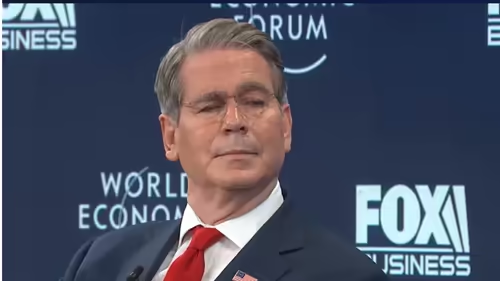
In a high-stakes move that could reshape global energy flows, the United States has openly threatened to impose a staggering 500% tariff on Indian goods if New Delhi continues its heavy reliance on discounted Russian crude. The warning, delivered by U.S. Treasury Secretary Scott Bessent during a recent policy address, comes amid mounting Western pressure to isolate Moscow economically following its invasion of Ukraine .
Yet, in a surprising twist, the same U.S. official acknowledged that India appears to have already begun scaling back its purchases—stating that New Delhi has “geared down” its India Russian oil trade. This dual message—part threat, part concession—reveals the delicate balancing act both nations are performing: Washington wants to enforce its sanctions regime without alienating a critical strategic partner in Asia.
Table of Contents
- The 500% Tariff Threat: What It Means
- How Much Russian Oil Does India Really Buy?
- Has India Actually ‘Geared Down’? The Evidence
- The G7 Price Cap and India’s Loopholes
- Strategic Implications for US-India Relations
- Conclusion: Walking the Tightrope Between Moscow and Washington
- Sources
The 500% Tariff Threat: What It Means
The proposed 500% tariff isn’t arbitrary—it’s tied to pending U.S. legislation aimed at penalizing countries that help Russia circumvent the G7-imposed price cap on its oil exports. Under this framework, any nation importing Russian crude above the $60-per-barrel cap could face severe trade consequences .
For India, which imported over 80% of its oil needs in 2025, such a tariff would be devastating. Key export sectors like pharmaceuticals, textiles, and IT services could face punitive duties, eroding competitiveness in the world’s largest economy. The threat is clearly designed to force compliance—but it also risks pushing India closer to China and Russia in a multipolar energy alliance.
How Much Russian Oil Does India Really Buy?
Since early 2022, India has become one of the top buyers of Russian crude, taking advantage of steep discounts (often 20–30% below market rates). At its peak in mid-2024, Russian oil accounted for nearly 40% of India’s total imports—up from just 2% before the Ukraine war .
This shift saved India an estimated $15–20 billion annually in import bills, helping stabilize its current account deficit and fuel economic growth. However, it also drew sharp criticism from Western allies who accused New Delhi of indirectly funding Moscow’s war machine.
India Russian oil trade: Has India Actually ‘Geared Down’?
According to U.S. Treasury data cited by Secretary Bessent, India’s imports of Russian crude have declined noticeably in late 2025 and early 2026. Preliminary figures suggest a drop to around 25–28% of total imports—a significant reduction, though still far above pre-war levels .
Analysts attribute this to several factors:
- Shipping and insurance constraints as Western firms avoid Russian-linked transactions.
- Payment bottlenecks due to restrictions on using dollars and euros.
- Diplomatic signaling to appease U.S. concerns ahead of key defense and tech deals.
Still, India maintains it is acting within international law and has not violated any UN sanctions—only those imposed unilaterally by the West.
The G7 Price Cap and India’s Loopholes
The G7 price cap, introduced in December 2022, allows countries to buy Russian oil only if they pay ≤$60/barrel and use Western-insured tankers. India, however, has largely bypassed this by:
- Using a “shadow fleet” of non-Western tankers (often flagged in UAE, Malaysia, or Greece).
- Paying in currencies like dirhams, yuan, or rupees via alternative banking channels.
- Negotiating direct barter deals (e.g., oil for pharmaceuticals or machinery).
While effective, these workarounds increase transaction costs and legal risks—making the U.S. threat of tariffs even more potent.
Strategic Implications for US-India Relations
This standoff tests the limits of the U.S.-India “strategic partnership.” On one hand, Washington sees India as a vital counterweight to China in the Indo-Pacific. On the other, it cannot ignore what it views as undermining of its sanctions architecture.
India, meanwhile, insists on “strategic autonomy”—the right to pursue its national interest without external diktats. As one senior Indian official told Reuters: “Energy security is non-negotiable” .
[INTERNAL_LINK:us-india-trade-relations-2026] will likely hinge on whether both sides can find a compromise—perhaps through a phased reduction in Russian imports paired with U.S. support for alternative energy sources.
Conclusion: Walking the Tightrope Between Moscow and Washington
The U.S. threat of a 500% tariff over the India Russian oil trade is less about immediate enforcement and more about sending a clear signal: alignment with Western economic policies is expected from strategic partners. India’s reported “gear down” may be enough to temporarily defuse tensions, but the underlying conflict remains.
As global energy politics grow more fragmented, India’s ability to navigate between great powers will define its economic sovereignty. For now, New Delhi is walking a tightrope—one misstep could trigger a trade war; too much caution could mean losing access to affordable energy. The world is watching closely.
Sources
- Times of India: India’s Russian oil trade: US secy claims India ‘geared down’; threat of 500% tariff looms
- U.S. Department of the Treasury: Guidance on the Implementation of the Price Cap Policy for Russian Oil
- International Energy Agency (IEA): India Energy Outlook 2025
- Reuters: India defends Russian oil purchases amid US pressure