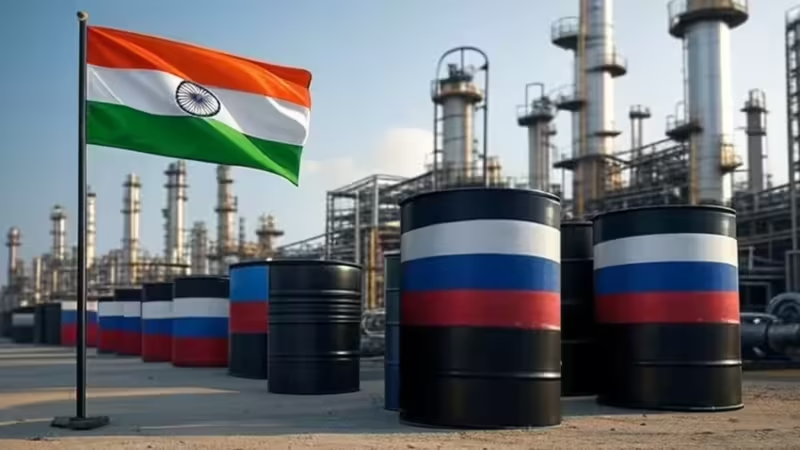
Remember when Indian refineries were gorging on cheap Russian crude, turning Moscow into New Delhi’s top oil supplier almost overnight? That era may be coming to an abrupt end. In a dramatic shift that signals a major realignment in global energy flows, India has slipped to third place among buyers of Russian oil for December 2025 .
Turkiye has surged past to claim the number two spot, while China remains the undisputed heavyweight champion of Russian fossil fuel imports. This isn’t just a blip on a chart; it’s a direct consequence of tightening US sanctions and a strategic retreat by India’s biggest refiners, including Mukesh Ambani’s Reliance Industries. The story behind this pivot in the Russian oil trade reveals the high-stakes game of geopolitics, economics, and risk management that defines today’s energy markets.
Table of Contents
- The December 2025 Shift: Who’s Buying What?
- Why India Pulled Back: The Role of US Sanctions
- Reliance and State Refiners Cut Purchases
- Turkiye’s Strategic Energy Play
- China’s Unwavering Demand for Discounted Crude
- What This Means for India’s Energy Security
- Conclusion: Navigating a Volatile New Normal
- Sources
The December 2025 Shift: Who’s Buying What?
According to data from analytics firm Vortexa, India imported approximately 780,000 barrels per day (bpd) of Russian crude in December 2025 . This marks a significant drop from its peak of over 2 million bpd in mid-2024 and is a sharp decline from the 1.2 million bpd it was averaging just a few months prior.
In contrast, Turkiye’s imports jumped to around 950,000 bpd, securing its position as the second-largest buyer. China, however, continues to dominate the market, importing a staggering 2.1 million bpd, leveraging its massive refining capacity and long-term supply deals with Moscow .
Why India Pulled Back: The Role of US Sanctions
The primary catalyst for India’s retreat is a new wave of aggressive US sanctions targeting the entire Russian oil export ecosystem. In November 2025, the US Treasury Department imposed sanctions on key Russian shipping companies, insurance providers, and even financial intermediaries that facilitate the sale of Russian oil above the G7 price cap of $60 per barrel .
These measures have made it exponentially more difficult—and risky—for Indian refiners to secure the necessary tankers and insurance for their Russian cargoes without running afoul of US law. The threat of secondary sanctions, which could cut a company off from the US financial system, is a risk that even the most profit-driven corporations are unwilling to take .
Reliance and State Refiners Cut Purchases
The pullback wasn’t uniform across the industry, but it was decisive. Reliance Industries, India’s largest private refiner, reportedly slashed its Russian crude intake by over 60% in December . Similarly, state-owned giants like Indian Oil Corp (IOC) and Bharat Petroleum Corp Ltd (BPCL) also significantly reduced their orders.
This move is a stark reversal from their previous strategy of maximizing profits by processing deeply discounted Urals crude. Now, the calculus has changed: the potential legal and financial fallout from US sanctions outweighs the savings on the oil itself. [INTERNAL_LINK:india-energy-policy-russia] explores how this shift impacts India’s long-term energy planning.
Turkiye’s Strategic Energy Play
While India steps back, Turkiye is stepping up. President Recep Tayyip Erdogan has long positioned his country as a critical energy hub between Europe and Asia. By increasing its imports of Russian oil, Turkiye is not only securing its own energy needs at a discount but also building its reputation as a reliable alternative trading partner for Moscow—a role that comes with significant geopolitical leverage .
Turkish refiners appear to be operating with a different risk tolerance or have found alternative logistical channels that are less exposed to US scrutiny, allowing them to capitalize on the vacuum left by others.
China’s Unwavering Demand for Discounted Crude
China’s position at the top is largely unassailable. Its massive, state-controlled economy is less vulnerable to US secondary sanctions than private or even state-linked Indian firms. Beijing can use its own financial systems, its own tankers, and its own insurance mechanisms to keep the oil flowing .
For China, the discounted Russian crude is a strategic asset, helping to fuel its industrial engine while simultaneously strengthening its political alliance with Moscow against a backdrop of US-China tensions.
What This Means for India’s Energy Security
This shift poses a complex challenge for India. On one hand, it reduces exposure to volatile geopolitics and potential US penalties. On the other, it means losing access to its cheapest source of crude, which will likely lead to higher import costs and, eventually, higher fuel prices for consumers.
New Delhi now faces the urgent task of diversifying its sources once again, looking towards traditional suppliers in the Middle East and potentially Africa, while navigating a global oil market that is increasingly fragmented along political lines.
Conclusion: Navigating a Volatile New Normal
The December 2025 data on the Russian oil trade is more than just a ranking change; it’s a clear signal that the era of easy, sanction-free arbitrage on Russian crude is over for many nations. India’s fall to third place is a pragmatic, if costly, decision driven by the harsh realities of US financial power. As the world’s energy map continues to be redrawn by conflict and sanctions, countries like India must walk a tightrope between economic necessity and geopolitical survival.
Sources
- Times of India. “Russian oil trade: India slips to third-largest buyer in December…” https://timesofindia.indiatimes.com/…
- Vortexa. “December 2025 Russian Crude Export Flows.” https://www.vortexa.com/
- U.S. Department of the Treasury. “Sanctions Imposed on Russian Oil Sector.” https://home.treasury.gov/
- Council on Foreign Relations. “The Impact of Secondary Sanctions.” https://www.cfr.org/
- Reuters. “Turkiye ramps up Russian oil imports as others pull back.” https://www.reuters.com/
- International Energy Agency (IEA). “Oil Market Report – January 2026.” https://www.iea.org/