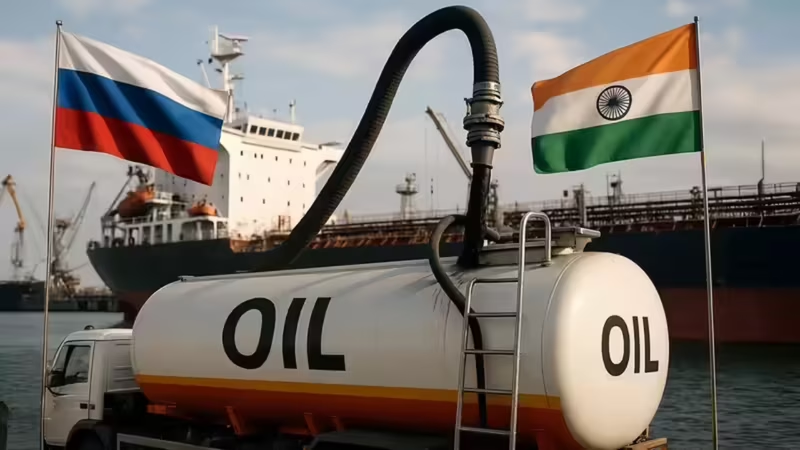
India’s Russian Oil Gamble: Why December Saw a Shocking 29% Import Drop
For over two years, India has been the undisputed champion of buying discounted Russian crude oil, turning a geopolitical crisis into an economic opportunity. But a new report reveals a startling reversal: India’s Russian crude imports plummeted by a massive 29% month-on-month in December 2025. This isn’t just a blip; it’s a potential signal of a major shift in the world’s third-largest oil consumer’s energy strategy. What’s behind this dramatic pullback, and what does it mean for India’s refiners, its trade balance, and the global oil market?
Table of Contents
- The Numbers Behind the Plunge
- Why Did India Pull Back on Russian Oil?
- The G7 Price Cap: A Lingering Shadow
- Shifting Refinery Economics and Margins
- A Strategic Diversification Move?
- What This Means for India’s Energy Future
- Conclusion: Navigating a Volatile Market
- Sources
The Numbers Behind the Plunge
According to data from energy analytics firm Vortexa, India imported approximately 1.57 million barrels per day (mbpd) of Russian crude in December 2024, a sharp decline from the previous month . This drop brought the share of Russian oil in India’s total crude import basket down to 33% from a peak of 38% for the entire year of 2024 . For context, India’s overall crude imports were around 4.8 mbpd in December, showing that while total demand was stable, the source mix changed dramatically . This marks the lowest level of Russian crude inflows since the G7 price cap mechanism was implemented .
Why Did India Pull Back on Russian Oil?
The reasons for this significant reduction are multifaceted, stemming from a confluence of logistical, economic, and strategic factors.
The G7 Price Cap: A Lingering Shadow
While India is not a signatory to the G7’s $60-per-barrel price cap on Russian seaborne crude, the policy has created a complex and risky logistics environment. The cap has led to a shortage of Western-owned tankers and insurance willing to handle Russian cargoes, forcing buyers like India to rely on a so-called “shadow fleet” of older vessels. By late 2025, this fleet was operating at near-maximum capacity, with reports suggesting it could only sustain about 93% of the first-half 2025 flow levels . This logistical bottleneck likely played a key role in the December slowdown, as arranging shipping became more difficult and expensive .
Shifting Refinery Economics and Margins
Another critical driver is the changing profitability for Indian refiners. The massive windfall from processing cheap Russian Urals crude into high-value products for export has been a cornerstone of their recent success. However, refining margins have shown signs of softening. While they remain healthy due to lower crude prices , they are expected to stabilize in a more modest range of $3.5-$4.5 per barrel in the coming fiscal year . With the arbitrage opportunity narrowing, the complex logistics and potential reputational risks of handling Russian oil may no longer be worth the marginal cost savings for some refiners.
A Strategic Diversification Move?
Beyond immediate economics, this move could signal a long-term strategic shift. Over-reliance on a single, sanctioned supplier carries inherent geopolitical risk. India appears to be actively diversifying its sources. Imports from traditional Middle Eastern suppliers like Iraq and Saudi Arabia, as well as from the Americas, have seen growth. In fact, crude inflows from the US surged by over 50% in the first half of 2025 compared to the same period in 2024 . This diversification strengthens India’s energy security and provides greater flexibility in a volatile global market .
What This Means for India’s Energy Future
This 29% drop is unlikely to be a permanent divorce from Russian oil. Russia remains a crucial, cost-effective supplier that helps India manage its massive $15 trillion annual petroleum import bill . However, it does highlight a new phase in this relationship—one of managed dependence rather than aggressive acquisition.
Indian refiners are now sophisticated players in the global market. They will continue to buy Russian crude when the economics are overwhelmingly favorable and logistics are smooth. But they are also building a more resilient and diversified supply chain. This pragmatism is essential for a nation that imports over 80% of its oil needs and is keenly aware of its vulnerability to external shocks. For more on India’s broader energy challenges, see our deep dive on [INTERNAL_LINK:india-energy-security-challenges].
Conclusion: Navigating a Volatile Market
The sharp decline in India Russian crude imports in December 2025 is a powerful reminder that even the most lucrative trades are subject to change. It wasn’t a single factor but a perfect storm of logistical constraints from the G7 price cap, tightening refining margins, and a strategic push for diversification that led to this pullback. While Russian oil will remain a key part of India’s energy mix, the era of unchecked growth in these imports appears to be over. India’s refiners are now focused on a more balanced, flexible, and ultimately secure approach to meeting the nation’s ever-growing energy demands.
Sources
- Times of India: India’s import of Russian crude down 29% month-on-month in Dec: Report
- Vortexa Analytics Data cited in various industry reports [[1], [2], [4], [5]]
- Ministry of Commerce and Industry, India
- International Energy Agency (IEA) analysis on global oil markets