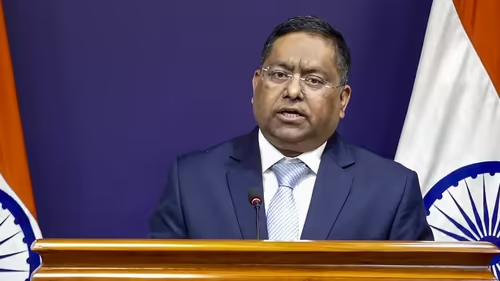
The war of words between India and Pakistan has flared up again—but this time, it’s not about cricket or border skirmishes. It’s about blame, deflection, and a long-simmering insurgency in Pakistan’s restive province of Balochistan. In a strongly worded statement, India’s Ministry of External Affairs (MEA) has dismissed as “baseless” and “fabricated” Pakistan’s latest attempt to pin responsibility for recent terrorist attacks in Balochistan on New Delhi [[1]].
Table of Contents
- The Allegations and India’s Response
- What Are the Balochistan Attacks?
- Why India Calls It a Deflection Tactic
- The Human Rights Crisis in Balochistan
- Historical Context of India-Pakistan Accusations
- International Perspective on Balochistan
- Conclusion
- Sources
The Allegations and India’s Response
Pakistan’s military and government officials recently alleged that Indian intelligence agencies were behind a series of deadly attacks in Balochistan, including strikes on security installations and civilian infrastructure. These claims, however, came without presenting any verifiable evidence.
In response, India’s MEA issued a scathing rebuttal. A spokesperson stated, “Pakistan’s attempt to link India to incidents of violence in Balochistan is not only baseless but also a deliberate ploy to deflect attention from its own internal failings.” The statement went on to urge Pakistan to “address the legitimate grievances of the people of Balochistan and its long-standing record of suppression, brutality, and violation of human rights” [[1]].
What Are the Balochistan Attacks?
The Balochistan attacks refer to a surge in militant activity in Pakistan’s largest but least populous province. Balochistan has been a hotspot for separatist movements for decades, with groups like the Balochistan Liberation Army (BLA) demanding greater autonomy or outright independence. Recent attacks have targeted:
- Military convoys and checkpoints
- Railway infrastructure (including the Jaffar Express attack)
- Chinese-funded projects under the China-Pakistan Economic Corridor (CPEC)
- Civilian areas in Quetta and other urban centers
These incidents have resulted in dozens of casualties, including security personnel and civilians, and have raised serious questions about Pakistan’s ability to maintain internal security—especially in a region critical to its strategic partnership with China.
Why India Calls It a Deflection Tactic
India’s accusation that Pakistan is “deflecting attention” isn’t made in a vacuum. The timing of these allegations coincides with mounting domestic pressure on Pakistan’s government over:
- Economic collapse: Soaring inflation, currency devaluation, and IMF bailout conditions.
- Political instability: Ongoing power struggles between civilian and military leadership.
- Security failures: Inability to curb rising terrorism in Balochistan and Khyber Pakhtunkhwa.
By blaming India—a familiar scapegoat—Pakistan’s establishment can rally nationalist sentiment and shift public focus away from its governance failures. This tactic has been used repeatedly over the years, especially when internal crises reach a boiling point [[3]].
The Human Rights Crisis in Balochistan
India’s MEA didn’t just reject the allegations—it turned the spotlight back on Pakistan’s human rights record in Balochistan. For years, international organizations like Human Rights Watch and Amnesty International have documented systematic abuses in the province, including:
- Enforced disappearances of Baloch activists and students
- Extrajudicial killings by security forces
- Restrictions on press freedom and internet shutdowns
- Marginalization of the Baloch people in political and economic decision-making
India’s statement echoes these concerns, suggesting that instead of manufacturing external enemies, Pakistan should address the root causes of unrest: decades of neglect and repression.
Historical Context of India-Pakistan Accusations
This isn’t the first time Pakistan has accused India of fomenting trouble in Balochistan. Similar claims surfaced after major attacks in 2016, 2019, and 2023. Each time, India has denied involvement and cited lack of evidence. Meanwhile, independent analysts and U.S. intelligence assessments have consistently found no credible proof of Indian support for Baloch militants [[4]].
In fact, India has long maintained a policy of non-interference in Pakistan’s internal affairs—at least officially. While [INTERNAL_LINK:pakistan-terrorism-history] experts debate the nuances of covert operations, the public stance remains clear: India’s focus is on its own security and development, not destabilizing its neighbor.
International Perspective on Balochistan
The international community largely views the Balochistan conflict as an internal Pakistani matter. Even China, which has invested billions in CPEC projects in the province, has urged Pakistan to “ensure the safety of Chinese personnel” without endorsing Islamabad’s accusations against India [[5]].
Western diplomats often express concern about the humanitarian situation but stop short of assigning blame to external actors. The consensus is that sustainable peace in Balochistan requires political dialogue, economic inclusion, and respect for human rights—not conspiracy theories.
Conclusion
The latest row over the Balochistan attacks underscores a recurring pattern in India-Pakistan relations: when Pakistan faces internal turmoil, it often points fingers at India. But this time, New Delhi’s response was unusually direct, turning the accusation into an indictment of Pakistan’s own governance and human rights record. As the region watches, one thing is clear: until Pakistan addresses the legitimate aspirations of its Baloch citizens, the cycle of violence—and blame—will likely continue.
Sources
- Times of India: ‘Pakistan deflecting attention’: India rejects ‘baseless’ claims on Balochistan attacks
- Ministry of External Affairs, Government of India: Official Statements Archive
- Al Jazeera: Why is Pakistan’s Balochistan province so unstable?
- U.S. State Department Country Reports on Terrorism: 2023 Report (South Asia Section)
- Reuters: China urges Pakistan to protect Chinese citizens after train attack