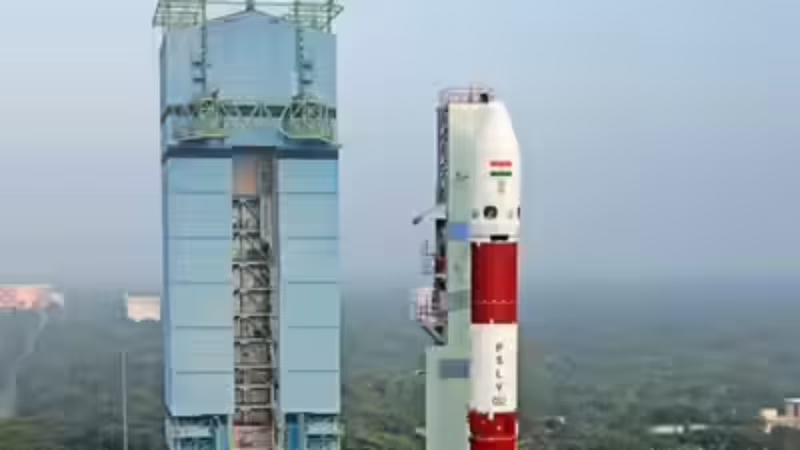
Imagine a future where satellites don’t die when their fuel runs out—but get a second life with an in-orbit pit stop. That future is no longer science fiction for India. The Indian Space Research Organisation (ISRO) is finalizing preparations for a landmark mission that will make India the second nation in history—after the United States—to successfully refuel a satellite in orbit. This achievement, part of the ambitious SpaDeX (Space Docking Experiment) program, marks a quantum leap in India’s space capabilities and positions the country at the forefront of space sustainability.
If successful, this mission won’t just be a technical triumph—it will redefine how we manage assets in space, extend satellite lifespans, reduce orbital debris, and unlock new commercial opportunities in the rapidly growing space economy.
Table of Contents
- What Does It Mean to Refuel a Satellite in Orbit?
- India’s Path to the Refuel Satellite in Orbit Milestone
- The SpaDeX Mission: How It Works
- Why On-Orbit Refueling Is a Game-Changer
- Global Context: Who Else Can Do This?
- Commercial and Strategic Implications for India
- Challenges and Risks of In-Space Refueling
- Conclusion: India Poised to Lead the Next Space Revolution
- Sources
What Does It Mean to Refuel a Satellite in Orbit?
Most satellites carry limited fuel—used not for propulsion through space (which is mostly vacuum), but for station-keeping: small thruster burns to maintain their correct orbit, avoid collisions, or adjust orientation. Once this fuel depletes, even a fully functional satellite must be decommissioned and either deorbited or moved to a “graveyard orbit,” contributing to the growing problem of space junk.
Refueling a satellite in orbit involves sending a service vehicle to rendezvous, dock, and transfer propellant—typically hydrazine or newer green fuels—extending the satellite’s operational life by years. This requires extreme precision in autonomous navigation, robotic docking, and fluid transfer in microgravity.
India’s Path to the Refuel Satellite in Orbit Milestone
ISRO has been methodically building toward this capability for over a decade. Key milestones include:
- 2014: Successful re-entry experiment (CARE) demonstrated controlled descent.
- 2017: PSLV-C37 launched 104 satellites, showcasing advanced orbital insertion skills.
- 2023: Chandrayaan-3’s precise lunar landing proved autonomous navigation prowess.
- 2024–2025: Series of proximity operations tests using POEM (PSLV Orbital Experimental Module) platforms.
Now, with the SpaDeX mission scheduled for late 2026, ISRO is integrating all these technologies into a single, high-stakes demonstration .
The SpaDeX Mission: How It Works
The SpaDeX mission will involve two small satellites—Chaser and Target—launched together on a PSLV rocket:
- After reaching a 475-km circular orbit, the two satellites will separate.
- The Chaser will use AI-powered vision systems and LIDAR to navigate within meters of the Target.
- It will then perform a soft dock using a specially designed interface.
- Finally, a small quantity of simulated fuel (or actual propellant in later phases) will be transferred.
This end-to-end demonstration is a critical precursor to future missions like ISRO’s planned Orbital Servicing Vehicle, which could one day refuel communication satellites like GSAT series or even assist international partners.
Why On-Orbit Refueling Is a Game-Changer
The implications extend far beyond extending satellite life:
- Cost savings: A $200M satellite can gain 5+ extra years of service for a fraction of replacement cost.
- Debris reduction: Fewer dead satellites mean less collision risk in crowded orbits.
- Deep space readiness: Refueling depots in Earth orbit are essential for Mars and lunar missions.
- Commercial opportunity: India could offer “space tow truck” services globally—a market projected to hit $4B by 2030 (per NASA estimates) .
Global Context: Who Else Can Do This?
Currently, only the United States has demonstrated full on-orbit refueling:
- NASA’s Robotic Refueling Mission (RRM) (2011–2019): Tested tools on the ISS.
- Northrop Grumman’s MEV (2020): Docked with Intelsat satellite for life extension (though without fuel transfer).
- DARPA’s RSGS program: Developing advanced servicing vehicles.
China and Russia have tested rendezvous tech but not full refueling. If ISRO succeeds, India will leapfrog both—and become the first nation to do it with a fully indigenous system.
Commercial and Strategic Implications for India
Success would elevate India’s stature in the global space arena. NewSpace India Limited (NSIL), ISRO’s commercial arm, could market refueling and docking services to foreign satellite operators. Militarily, the same technology enables inspection—or neutralization—of adversarial satellites, adding a strategic layer to India’s space doctrine.
[INTERNAL_LINK:india-space-policy-2026] explores how such capabilities align with India’s National Space Policy.
Challenges and Risks of In-Space Refueling
The mission isn’t without hurdles:
- Precision docking: Requires sub-centimeter accuracy at relative speeds under 0.1 m/s.
- Propellant compatibility: Different satellites use different fuels; universal interfaces are complex.
- Regulatory gaps: No international laws govern who can service whose satellite.
ISRO engineers are mitigating these through rigorous ground simulations and redundant systems.
Conclusion: India Poised to Lead the Next Space Revolution
India’s upcoming attempt to refuel satellite in orbit is more than a technological stunt—it’s a strategic investment in sustainable space operations. By mastering on-orbit servicing, India isn’t just keeping its own satellites alive; it’s positioning itself as a responsible, innovative steward of the space domain. As the countdown to SpaDeX begins, the world watches. If successful, January 2026 could mark the moment India truly arrived as a space superpower—not just in launches, but in the delicate art of caring for what’s already above us.