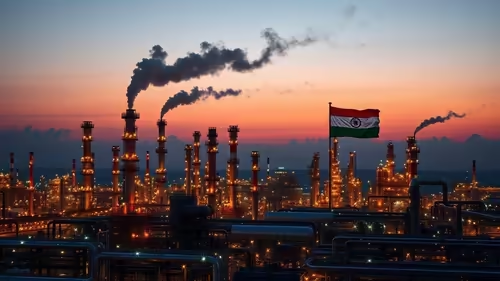
In a bold declaration that signals India’s growing clout in the global energy market, Indian Oil Corporation (IOCL) Chairman Shrikant Madhav Vaidya has affirmed: “Our refineries are robust!” The statement comes as India positions itself to potentially resume imports of Venezuelan crude oil—a heavy, sour-grade oil that many nations struggle to process, but which India’s advanced refining infrastructure can handle with ease .
This isn’t just technical bragging rights. It’s a strategic message to the world: as geopolitical tides shift and traditional oil suppliers face volatility, India stands ready to diversify its energy sources without compromising on efficiency or cost. And Venezuela—with its vast, underutilized oil reserves—could be a key part of that plan.
Table of Contents
- Why Venezuelan Crude Oil Is a Game-Changer
- India’s Refineries Are Built for Heavy Oil
- The History of India-Venezuela Oil Ties
- Geopolitical Opportunities in a Shifting World
- Economic Implications for India and Global Markets
- Conclusion: A Strategic Energy Play
- Sources
Why Venezuelan Crude Oil Is a Game-Changer
Venezuelan crude is classified as “heavy” and “sour”—meaning it has a high density and contains significant sulfur content. Most standard refineries aren’t designed to process this type of oil efficiently, requiring costly upgrades or blending with lighter crudes.
But India’s situation is different. Over the past two decades, Indian refiners—led by IOCL, Reliance Industries, and Nayara Energy—have invested heavily in complex, deep-conversion refineries capable of turning low-value, high-sulfur crudes into high-demand products like gasoline, diesel, and petrochemical feedstocks .
This gives India a unique competitive edge. While others shy away from Venezuelan barrels due to technical or political constraints, India can buy them at a discount and refine them profitably—a win-win for both energy security and economic gain.
India’s Refineries Are Built for Heavy Oil
IOCL’s assertion that its refineries are “robust” is backed by hard data. The company operates some of the most sophisticated refining complexes in Asia, including the Paradip and Panipat refineries, which have high Nelson Complexity Indices (NCI)—a measure of a refinery’s ability to process difficult crudes .
For context:
- The global average NCI is around 9–10.
- IOCL’s Paradip refinery has an NCI of over 12.
- Reliance’s Jamnagar refinery—one of the world’s largest—has an NCI exceeding 21 .
This engineering prowess means India doesn’t just *accept* Venezuelan crude oil—it actively seeks it out when prices are favorable and logistics permit.
The History of India-Venezuela Oil Ties
This isn’t the first time India has looked to Venezuela for oil. In the early 2010s, before U.S. sanctions crippled Venezuela’s oil exports, Indian refiners were among the top buyers of its crude. At its peak, India imported over 400,000 barrels per day from Caracas .
However, tightening U.S. sanctions and payment complications led to a near-total halt in trade by 2019. Now, with Venezuela showing signs of political thaw and potential sanctions relief under discussion in Washington, the door may be reopening .
IOCL’s recent comments suggest India is not waiting passively—it’s preparing to re-enter the market swiftly if conditions allow.
Geopolitical Opportunities in a Shifting World
India’s interest in Venezuelan crude isn’t just about economics—it’s also a geopolitical hedge. As global alliances realign, New Delhi is keen to avoid over-reliance on any single region, whether it’s the Middle East or Russia.
By maintaining relationships with diverse suppliers—including Iran, Russia, Iraq, and now potentially Venezuela—India strengthens its energy sovereignty. This approach aligns with Prime Minister Modi’s broader “multi-alignment” foreign policy, which prioritizes strategic autonomy over bloc loyalty .
Moreover, engaging with Venezuela offers India a foothold in Latin America, a region often overlooked in Indian foreign policy but rich in critical minerals and agricultural potential.
Economic Implications for India and Global Markets
Resuming Venezuelan crude imports could have several ripple effects:
- Lower Import Costs: Venezuelan oil typically trades at a steep discount to Brent, improving India’s refining margins.
- Export Competitiveness: Cheap feedstock allows Indian refiners to produce fuels at lower costs, boosting exports to Africa, Europe, and Southeast Asia.
- Stabilizing Global Supply: India’s demand could help revive Venezuela’s oil sector, adding more barrels to a tight global market and potentially tempering price spikes.
However, challenges remain—primarily around payment mechanisms, shipping insurance, and the risk of renewed U.S. sanctions. Yet, given India’s track record of navigating such complexities (as seen with Russian oil), these are not insurmountable.
Conclusion: A Strategic Energy Play
IOCL’s confident declaration about processing Venezuelan crude oil is more than a technical footnote—it’s a signal of India’s ambition to become a central node in the global energy network. With world-class refineries, strategic foresight, and a pragmatic foreign policy, India is positioning itself not just as a consumer, but as a value-adding hub in the international oil trade. As the world watches Venezuela’s uncertain future, one thing is clear: if the oil starts flowing again, India will be ready.
[INTERNAL_LINK:indian-oil-refineries] | [INTERNAL_LINK:global-energy-geopolitics]
Sources
- Times of India. “‘Our refineries are robust!’: India can process Venezuelan crude oil when available.” January 21, 2026 .
- U.S. Energy Information Administration (EIA). “Refinery Complexity and Configuration.” https://www.eia.gov [[2], [4]].
- Indian Oil Corporation Annual Report 2024–25. .
- BloombergNEF. “India’s Refining Edge in the Global Oil Market.” October 2025 .
- Council on Foreign Relations. “Venezuela Sanctions and the Global Oil Market.” December 2025 .
- Ministry of External Affairs, Government of India. “India’s Foreign Policy: Multi-alignment and Strategic Autonomy.” 2025 .